 Society
Panama’s export processing zones offer opportunities for Vietnamese firms
1.
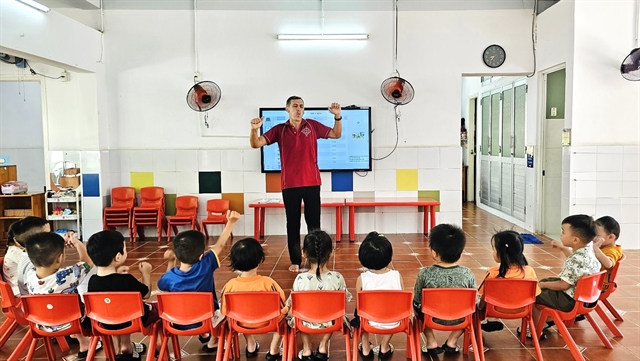 |
| Preschoolers participate in an introductory English activity at the City Kindergarten during the 2025-26 academic year. — VNS Photo Nguyễn Diệp |
HCM CITY — HCM City is forging a road map to gradually establish English as a second language in schools, building a comprehensive bilingual ecosystem by 2045 through teacher development, integrated curricula, and immersive learning environments.
Its education sector has outlined a three-level framework comprising Foundational, Integrated, and Bilingual Ecosystem stages to ensure that language acquisition progresses naturally from formal instruction to practical use.
Under the municipal strategy, the 2027-30 phase will prioritise training core teaching staff with a target of at least 20 per cent of educational institutions offering selected subjects in English.
By 2031-35, the city aims to standardise language proficiency among 100 per cent of teaching staff and finalise tailored English-medium curricula for specialised subjects.
The 2036-45 vision targets the full modernisation of the linguistic environment and the establishment of a sustainable bilingual ecosystem across the city.
To lay the groundwork for the transition, local authorities recently assessed the English proficiency of more than 45,700 public school teachers to tailor training programmes and staff allocation.
Pilot scheme for English at preschool level
To put the overarching strategy into practice at the early childhood education level, the municipal Department of Education and Training has issued a plan to pilot an integrated English programme across public kindergartens from the 2026-27 to 2028–29 academic years.
The three-year pilot scheme will apply to children aged three to five at qualified public kindergartens and advanced integrated preschools, and operate strictly on the basis of voluntary parental consent and without placing undue academic pressure on children.
Financed entirely through non-state funding rather than by the government and operated on a non-profit basis, the scheme ensures full transparency over service fees for parents.
Children not participating in the pilot will retain full rights to standard learning and daily activities.
Learning materials will adhere to national frameworks and use vetted integrated preschool English resources.
Teaching methods will focus on child-centred approaches, including project-based learning and play-based activities, seamlessly incorporating English into daily routines, basic mathematics, and exploring the world around them.
To ensure instructional quality, core management personnel and coordinating teachers are required to have a minimum B1 level of language proficiency along with specialised pedagogical training before entering the classroom.
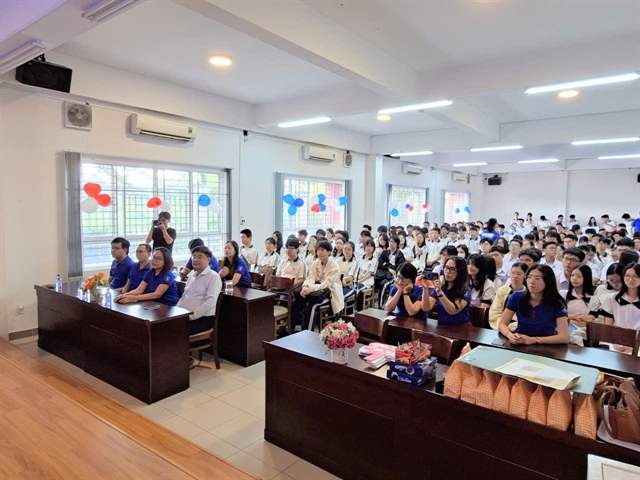 |
| Students specialising in English at the Trần Đại Nghĩa High School for the Gifted in HCM City. The city aims to build a sustainable bilingual education ecosystem. — Photo trandainghia.edu.vn |
Fostering language practice beyond classrooms
Schools across the southern hub have already begun fostering language practice beyond traditional classroom settings.
At Trần Đại Nghĩa Secondary and High School, interdisciplinary lessons, career orientation programmes, and cross-cultural initiatives are increasingly conducted in English, helping shift students from “learning English” to “using English to learn.”
Trần Thị Hồng Thủy, principal of Trần Đại Nghĩa Secondary and High School, said creating a natural language environment is paramount to long-term success.
“To make English a second language in schools, the crucial factor is not merely increasing the number of lessons, but providing students with regular and natural opportunities to use the language in practice,” Thủy said.
Similarly, Marie Curie High School has adopted an “English active school” model, integrating the language into STEM projects, scientific research, official communications, and specialised demonstration lessons across subjects such as chemistry, biology, history, and physical education.
Everyone in its English faculty meets Level 4 language proficiency standards or higher.
The city’s current initiative builds on decades of pioneering foreign-language programmes, including intensive English pilot schemes launched in 1998 and integrated mathematics and science programmes under Project 5695, which has operated since 2014.
In the 2025–26 academic year, nearly 50 per cent of preschool children, or around 206,800 of them, were introduced to English across 67.4 per cent of public kindergartens.
At the general education level, more than 90 per cent of public schools offer intensive English or bilingual programmes, providing a strong baseline for the city’s long-term educational reform. — VNS
Society
 Society
 Society
 Society
 Society
 Society
 Society
 Society
 Society
 Society
 Society
 Society
 Society
 Society
 Society