 Society
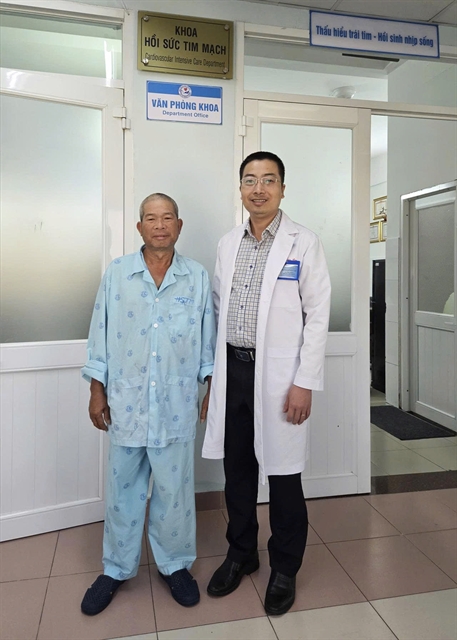
HCM City doctors save heart attack patient after 30-minute cardiac arrest
1.
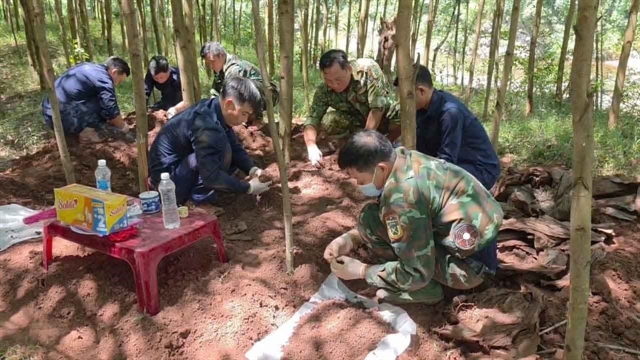 |
| The Quảng Tri Provincial Military Command on October 3 reinters the remains of three martyrs in a cajuput forest area in Bãi Dinh Hamlet, Dân Hóa Commune, Quảng Trị Province. — VNA/VNS Photo |
HÀ NỘI — More than half a century has passed since the resistance war. A road may have vanished, a bomb crater turned into a rice field, the name of a hill no longer appears on any map.
Yet in the memories of those who lived through the war, tiny markers remain: a rocky cave, a stream, the direction of a hillside, the place where comrades were hastily buried.
For those searching for martyrs in Quảng Trị Province, some of today’s searches begin precisely from such memories.
Colonel Trương Viết Hải, Political Commissar of the Quảng Trị Provincial Military Command, said information provided by the American Veterans Association in Việt Nam indicated that in the Cồn Tiên mountain area, 173 Vietnamese soldiers who fell in the battle on May 8, 1967 were buried in a mass grave.
But two witnesses who directly guarded the base said that the bodies of 283 people, including 12 women, were buried in two trenches running north–south, about 60m long, 2–2.5m wide and 2–2.5m deep.
The location indicated was a makeshift helicopter landing site, near a burnt tank southeast of the base.
Different figures do not diminish the value of memory. On the contrary, they create a need to find additional missing pieces for verification.
Lieutenant Colonel Nguyễn Trung Thành, head of Team 2 for the Search and Collection of Martyrs’ Remains under the Quảng Trị Provincial Military Command, said that witnesses’ accounts after decades sometimes retained only a few signs.
A person might not remember coordinates, but could still recall the direction from a village, a stream, a rock, or the distance from a familiar place. The work of those searching would be to cross-check those markers with records, unit histories and the actual terrain.
The race to identify martyrs' remains is not just underground. It also takes place in human memory.
The nationwide '500 Days and Nights Campaign to Accelerate the Search, Recovery and Identification of Martyrs' Remains', was launched nationwide in preparation for the 80th anniversary of War Invalids and Martyrs' Day (July 27, 2027).
Note left by comrade
Lieutenant Colonel Nguyễn Trung Thành recalled a search in the mountainous Đakrông forest area. The recovery force discovered the remains of two martyrs. Beside the remains was an ammunition pouch. Inside that pouch was a small piece of paper.
Colonel Thành said the note was not written by the fallen soldier for himself. A living comrade at that time recorded information about the person who had just fallen, placed it in the ammunition pouch so that those who came later would have a marker to follow.
After more than half a century underground, the small piece of paper still contained information. From that, functional forces had additional basis to trace the hometowns of the two martyrs in Thanh Hoá and Thái Nguyên for further verification.
In the midst of battle, a soldier buried a comrade, then recorded the name and hometown, rolled the note and put it into an ammunition pouch, leaving it for the day when someone would find it.
More than half a century later, today’s searchers are continuing that work: following an account, a cave, a grave, a piece of paper in an ammunition pouch to bring those who remain back to their homeland and their names.
Time waits for no one. Witnesses are growing older, and artefacts and remains underground continue to change. The 500 Days and Nights Campaign is also a race to preserve the last markers while they still exist.
Today’s soldiers search for yesterday’s
In Quảng Trị, a search sometimes begins from very small pieces of information. A resident remembers where soldiers once fell, a veteran points out the place where comrades were buried, or a construction site discovers fragments of tanks, bones or other artefacts left underground.
Once the information is received, the soldiers set out again.
On September 22, in the Thành Cổ quarter of Quảng Trị Ward, based on information that a construction area within the grounds of Agribank's Thành Cổ Quảng Trị Branch might have found martyrs’ remains, Team 2 for the Search and Collection of Martyrs’ Remains under the Quảng Trị Provincial Military Command's Political Department organised a survey and search.
Beneath layers of bricks and stones, soldiers’ artefacts gradually appeared: tank fragments, ammunition boxes, AK magazine boxes and backpacks. As the search area expanded, sections of shin bones, thigh bones and vertebrae were found mixed in the soil and rocks. Six martyrs’ remains were collected.
At the site, Colonel Trương Viết Hải, Provincial Party Committee member, Permanent Deputy Secretary of the Provincial Military Party Committee and Permanent Deputy Head of the Provincial Steering Committee for the Search, Collection and Identification of Martyrs’ Remains, acknowledged the sense of responsibility, dedication and efforts to overcome difficulties of the Team 2 staff.
He requested the force to continue reviewing the area, exploiting verifiable information sources, expanding the search scope and coordinating with local authorities and people to collect information on martyrs and their graves.
Also last month, in Gio Linh Commune, based on witness information about 11 commando soldiers who fell in the battle on April 29, 1965, the provincial Military Command continued to study, verify, delineate the suspected grave area and deploy search forces.
More than 60 years have passed, with altered terrain, war traces covered by time and production activities. Some days, digging down leads to discoveries. Some searches have yet to yield results.
After 190 days of implementing the 500 Days and Nights Campaign, by September 20 this year, Quảng Trị had completed the exhumation of 22,864 out of 22,864 graves at 130 out of 130 cemeteries, collected 13,221 biological samples for DNA testing, and completed sampling for 73 newly collected martyrs’ remains.
Behind those figures lies a huge volume of work by cadres, soldiers and participating forces. Exhumation and sampling require caution and precision. After each round, the graves and cemetery grounds are tidied and maintained with due solemnity.
Whole country brings martyrs home
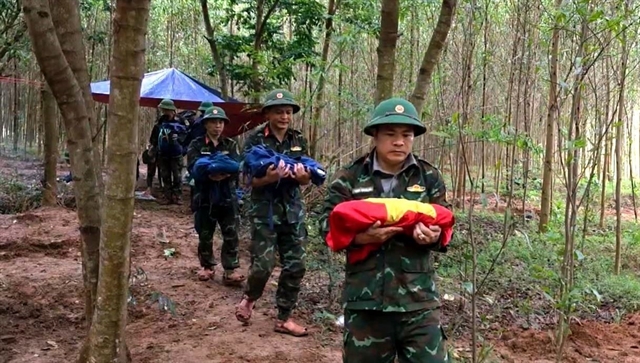 |
| By September 20 this year, Quảng Trị collected more than 13,200 biological samples for DNA testing, and completed sampling for 73 newly collected martyrs’ remains. — VNA/VNS Photo Võ Dung |
According to Nguyễn Thị Trang, director of the Management Board of the Quảng Trị Ancient Citadel Relic, after the 81 days and nights of fighting in 1972, to this day no one knows exactly how many people fell and how many remain. But at the citadel, those people still have a meeting point for commemoration.
Every year on September 16 – the day marking the end of the 81 days and nights of fighting to protect the Citadel and Quảng Trị Town in 1972 – veterans, relatives of martyrs and local people return.
Colonel Trương Viết Hải said that finding and collecting remains was a highly valued result, but what families long for most was to know the names, hometowns and resting places of those who sacrificed their lives.
Search and collection are thus always linked with information gathering, biological sampling and identification of martyrs’ remains.
“For us, every martyr's remains found is a return. Every identity confirmed means one family’s pain is eased, one more mother, wife or child can call their loved one’s name correctly before the grave,” Colonel Hải said.
For veterans who passed through many battlefronts, for relatives of martyrs and even for those born long after the war receded, the citadel has become a place to return to. Some come to remember. Some come to find peace. Some only hope, once in their lifetime, to stand before the citadel, light a stick of incense and lay a flower upon the Thạch Hãn River.
This is precisely the place the martyrs chose to return to. If one day there is no longer any way to find and bring them home, then they will remain here, in the grief and respect of the entire nation. — VNS
Society
 Society
 Society
 Society
 Society
 Society
 Society
 Society
 Society
 Society
 Society
 Society
 Society
 Society
 Society