 Society

Việt Nam urged to take cautious approach to carbon capture technology
1.
|
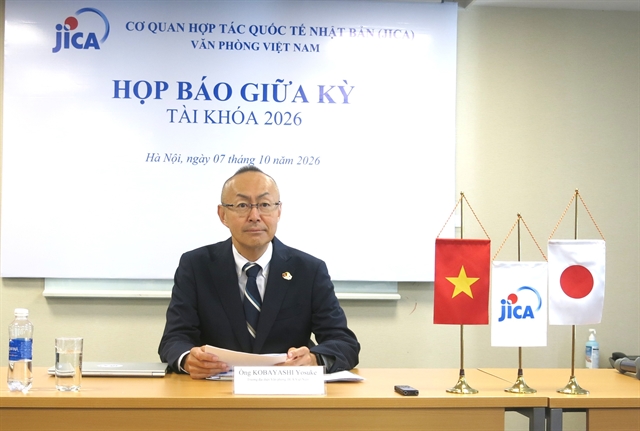
| Kobayashi Yosuke, chief representative of the Japan International Cooperation Agency (JICA) Việt Nam Office. — VNS Photo Nguyễn Hằng |
HÀ NỘI — The Japan International Cooperation Agency (JICA) is advancing greater scientific cooperation with Việt Nam.
Kobayashi Yosuke, chief representative of JICA Việt Nam Office, said on Wednesday that they are promoting four key pillars in science and technology, innovation, digital transformation and human resources.
Other priorities include developing domestic businesses, helping them integrate more deeply into global value chains, improving the investment environment, and developing strategic infrastructure.
These are part of a support package for Việt Nam’s transition towards a new growth model, with the goal of becoming a high-income country by 2045.
The first pillar closely aligns with several major reform initiatives recently adopted by Việt Nam, particularly Politburo resolutions 57, 71 and 80, which emphasise the role of science and technology, innovation, education and training, and cultural development as future drivers of growth.
“JICA believes human resources are at the heart of Việt Nam’s transformation,” he said.
It provides comprehensive support ranging from policy advice and institutional assistance to higher education, research cooperation and stronger links between the Government, businesses and academia.
Over the years, JICA has established partnerships with more than 20 universities and research institutes in Việt Nam, including Việt Nam - Japan University, Cần Thơ University, and Hà Nội University of Science and Technology.
It has also cooperated with the Hòa Lạc Hi-Tech Park and the Việt Nam National Space Centre.
Building on these foundations, JICA will focus on strategic areas expected to play an increasingly important role in Việt Nam’s future, including space technology, the semiconductor industry, artificial intelligence and digital transformation.
“JICA is also discussing with the Vietnamese Government the possibility of providing a new programme loan for AI and digital transformation,” he added.
The agency will also support the application of these technologies for green transformations, disaster risk management, agriculture, transport and healthcare.
Other pillars
The second pillar supports Politburo resolutions 68 and 79 on the development of private and State-owned enterprises, as well as Resolution 70 on energy security.
JICA will support Vietnamese businesses through innovation, technological upgrading and stronger cooperation with Japanese companies. Assistance will include technology transfers, business matching and improved access to finance.
“We will continue working with businesses, universities, non-governmental organisations and Japanese volunteers to provide Vietnamese people with new knowledge and skills across a range of fields,” he said.
JICA is committed to long-standing cooperation with the Việt Nam-Japan Human Resources Development Institute (VJCC), a training institute under Foreign Trade University, to provide business management training courses based on Japanese experience.
In terms of finance, JICA will leverage private-sector investment financing. It recently completed a loan to BIDV under a programme supporting micro, small- and medium-sized enterprises in rural areas.
JICA also expects Việt Nam’s stock market upgrade by FTSE Russell from frontier to secondary emerging market status to have a positive impact. The agency is proud to have provided technical assistance to support this process over the years.
JICA also plans to strengthen cooperation in areas of growing importance to economic security, including energy, critical minerals, food security and maritime security.
“As part of these efforts, JICA will conduct a survey into the possibility of supporting Việt Nam in strengthening its strategic oil and gas reserves.”
Through these initiatives, JICA hopes to help Vietnamese businesses become more competitive, innovative and better connected to regional and global value chains.
Under the third pillar, JICA will support the development and implementation of institutions and policies aimed at creating a more attractive and stable business environment.
Key areas of cooperation include the legal and judicial system, intellectual property rights protection, tax policy and efforts to reform Việt Nam’s governance model, including the implementation of the two-tier local government model.
In intellectual property protection, JICA is currently focusing on trademark protection while preparing to potentially expand cooperation into copyright protection in the future.
Under the fourth pillar, JICA will continue to support Việt Nam in developing strategic infrastructure that provides the foundation for effectively implementing the other three pillars.
Areas of assistance will include facilities for education and research, advanced technological infrastructure, and strategic urban infrastructure such as urban railways, seaports, roads, bridges, drainage systems and wastewater treatment facilities.
The package reflects JICA’s commitment to accompanying Việt Nam on its new development path.
“We believe these efforts will contribute to realising Việt Nam’s goal of becoming a high-income country by 2045, while further strengthening Việt Nam-Japan cooperation in areas of growing importance to economic security and sustainable development,” Kobayashi said. — VNS
Society
.jpg) Society
Society
 Society
 Society
 Society
 Society
 Society
 Society
 Society
 Society
 Society
 Society
 Society
 Society
 Society