 Economy


Drive to Great: BAIC FOTON Africa Partners Conference Set to Open
1.
|
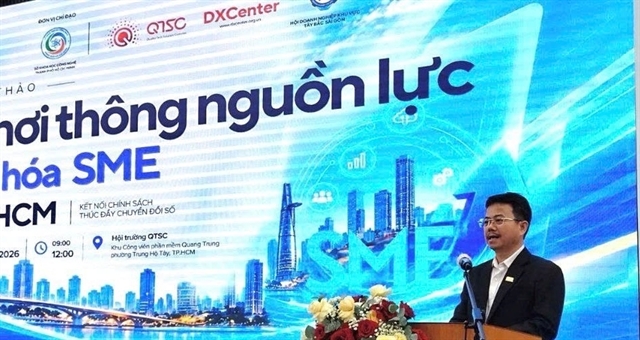
| Trần Hữu Dũng, director of Quang Trung Software City Development Company Limited, speaks at the seminar in HCM City on October 7. — VNS Photo Văn Châu |
HCM CITY — HCM City is rolling out financial and technical support to help small and medium-sized enterprises accelerate digital transformation and AI adoption.
A seminar titled “Unlocking Resources – Digitalising SMEs in HCM City” was held at Quang Trung Software City on Tuesday, bringing together businesses, technology experts and policymakers to discuss ways to help SMEs make more effective use of digital technologies.
The event was organised under the direction of the municipal Department of Science and Technology.
Lý Minh Tuân, head of the Digital Economy and Digital Society Division under the department, said the city had issued a plan for implementing its SME digital transformation programme for 2026-30.
Under the programme, the city will provide non-refundable support covering 50 per cent of costs for SMEs purchasing or leasing digital transformation solutions, including accounting software, enterprise resource planning (ERP), customer relationship management (CRM) and automation tools.
The maximum annual support will be VNĐ40 million (US$1,500) for micro-enterprises, VNĐ90 million ($3,400) for small enterprises and VNĐ170 million ($6,400) for medium-sized enterprises.
Small enterprises can receive up to VNĐ90 million per consultancy contract for advice on business processes, management or production, while medium-sized enterprises can receive up to VNĐ170 million.
For science, technology and innovation activities, enterprises will receive support covering 50 per cent of the cost of specialised AI training in Việt Nam, as well as consultancy, risk assessment and safety testing for AI systems.
The programme also provides up to VNĐ170 million annually for consultancy on intellectual property management and development, up to VNĐ100 million for technology transfer consultancy, and up to VNĐ50 million for enterprises commissioning research, development and testing from universities and research institutes.
By 2030, the city aims to help between 150,000 and 200,000 SMEs access the support policies, including 100,000 enterprises adopting digital technologies and AI.
It also plans to develop 200 exemplary digital transformation models and mobilise about 500 organisations and experts to support businesses.
In 2026 alone, the city is expected to select 200 enterprises to develop pilot digital transformation models.
Trần Hữu Dũng, director of Quang Trung Software City Development Company Limited, said the key question for businesses was whether technology could generate tangible value.
For SMEs, digital transformation often starts with practical needs such as streamlining operations, reducing operating costs, connecting data between departments, improving customer experience and accessing new markets.
However, many businesses still struggle to identify where to start, choose solutions that match their resources and access available support policies.
PGS.TS Nguyễn Văn Phước of the Posts and Telecommunications Institute of Technology said a proposed business assessment tool would go beyond simply measuring digital maturity.
Businesses would complete a questionnaire to assess their level of digital maturity and readiness for AI adoption. The system would then analyse capability gaps, identify bottlenecks, compare businesses with others in the same sector and determine priority areas for improvement.
The proposed platform could also use AI to recommend solutions tailored to individual businesses.
The eventual output could be a 12-month digital transformation roadmap covering the company's current situation, priority areas, recommended solutions, estimated costs and expected improvements.
With data collected from a large number of businesses, the platform could also help authorities identify enterprises requiring priority support, determine areas with weak digital capabilities and allocate resources more effectively, Phước said.
Nguyễn Ngọc Hoàng, director of technology and digital transformation consulting at KPMG Vietnam, cited KPMG International's Transforming the Enterprise 2026 survey of 1,750 senior executives in 20 countries and territories.
The survey found that 99 per cent of organisations were undertaking digital transformation, with an average of 3.5 programmes being implemented simultaneously.
However, only 26 per cent of executives said AI had contributed to their organisations' overall growth objectives.
According to KPMG, SMEs should initially apply AI to one or two processes with a clear impact on revenue, costs or customers. They should first standardise data, assign people to review AI-generated results and measure performance before expanding applications.
“Businesses also need to redesign their workflows so that AI can handle part of the work while people retain responsibility for evaluation and decision-making,” Hoàng said. — VNS
Economy
 Economy
 Economy
 Economy
 Economy
 Economy
 Economy
 Economy
 Economy
 Economy
 Economy
 Economy
 Economy
 Economy
 Economy




