 Economy


VIFC needs to build trust, ensure stable investment climate
1.
|
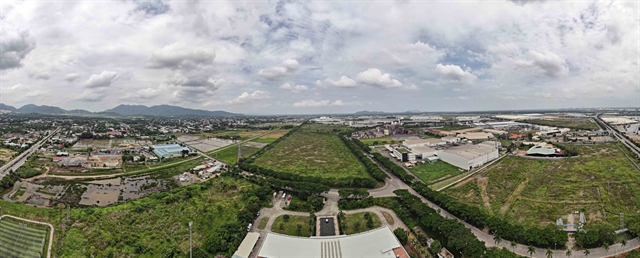
| Phú Mỹ 3 specialised industrial park in HCM City. Data centre operators require large power supplies, telecommunications infrastructure, appropriate technical standards and land that can accommodate long-term expansion. — VNA/VNS Photo Đoàn Mạnh Dương |
HÀ NỘI — Việt Nam’s ambition to become an artificial intelligence (AI) hub in Southeast Asia by 2030 is set to reshape the country’s industrial real estate market with new infrastructure requirements emerging as investors seek to capture growing flows of capital into AI, data centres and high-tech manufacturing.
With the government targeting an AI economy equivalent to 6 per cent of gross domestic product (GDP) by 2030, demand for data centre capacity and high-tech manufacturing infrastructure is expected to rise strongly.
Data from the General Statistics Office under the Ministry of Finance showed that registered foreign direct investment (FDI) in Việt Nam reached nearly US$50.4 billion in the first nine months of the year, up 76.4 per cent from a year earlier. Disbursed FDI stood at $21.1 billion, the highest level in five years.
New investment is increasingly targeting high-tech sectors, including semiconductors, AI and data centres.
The trend is creating additional demand for industrial real estate, particularly in high-tech zones and industrial parks with integrated infrastructure and the ability to meet specialised technical requirements.
According to real estate firm Cushman & Wakefield, investors are looking beyond location and increasingly prioritising infrastructure quality, the capabilities of developers and their ability to meet stringent operating standards.
The key question for investors is no longer simply whether there is enough land to build a data centre, but whether there is sufficient electricity to operate the facility reliably with integrated infrastructure, skilled workers and room for future expansion, said David Jackson, managing director of Avison Young Vietnam and Cambodia, a real estate services corporation.
“This changes the way we assess industrial real estate, as the factors surrounding a site are becoming increasingly important, and in some cases as important as the land itself.”
According to Savills Vietnam, the country’s data centre market was expanding rapidly and could reach total capacity of about 950 MW by 2030. In 2025, the total designed capacity of operational data centres in Việt Nam stood at about 524.7 MW, with 28 facilities in operation and 13 projects under development.
The market generated an estimated $1-1.6 billion in revenue and could exceed $3 billion by 2031, representing compound annual growth of more than 20 per cent a year.
Beyond location and rental costs, data centre operators require large power supplies, telecommunications infrastructure, appropriate technical standards and land that can accommodate long-term expansion.
This presents an opportunity for industrial park and high-tech zone developers with land supported by suitable infrastructure. Competitiveness will depend not only on location or rental costs but also on how ready the infrastructure is when investors begin implementing their projects.
If total data centre capacity reaches about 950 MW by 2030, the sector would become a significant source of demand for Việt Nam’s industrial real estate market, Savills Vietnam said.
Power, speed: new competitive advantage
|
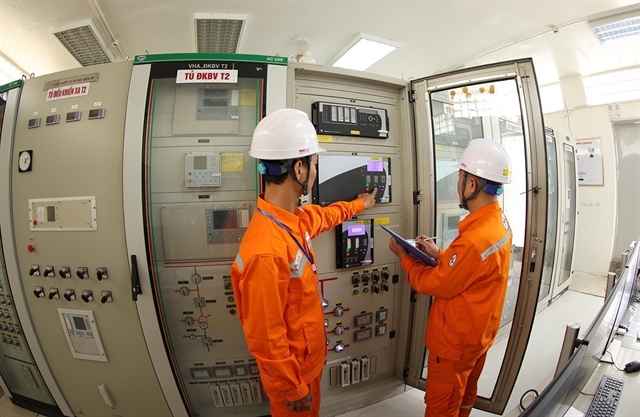
| Workers of EVN checks the 110kV Vân Trung Industrial Park Substation in Bắc Ninh Province. — VNA/VNS Photo Vũ Sinh |
According to Avison Young, with capital for AI and data centres already available, the challenge now is creating the conditions that allow projects to become operational quickly and efficiently.
Data centres cannot afford power outages, so backup generators and energy storage systems are needed to ensure continuous operations, Avison Young Vietnam said.
The projected 61 billion kWh power shortfall represented unmet demand and could create investment opportunities in power generation, storage and supply infrastructure.
A renewable energy supply partnership between BIM Energy and Evolution Data Centres for a new data centre in HCM City also highlights the potential of the direct power purchase agreement (DPPA) mechanism.
Beyond electricity, high-tech projects also require clear procedures and a sufficiently empowered authority or focal point to shorten approval and implementation times.
Speed is particularly important in the technology sector. Delays can increase costs and potentially cause Việt Nam to miss investment opportunities before the required infrastructure is completed, Avison Young said.
For data centres and high-tech manufacturing projects, investors need assurances that the required power will be available at the right location and time, with the ability to increase capacity as operations expand, which requires coordination between power generation, transmission networks and local electricity infrastructure.
A semiconductor project, for example, could require electricity comparable to that of an entire industrial park despite occupying a much smaller area, according to Avison Young.
IP developers seeking to attract high-tech manufacturers therefore cannot rely solely on existing power capacity when positioning their projects.
Power requirements need to be calculated and planned from the outset with phased plans to increase capacity and provide clear commitments to tenants. — VNS
Economy
 Economy
 Economy
 Economy
 Economy
 Economy
 Economy
 Economy
 Economy
 Economy
 Economy
 Economy
 Economy
 Economy
 Economy