 Economy


HKSTP Partners with Leading Science and Technology Company Merck to Open a New Chapter in I&T Collaboration
1.
|
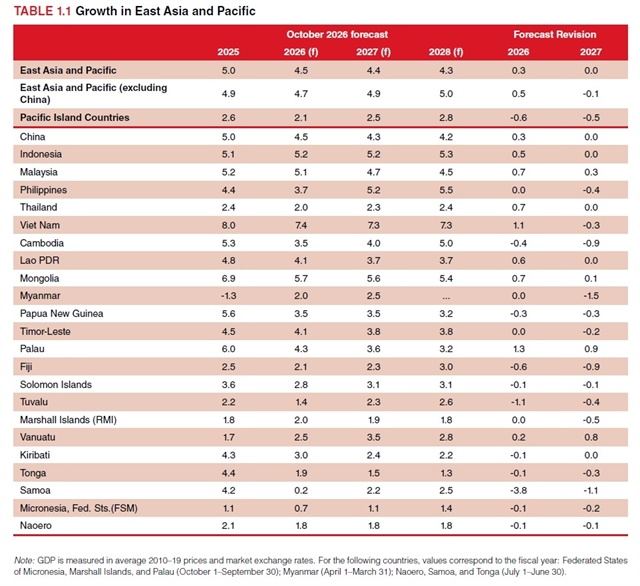
| The World Bank’s forecast for economic growth in East Asia and the Pacific, with Việt Nam’s 2026 growth forecast upgraded to 7.4 per cent. — Source of World Bank |
HÀ NỘI — The World Bank has raised its forecast for Việt Nam’s economic growth in 2026 by 1.1 percentage points to 7.4 per cent, citing stronger-than-expected manufacturing and exports of high-tech and artificial intelligence (AI)-related goods.
The latest East Asia and Pacific Economic Update, released on October 6, said Việt Nam’s growth was expected to remain robust at 7.4 per cent this year, before moderating slightly to 7.3 per cent in both 2027 and 2028.
The upgrade reflects the stronger performance of the manufacturing and export sectors, particularly the production and shipment of high-tech and AI-related products. The World Bank expects this trend to continue, supported by increased domestic stimulus from structural reforms and expanded public investment.
However, inflationary pressures are expected to remain a concern. Consumer price inflation in Việt Nam is projected to average 4.2 per cent in 2026, driven mainly by higher fuel, housing and utility costs, according to the report.
The World Bank’s upgrade puts Việt Nam among the region’s stronger performers. The East Asia and Pacific region as a whole is projected to grow 4.5 per cent in 2026, while Malaysia and Thailand are forecast to expand by 5.1 per cent and 2 per cent, respectively.
AI adoption gathers pace
The report also highlighted Việt Nam’s growing adoption of AI, although it noted that the pace and scale of adoption remain uneven across developing economies in East Asia and the Pacific.
Among emerging-market and developing economies in the region, Malaysia and Việt Nam recorded the highest levels of individual generative AI use in early 2026.
In Việt Nam, AI applications are already being used in a range of practical areas. An AI coach tailored to Vietnamese speakers has become one of the country’s popular language-learning tools, while AI-powered medical imaging is helping under-resourced hospitals improve diagnoses.
Small hotels and tour operators are also using AI to generate promotional visuals and apply dynamic pricing at lower cost.
The World Bank said these examples illustrate the potential of what it calls “Small AI” – the adoption or adaptation of existing AI tools for specific local needs – rather than developing costly frontier AI models.
For most developing economies, adopting and adapting existing technologies is likely to deliver greater benefits in the near term, particularly when tools are tailored to local languages and economic conditions.
The report warned that AI adoption alone would not be enough to deliver broad-based productivity gains. Businesses face constraints including skills shortages, high adoption costs and concerns over security and data privacy.
It also noted that demand for AI-related skills in emerging and developing economies in the region remains relatively low compared with other emerging markets, pointing to the need for stronger investment in skills and education.
Reliable electricity and sound governance are also important for attracting investment in data centres. Southeast Asian economies could benefit from opportunities in semiconductor manufacturing and other parts of the AI value chain.
The World Bank said governments should create an enabling environment for AI adoption by improving digital and energy infrastructure, access to capital and skills, while also using AI themselves to improve public services. BIZHUB/VNS
Economy
 Economy
 Economy
 Economy
 Economy
 Economy
 Economy
 Economy
.jpeg) Economy
Economy
 Economy
 Economy
 Economy
 Economy
 Economy
 Economy