 Economy



Carving a moment of calm
1.
|
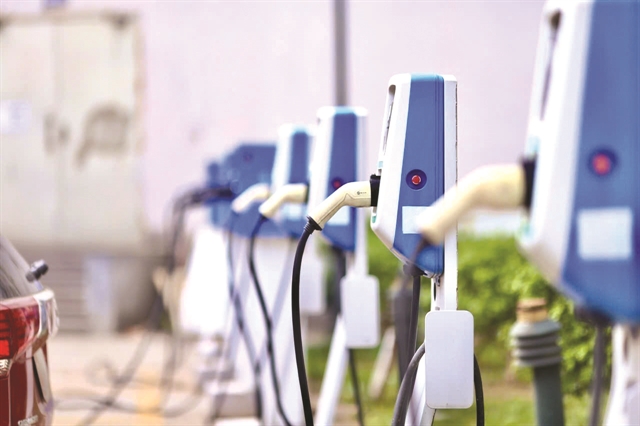
| A VinFast charging station in Hà Nội. Charging stations must support shared use by compatible vehicles from July 1, 2027. — VNAVNS Photo Phương Anh |
HÀ NỘI — Electric vehicle (EV) charging stations are required to support shared use by compatible vehicles from July 1, 2027, under new technical regulations issued by the Ministry of Industry and Trade.
The rules, issued under Circular 61/2026/TT-BCT together with national technical regulation QCVN 32:2026/BCT, require charging stations to be technically compatible with vehicles using supported charging connectors, charging modes and configurations.
The requirement applies to charging stations in public areas, parking facilities and rest stops, outdoor stations and stations under standalone shelters. It excludes those located in basements, garages or indoor parking areas, wireless chargers, vehicle-supplied chargers and certain equipment used for testing and research.
Four main areas are covered under the new regulation: equipment and electrical connections, site layout and installation, operational safety and management and maintenance.
Charging service operators must provide customers with information on electricity consumption, charging time, prices or pricing methods, plus the total amount payable before and during transactions. Information on operations, incidents, metering, payments and customer feedback must be stored, protected and retrievable.
The regulations also introduce transition arrangements for charging equipment installed legally before July 1, 2027.
Owners and operators will have six months from the regulation's effective date to review safety compliance, and up to 24 months to rectify deficiencies. Any defect posing safety risks must be immediately addressed.
Existing stations may continue operating during the transition period. However, any repaired, renovated or expanded part of a station after the new rules take effect must comply with the new technical requirements.
The ministry said the regulations were necessary to establish a mandatory minimum regulatory framework for the design, investment, import, installation, operation, inspection and post-inspection of charging infrastructure as EVs expand nationally.
|
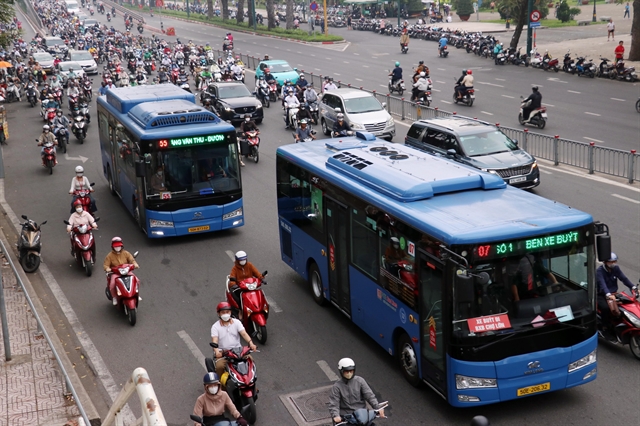
| EVs are developing rapidly in Việt Nam, increasing demand for charging infrastructure development. — VNA/VNS Photo Tiến Lực |
According to Motorcycles Data, the country sold 513,742 electric motorcycles in the first seven months of 2026, up 97.2 per cent from a year earlier. Electric models accounted for about 27.7 per cent of total two-wheeler sales during the period.
The electric car market has also expanded. VinFast reported delivering 137,697 electric cars in Việt Nam in the first seven months of 2026, including 21,781 vehicles in July alone.
It is estimated that Việt Nam currently has about 6.7 million cars, of which around 3 per cent are electric, and 70 million motorcycles, with electric models accounting for about 4.3 per cent.
The growing number of EVs is increasing demand for charging infrastructure. Việt Nam's charging market currently includes vehicle manufacturers, distribution networks and independent charging service providers, with some networks serving multiple compatible vehicle brands. VinFast currently has the largest charging network in Việt Nam.
The ministry said the issuance of technical standards is critical to support the development of charging infrastructure and strengthen consumer confidence in the transition to EVs.
Lê Thanh Hải, director of the Centre for Applied Economic Consulting at the HCM City Institute for Development Studies, was quoted by Thanh Niên (The Youth) newspaper as saying that the timing of the new regulations was appropriate because EVs had gained a significant foothold in the Vietnamese market, domestic manufacturing capacity had been established and investors were waiting for a clearer regulatory framework.
Global electric vehicle and charging technologies were still evolving, with standards often develop, he said. Introducing regulations too early could risk making them obsolete as battery and charging technologies change, while delaying them could discourage major investors concerned about regulatory risks after committing large amounts of capital to charging infrastructure.
The regulations come as Việt Nam seeks to expand electric mobility as part of its commitment to achieve net zero emissions by 2050. The country has set a target for 50 per cent of urban vehicles and all buses and taxis to run on electricity by 2030.
The World Bank estimates that Việt Nam will need about US$2.2 billion in charging infrastructure investment by 2030 and $32.6 billion by 2050. — VNS
Economy
 Economy
 Economy
 Economy
 Economy
 Economy
 Economy
 Economy
 Economy
 Economy
 Economy
.jpeg) Economy
Economy
 Economy
 Economy
 Economy


.jpg)