 Society

Top Vietnamese leader highlights new horizon for Việt Nam–Denmark cooperation
1.
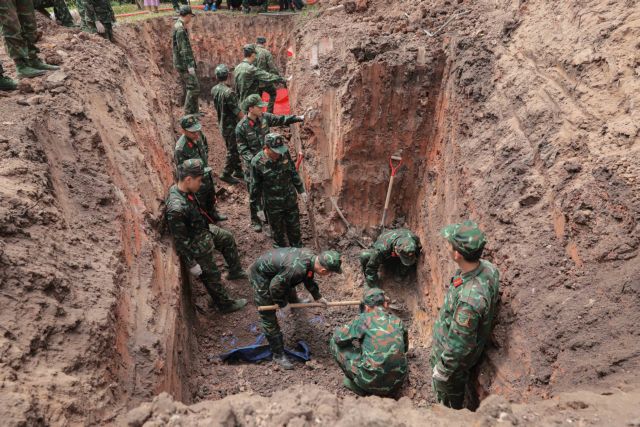 |
| Specialized forces under the HCM City Command perform their duties at Lê Thị Riêng Park. — VNA/VNS Photo Phan Phương |
HÀ NỘI — Việt Nam's nationwide 500-day campaign to accelerate the search for, repatriation and identification of fallen soldiers' remains has recovered 1,563 sets of remains and uncovered nine mass graves, according to the Office of the National Steering Committee for the work.
A campaign progress report said that from July 24 to 30, agencies and relevant units pushed ahead with coordinated operations to seek and recover remains, collect DNA samples, identify remains and clear unexploded ordnance to support search efforts.
During the week, the National Steering Committee continued to direct military regions and local authorities to verify information on fallen soldiers and burial sites provided by organisations and individuals, while expert groups reviewed records related to mass graves.
The committee also asked telecommunications providers Viettel, MobiFone and Vinaphone to send text messages to mobile subscribers encouraging the public to provide information on fallen soldiers and their burial sites.
It further instructed the Đồng Nai Municipal Steering Committee to transfer remains recovered in Minh Đức commune to the Military Institute of Forensic Medicine for DNA testing.
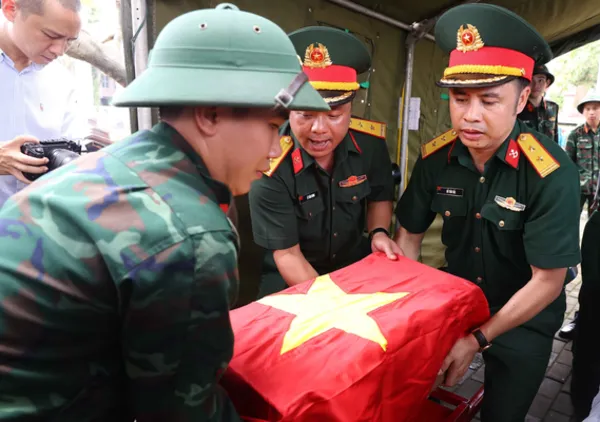
The Ministry of National Defence supported several key activities, including the launch of a recovery operation in Minh Đức Commune of Đồng Nai City, inspections and visits to personnel working at Lê Thị Riêng Park in HCM City, and a memorial and burial ceremony for 34 fallen soldiers at the Vị Xuyên Martyrs' Cemetery in Tuyên Quang Province.
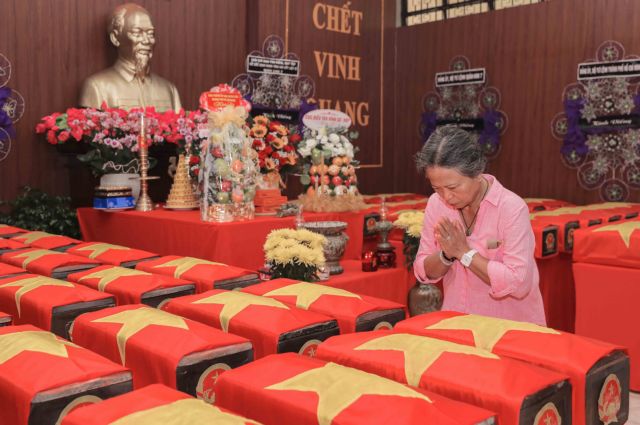 |
| Nguyễn Xuân Huệ, daughter of fallen soldier Nguyễn Thanh Hải, lights incense at the Martyrs’ Memorial in Lê Thị Riêng Park. |
To date, the campaign has recovered 1,563 sets of remains, including 539 in Việt Nam, 174 in Laos and 850 in Cambodia. Authorities have also discovered nine mass graves, including five in Tuyên Quang province and four at Lê Thị Riêng Park in HCM City.
During the reviewed week, recovery teams located 81 sets of remains and uncovered two additional mass graves at Lê Thị Riêng Park.
Alongside search operations, authorities have stepped up DNA sample collection from martyrs' graves.
So far, samples have been collected from 88,889 graves nationwide. Of these, 61,887 met sampling requirements, accounting for 69.62 per cent, while the remaining 27,002 were unsuitable for sampling.
Between July 24 and 30, authorities collected samples from 15,073 graves, including 10,621 eligible and 4,452 ineligible sites.
On DNA identification, the Military Medical Department under the General Department of Logistics and Technical Services under the Ministry of National Defence worked with the Department of National Contributors under the Ministry of Home Affairs to adjust the localities responsible for receiving and analysing DNA samples.
The Military Institute of Forensic Medicine is currently storing and preserving 16,760 samples from 16 of the 17 participating provinces and cities, with Lâm Đồng yet to complete the handover.
The institute has extracted DNA from 146 samples, successfully generating 31 mitochondrial DNA sequences and confirming the identities of two fallen soldiers.
Mine and unexploded ordnance clearance has also progressed in support of recovery efforts. Teams have cleared 10,225 hectares of the planned 22,725 hectares, equivalent to 45 per cent of the target.
.jpg) |
| Along with the remains of the fallen soldiers, the search teams find many important artifacts. |
In the core Vị Xuyên area of Tuyên Quang Province, 3,875ha out of 4,460ha have been cleared, reaching 86.9 per cent of the planned area.
In the next phase, the National Steering Committee said it will intensify search and recovery operations both at home and abroad, with priority given to domestic sites. It will also accelerate DNA sampling from unidentified graves at martyrs' cemeteries.
The committee will continue reviewing records and information on fallen soldiers and burial sites, particularly mass graves, before submitting verified findings to relevant agencies and local authorities for expert assessment. It will also ensure adequate equipment and resources for recovery operations.
At the same time, authorities will organise training in next-generation DNA testing procedures and prepare the personnel and infrastructure needed to adopt advanced DNA identification technologies. — VNA/VNS
Society
 Society
 Society
 Society
 Society
 Society
 Society
 Society
 Society
 Society
 Society
 Society
 Society
 Society
 Society