 Society
Top Vietnamese leader highlights new horizon for Việt Nam–Denmark cooperation
1.
|
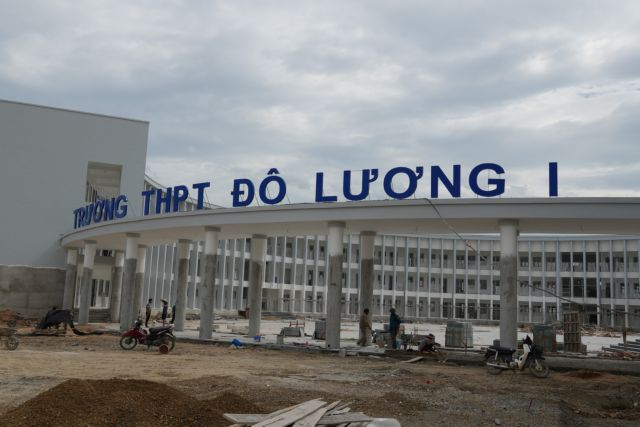
| A high school under construction in the central province of Nghệ An to meet classroom demand after smaller schools were merged and substandard ones dissolved. — VNA/VNS Photo |
HÀ NỘI — In Giảng Võ, a dense inner-city ward of Hà Nội, the authorities plan to turn 17 public schools into eight.
No classroom will close, no student will be turned away, no lesson will be cancelled. What disappears is the letterheads – 17 principals, 17 separate chains of command, folded into a handful of larger institutions with branch campuses.
Giảng Võ is a footnote in something far bigger. Under a directive issued on July 10 – Official Dispatch 777 – all 34 provinces and cities have been urged to cut the number of public education institutions by at least 30 per cent against a July 2025 baseline, and by roughly half where conditions allow.
The Ministry of Education and Training puts the number of schools slated for merger or dissolution at more than 11,000, with a first deadline of August 30 – days before the 2026–2027 academic year begins.
Why now
The trigger was constitutional rather than educational. On July 1, 2025, Việt Nam abolished the district tier of government, leaving the country with 34 provinces and cities and 3,321 communes and wards arranged in a new two-tier structure.
Responsibility for preschool, primary and secondary education passed down to those communes and wards, many of them barely a year old and still building the administrative capacity to run a school system at all.
The transfer exposed a problem almost immediately. Ministry figures cited in July show that roughly 40 per cent of commune-level officials now responsible for education have no professional background in the field, and the gap is far from evenly spread: in the central province of Quảng Trị, that was true of all 88 communes; in the Central Highlands province of Gia Lai, of 99 out of 135; in HCM City, of 80 out of 168.
That gap in local capacity is part of what the July 10 directive is meant to address, and it insists from the outset that the fix is not meant to be arithmetic.
Consolidation is required to follow population density and settlement patterns rather than headcount targets, and every commune or ward must retain at least one preschool, one primary school and one secondary school – or a single multi-level school covering all three.
Certain combinations are ruled out altogether: preschools may not be merged into general schools, general schools may not absorb continuing-education centres and special schools may not be folded into mainstream ones.
Only two organisational models are permitted – a large single-level school with branch campuses, or a large multi-level school operating across one or several sites – with one principal assigned to each institution and one deputy to each branch campus.
The timetable is staged to match that ambition. August 30 marks the end of a pilot phase, not the end of the process: continuing-education centres are due to be restructured by then, with vocational schools following by the end of September.
A review of the pilot is scheduled for December, a second round of reorganisation begins in March 2027, and the government has set April 30, 2027 as the ultimate deadline for the entire school system to be fully reorganised.
What has already gone
The July 10 directive extends a process that was already well under way. An earlier round of reorganisation, carried out as the two-tier system bedded in, had already reduced the number of public education institutions from 45,390 to 39,581 – a net cut of 5,809, achieved through nearly 2,000 mergers, more than 1,000 dissolutions, some 1,500 reorganisations and around 850 new institutions created from scratch.
The pattern varied by level: preschools fell by 700, primary schools by 408 and secondary schools by 226, while high schools edged up by ten and multi-level schools rose by 106. Community learning centres were cut hardest of all, from 6,630 down to 2,140.
Management posts shrank in step. The number of principals and centre directors fell by 2,561, from 29,376 to 26,815, while deputy heads dropped from 44,309 to 42,553. More than 1,000 satellite school sites now stand empty, and a further 1,370 have been repurposed for other uses.
Even so, the system that remains is vast: 36,794 preschool and general schools, 582,659 classrooms, and 98,477 school administrators.
|
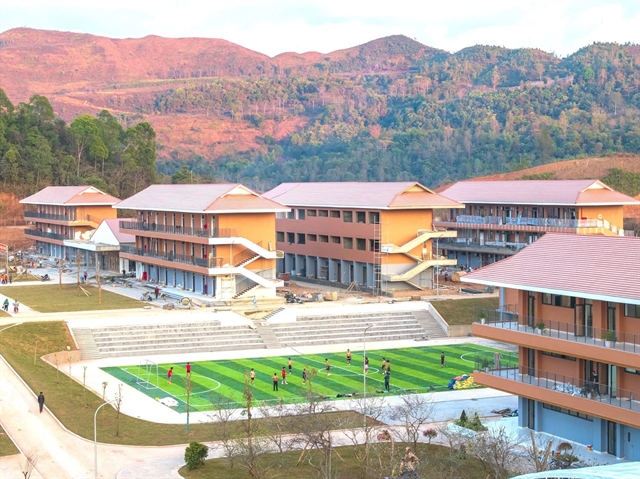
| Si Pa Phìn Multi-level Boarding School, in the border commune of the same name in Điện Biên Province, completed in January. — Photo danviet.vn |
The ministry expects more than 20,000 administrators to be reassigned in the new round, with about 11,000 of them returning to classroom teaching – a deliberate response, officials say, to a persistent teacher shortage rather than a mere by product of the cuts.
Vũ Minh Đức, director of the ministry's Department of Teachers and Education Administrators, told the press on July 23 that teachers should expect little disruption.
"We don't expect this to affect teachers much. The structure, the norms and the terms of employment will essentially stay as they are," he said.
He framed the reshuffle as a partial answer to chronic understaffing as well, arguing that folding administrative posts into teaching ones is one of the few levers available without new hiring.
"The country has around 98,000 education administrators. Trimming the number of school administrations could close 20 to 25 per cent, maybe up to 30 per cent, of the current shortfall," he added.
Meanwhile, accountants and clerks are to be shared across campuses under existing staffing rules, with their numbers reduced to free up resources for teaching posts.
In the south-central province of Khánh Hòa, where the plan calls for cutting 248 of 728 institutions, Vũ Ngọc Đương, director of the province's Department of Education and Training, has been blunt about the arithmetic.
"Each school will lose three to six staff. Across more than 200 schools, that adds up to over 700 people affected," he said.
How far provinces and cities intend to go varies sharply. HCM City's boldest of three options on the table would cut 757 units from the 1,891 in scope – a reduction of 40 per cent – while redeploying around 1,470 administrators and shedding some 2,371 support posts.
Đắk Lắk's provincial proposal goes further still, eliminating 690 of 1,238 institutions, or 55.7 per cent, a sharper cut than the 40 per cent proposed by its own communes and wards. Quảng Ninh, further along in the process, reports a 49-per-cent reduction.
Hà Nội, which has roughly 3,000 public education institutions, aims to cut at least half of them by August 10. Phú Thọ aims for 45 to 50 per cent in its better-off localities and at least 30 per cent elsewhere, on top of cutting its continuing-education centres from 32 to 23.
Nowhere is the policy more delicate than in the uplands, where ethnic communities are still served by thousands of small satellite schools, many of which remain poorly equipped.
Under the July directive, any site that fails to meet minimum facility standards is to be dissolved, with its students moved to boarding or semi-boarding schools at the main campus; where a locality has not yet built that infrastructure, the deadline shifts to the 2027–2028 school year instead.
Some provinces and cities are racing to build ahead of schedule. Lạng Sơn is putting up 11 boarding schools covering primary and secondary levels for more than 12,700 border-area children, with the first four due by the end of July.
Sơn La has launched a hundred-day push of its own, aiming to finish 13 more in border communes before the new school year begins, whereas Điện Biên has set a target of 15, with one completed in January and nine more due by August 30.
The argument beneath the timetable
Education experts have broadly welcomed the emphasis on governance over headcount, while insisting the real work starts only after the decision is official.
Hoàng Ngọc Vinh, an education expert, argued that reorganisation is an opportunity to build schools that are more modern rather than merely larger, and pointed to Singapore's heavy investment in principal training before granting schools greater autonomy.
"Hitting the target of cutting at least 30 per cent of institutions is only the easiest part. The real challenge begins once the merger decision takes effect," Vinh said.
That challenge, in his account, unfolds in layers. A single principal now manages more students and staff across multiple campuses, juggles competing interest groups and a wider range of parent expectations, and a reshuffled leadership structure can breed quiet resentment unless the decisions behind it are transparent.
Đỗ Đình Đảo, principal of Nguyễn Hữu Thọ High School in HCM City, said the distance that matters most in a merger is not the one measured on a map. It's the one between institutional cultures – schools that each carry decades of their own history, traditions and values into a single new organisation.
"The hardest gap to close after a merger isn't geographical. It's the gap between institutional cultures," Đảo said.
Left unmanaged, he said, those differences can harden into an old-guard-versus-newcomers divide. The fix is not a principal trying to be everywhere at once – it's a governance system precise enough to run smoothly without him, so the school stops depending on any one person's presence.
|
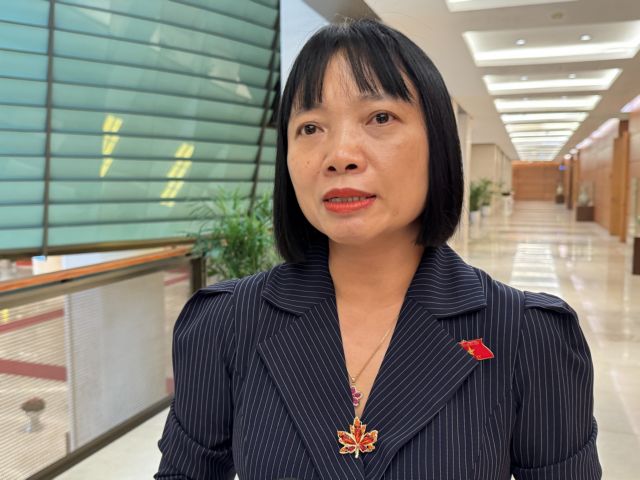
| Nguyễn Thị Việt Nga, a National Assembly deputy from Hải Phòng. — VNA/VNS Photo |
Nguyễn Thị Việt Nga, a National Assembly deputy from Hải Phòng, warned that placing experienced administrators in roles that exist only on paper does real harm to morale, and urged provinces and cities to keep people, not just headcounts, at the centre of the process.
"A token placement easily leaves people feeling diminished, or wasted," Nga said.
She said the process needs to be transparent from the outset, with officials told plainly what the selection criteria are, what their new placement will be, and what they're entitled to – steps she believes would head off much of the anxiety, resentment and grievance that reorganisations like this one tend to produce.
If the reorganisation succeeds, the lasting story will not be one of schools vanishing from the map, but of a country choosing depth over breadth — fewer institutions, better built. — VNS
Society
 Society
 Society
 Society
 Society
 Society
 Society
 Society
 Society
 Society
 Society
 Society
 Society
 Society
 Society