 Society

Liechtenstein Prime Minister concludes official visit to Việt Nam
1.
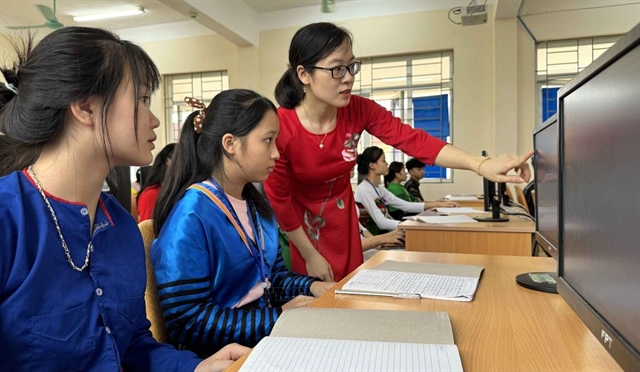 |
| Ethnic students should be provided with an equal and modern educational environment. — VNA/VNS Photo |
HÀ NỘI — To narrow the development gap between ethnic and advantaged areas, it is necessary to invest more heavily in education and human resource training.
The project to train high-quality human resources among ethnic communities in a number of key industries and fields in the period 2026–2035, with an orientation to 2045, demonstrates the Government's strong commitment to expanding opportunities to access high-quality education for ethnic communities.
One of the project’s objectives is to build a core team of ethnic workers and officials to meet the requirements of the labour market, which will contribute to socio-economic development and ensure national defense and security, especially in ethnic areas, mountainous areas, borders and islands.
Foundation reinforcement
With many years of experience as a teacher in N’Trang Lơng Ethnic Boarding School in Đắk Lắk, Hoàng Thị Trà Hương said: “The project of training high-quality human resources from ethnic communities is a very practical initiative, especially when focusing on improving the capacity and quality of the education and training system in the area."
“Boarding and semi-boarding schools for ethnic students or university preparatory facilities are important ‘cradles’ to help discover and initially foster talent sources in ethnic minority areas,” Hương said.
When schools properly invest in facilities such as computers, libraries or laboratories and teacher quality, students will have access to an equal and modern education environment.
One of the important factors of the project is to accelerate digital transformation and technology application in education and training, focusing on building a digital learning materials system with diverse languages, including Vietnamese and some popular ethnic languages.
Thus, students have the ability to access knowledge, document systems, and learning materials, helping to develop abilities equally, and focusing more on innovation and scientific and technological thinking.
High quality education is not only associated with modern cultural learning methods, but also comes with the development of soft skills and career orientation.
In particular, the project focuses on applying artificial intelligence (AI) and big data to analyse and forecast human resource needs, forecast employment, and support career counseling according to each industry and key field suitable for each region of ethnic and mountainous areas in general.
This would contribute to raising the sense of initiative and confidence of ethnic students when choosing majors and professions at prestigious universities, colleges or vocational schools.
Bridging to the market
According to educators, the project also encourages public-private co-operation and mobilises resources from businesses and society to develop education in the ethnic regions.
This is not just financial support, but a real "bridge" that helps eliminate the gap between school and the labour market.
When businesses or social organisations participate directly in the training process, the curriculum is no longer dry theory but becomes lively and highly applicable.
"Students can receive scholarships, internship opportunities or be hired right after graduation sponsored by businesses. This is a huge development door for each student," Hương said.
At the same time, businesses also support schools to improve facilities by investing in modern equipment and sending experts to teach.
More importantly, businesses can contribute to the training process through research, construction, and provision of digital education platforms and services specifically for ethnic minorities.
A dual benefit that students enjoy is being updated on career trends and local human resource needs to choose suitable industries and occupations.
When this cooperation deepens, it will help ethnic areas solve the "brain drain" situation, creating high-quality human resources on the spot instead of having to rely on skilled workers from other areas.
However, for the project to create positive changes, it still needs synchronisation in implementation.
From a teacher's perspective, Hương recommends that it is necessary to develop a plan and allocate a clear, transparent, and focused investment budget.
Priority should be given to investing in the boarding school system. The reason is because this is a front-line training facility, with the largest concentration of ethnic children.
In addition, the project has created favourable conditions for students to continue their postgraduate studies and research when aiming to increase the scale of training at master's and doctoral levels by 10 per cent each year.
At the same time, more attention must be paid to the issue of post-training.
Specifically, encouraging agencies, organisations, individuals, and businesses to recruit and employ ethnic workers in key industries and fields; and supporting start-up loans or guiding ethnic students and trainees after training to set up small production and business projects.
Therefore, the objective of the project will remain to create stable jobs for those willing to return to their hometowns and to provide genuine incentives for them to stay in the local area for longer. — VNS
Society
 Society
 Society
 Society
 Society
 Society
 Society
 Society
 Society
 Society
 Society
 Society
 Society
 Society
 Society