 Society

Go Where Flavors of Hunan Abound: Showcasing the Greater Zhangjiajie International Tourism Area Through Local Cuisine
1.
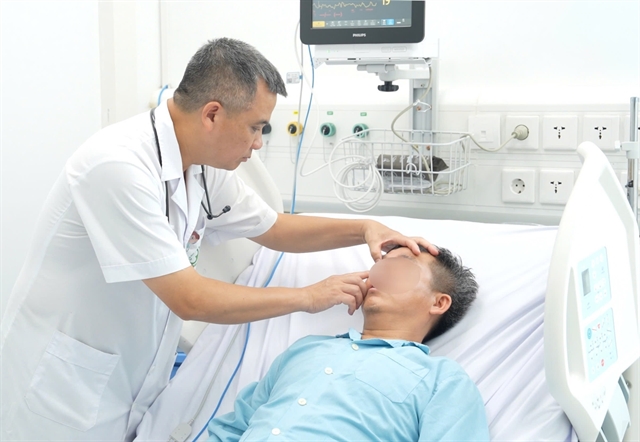 |
| A doctor examines a patient at Bạch Mai Hospital’s second branch in Ninh Bình Province. — VNA/VNS Photo Thanh Tuấn |
NINH BÌNH — Just one month after officially opening, Bạch Mai Hospital’s second branch in Ninh Bình Province received nearly 56,500 outpatient visits, treated more than 5,500 inpatients, performed hundreds of surgeries and carried out many advanced procedures that were previously available only in Hà Nội.
Behind these figures are shortened emergency journeys, with patients no longer needing to travel hundreds of kilometres to seek treatment, and a major step forward in bringing high-quality healthcare closer to local communities.
Trần Văn Hùng still cannot hold back his emotion when recalling the moment he was admitted to the Toxicology Intensive Care Unit after a biogas poisoning incident at a livestock farm in Thanh Hóa Province. The accident left several people in critical condition. On arrival, he was exhausted, struggling to breathe and had to cling to the bed frame even to sit up.
After just over a day of intensive treatment, his condition improved markedly.
“I can breathe more easily, I can sit up by myself and I can speak more clearly. I am very grateful to the doctors who saved me,” he said.
What affected Hùng and his family most was not only the high level of clinical expertise or the dedication of the medical team, but the fact that a tertiary hospital close to home had finally opened.
“If this hadn’t been available, we would certainly have had to transfer to Hà Nội. More than 150km, many hours on the road – in such a critical state that would have been very worrying,” Hùng’s family member said.
In emergency and critical care, every minute counts. The opening of Bạch Mai Hospital’s second branch in Ninh Bình Province has significantly reduced geographical distance, enabling patients from the southern Red River Delta and neighbouring localities to access leading critical care doctors and toxicologists more quickly and make full use of the ‘golden hour’ to save lives.
Advanced procedures
The new hospital branch is not just for acute emergencies. Its arrival has also brought major changes for many patients with chronic illnesses.
Hoàng Văn Minh from Đồng Thịnh Commune in Ninh Bình has been treated for cancer at Bạch Mai Hospital in Hà Nội for years. Each follow-up visit required the whole family to rearrange work and set off very early.
“This time I was examined right here in Ninh Bình Province. It was still the experienced doctors from the Nuclear Medicine and Oncology Centre examining me, so I felt very reassured. No long journey, no excessive waiting and the hospital is modern with up-to-date equipment,” Minh said.
Minh’s feelings reflect those of tens of thousands of patients who attended during the hospital branch’s first month.
Instead of travelling hundreds of kilometres to Hà Nội, people can now reach Bạch Mai's healthcare in a few dozen minutes or one to two hours’ travel from home.
One of the clearest achievements in the first month was the successful introduction of numerous advanced procedures, with many complex surgeries performed.
Surgeons at the facility undertook complex orthopaedic trauma operations and spinal surgeries, vertebral body augmentation with bio‑cement or minimally invasive intramedullary nailing for bone fixation, among other techniques.
Procedures that were previously only available at the first branch in Hà Nội, such as interventional cardiology, emergency thrombectomy for stroke, and spinal surgery, were rolled out at Ninh Bình.
The surgical department is equipped with advanced devices to support complex operations.
Doctors say the aim is not only to perform high‑level techniques, but also to apply minimally invasive methods to reduce pain, limit blood loss, shorten recovery time and improve patients’ quality of life.
Telling numbers
After one month of official operation, Bach Mai Hospital’s second branch in Ninh Bình recorded more than 56,000 outpatient visits, averaging 2,500 visits per day and exceeding 3,000 on some days.
Clinicians completed nearly 1,300 surgeries, including around 100 critical emergency procedures.
Bed occupancy consistently exceeded 100 per cent.
Bạch Mai Hospital Director Professor Đào Xuân Cơ said there were times when the hospital cared for up to 1,150 inpatients.
During the first month, inpatient demand was high and concentrated in several specialties, such as General Surgery, Neurology, Gastro‑hepatic, Cardiology, Nuclear Medicine and Oncology, Obstetrics and Gynaecology and Haematology and Transfusion.
These figures demonstrate the strong local demand for high‑quality healthcare services.
According to Cơ, Bạch Mai now operates under a 'One Bạch Mai – Two facilities' model. The Hà Nội and Ninh Bình facilities are not two independent hospitals, but a unified system in governance, finance, clinical standards and treatment quality.
“There is only one Bạch Mai,” he emphasised.
To ensure consistent quality, the hospital deployed about 1,300 experienced professors, doctors, nurses, technicians and support staff to work directly at the Ninh Bình branch.
Integrated management also makes transfers between the two facilities easier for patients, without the need to repeat complex administrative procedures.
Changing patient service
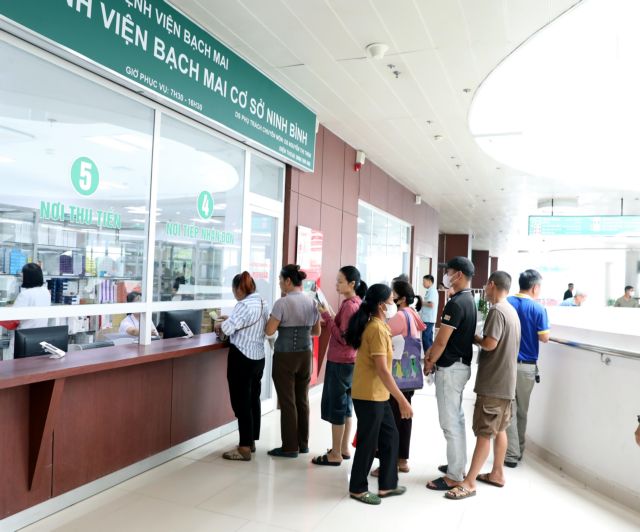 |
| Patients queue to buy medicines at the pharmacy in Bach Mai Hospital’s facility in Ninh Bình Province. — VNA/VNS Photo Thanh Tuấn |
Despite positive outcomes, Bạch Mai’s leadership is not complacent. Field surveys show that some patients still experience waiting times at certain administrative stages.
Cơ has asked units to continue streamlining processes, integrating services from the outpatient departments and minimising the need for patients to move between many locations.
'One patient, one ID, one journey' is a motto that Bạch Mai is determined to implement.
He said people coming to the Ninh Bình facility should be able to access high‑level techniques and feel the staff's professionalism in even the smallest details.
On a 21‑hectare base with a 1,000‑bed capacity, the Ninh Bình site is gradually becoming a modern medical centre.
Going forward, the hospital will continue to develop traditional medicine combined with modern medicine, and aim to build a medical tourism model that leverages Ninh Binh’s status as a heritage region to attract international patients seeking combined treatment and leisure.
But the greatest value the new campus has brought is changing people’s treatment journey.
One month is not long enough to fully evaluate the effectiveness of a large hospital. But, from lives saved in the ‘golden hour’, to cancer patients no longer having to travel hundreds of kilometres and advanced techniques being introduced locally for the first time, the project’s initial goals are clearly beginning to be realised.
This is not merely the story of a new healthcare facility opening. It is proof of a policy to bring tertiary healthcare closer to the people, so that every patient can access high‑quality services where they live, reduce the burden of referrals and help relieve overcrowding at central hospitals.
With positive signals after its first month, Bạch Mai Ninh Bình is steadily asserting its role as the extended arm of a top‑ranked hospital, bringing medical excellence closer to the people. — VNS
Society
 Society
 Society
 Society
 Society
 Society
 Society
 Society
 Society
 Society
 Society
 Society
 Society
 Society
 Society