 Economy
SBV to curb property price inflation, enforce lending rate rules
1.
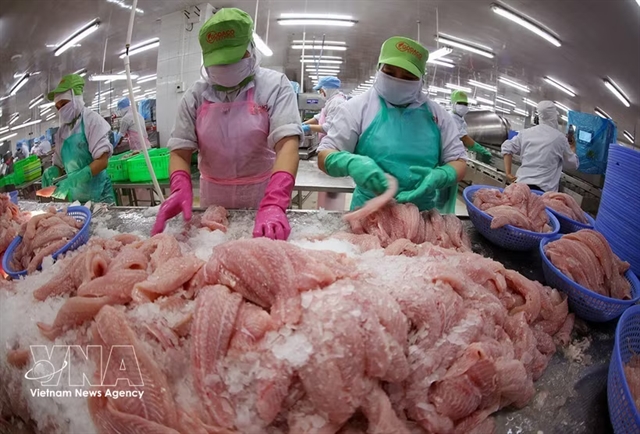 |
| Workers sort basa fish fillets for export at Go Dang Tien Giang Joint Stock Company. —VNA/VNS Photo |
HCM CITY — Việt Nam's agricultural, forestry and fisheries exports maintained solid growth in the first seven months of 2026, but bottlenecks in raw material supply, logistics and market access must be resolved to achieve the sector's export target of more than US$74 billion this year, according to officials and businesses.
The Ministry of Agriculture and Environment on July 30 held a conference with industry associations to discuss measures to accelerate exports during the second half of the year.
Deputy Minister Nguyễn Hoàng Hiệp said global uncertainties, including geopolitical tensions, higher logistics costs and rising trade barriers, were weighing on exports.
Despite these challenges, agricultural, forestry and fisheries exports were estimated at nearly $42.6 billion by the end of July, up around 7 per cent year-on-year and reaching 57.6 per cent of the annual target, reaffirming the sector's role as a key pillar of the economy.
Exports of fruit and vegetables, seafood, pepper, timber and wood products remained on a growth trajectory. The national agricultural, forestry and fisheries traceability system, launched on July 1, has also enhanced transparency, product quality and the international competitiveness of Vietnamese exports.
However, Hiệp noted that several major commodities, including coffee, rice, rubber and tea, recorded lower export values due to declining average export prices. Meanwhile, importing markets are imposing increasingly stringent requirements on quality, traceability, sustainability and emissions reduction.
To achieve the sector's growth target of at least 4 per cent and exceed $74 billion in export revenue this year, Hiệp called for stronger efforts to improve raw material production areas, logistics, product quality and green standards, while diversifying export markets and strengthening coordination among ministries, local authorities, industry associations and businesses.
At the conference, industry associations warned that longstanding weaknesses across production and export chains are undermining the competitiveness of Vietnamese agricultural products.
Đỗ Hà Nam, chairman of the Vietnam Food Association, said the Philippines remained Việt Nam's largest rice export market, but new import management policies there had created difficulties for exporters.
He proposed stronger engagement with Philippine authorities and closer cooperation between the two countries' industry associations to resolve trade issues, while also expanding rice exports to African markets to reduce dependence on traditional destinations.
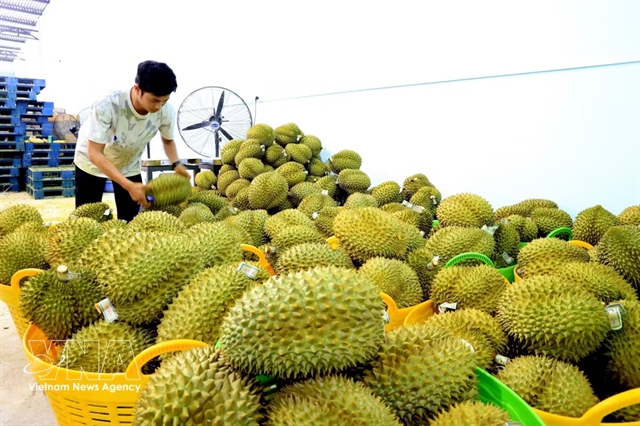 |
| Fresh durians ready for export. — VNA/VNS Photo |
Nguyễn Thanh Bình, chairman of the Vietnam Fruit and Vegetable Association, said complicated procedures for issuing and managing planting area and packing facility codes remained a major obstacle, particularly during harvest seasons, delaying exports and increasing costs for businesses and growers.
He also pointed to weak links between farmers and exporters, the persistent misuse of planting area codes, and gaps between domestic production practices and importing countries' requirements, all of which threaten market access.
The association proposed simplifying procedures for issuing planting area codes through digitalisation and shifting from pre-inspection to post-inspection, while strengthening awareness of sanitary and phytosanitary (SPS) regulations, traceability and digital transformation.
It also called for faster market access negotiations for products such as pineapples, custard apples, avocados and plums, as well as solutions to outstanding issues related to value-added tax refunds and documentation for transactions between farmers and businesses.
In addition, the association urged authorities to accelerate negotiations with China on mutual recognition of inspection and quarantine results and customs data sharing to shorten customs clearance times, while investing in logistics infrastructure and testing facilities in key production areas.
Đỗ Ngọc Tài, chairman of the Vietnam Association of Seafood Exporters and Producers, said the seafood sector should adopt a new growth model built on four pillars: lowering production costs while increasing value through deep processing; expanding product and market opportunities; removing supply chain bottlenecks to ensure stable raw material and product flows; and diversifying export markets over the next two to three years.
He also called for measures to improve raw material supplies for processors, develop market-specific action plans, reduce logistics and shipping costs, and address financing and labour shortages facing exporters.
 |
| Minister of Agriculture and Environment Trịnh Việt Hùng speaks at the event. — VNA/VNS Photo |
Minister of Agriculture and Environment Trịnh Việt Hùng said the ministry would closely monitor market developments, strengthen forecasting and early warning systems and manage exports more flexibly using data from the national traceability system to support agricultural, forestry and fisheries exports in the second half of 2026.
The ministry will prioritise support for sectors at risk of declining export values through improved access to credit, logistics, cold storage, customs clearance and market expansion.
It will also step up trade promotion linked to market opening, the removal of technical barriers, the development of distribution channels and cross-border e-commerce, with a focus on high-potential markets such as ASEAN, South Asia, the Middle East, Africa and Latin America.
The ministry also plans to expand the national agricultural, forestry and fisheries traceability system to help businesses leverage data for trade negotiations and export market development. — VNS
Economy
 Economy
 Economy
 Economy
 Economy
 Economy
 Economy
 Economy
 Economy
 Economy
 Economy
 Economy
 Economy
 Economy
 Economy