.jpg) Economy
Economy



Triton Crown launch draws more than 400 prospective buyers
1.
 |
| People attend a land auction in Hà Nội. — Photo laodong.vn |
HÀ NỘI — The once-booming market for auctioned land has lost momentum after a wave of speculative buying pushed prices to record highs in 2024 and early 2025, as auctions now see fewer bidders, lower winning prices and investors becoming increasingly cautious.
Just over a year ago, land auctions across several provinces drew thousands of applications as investors competed aggressively, driving winning bids to two or three times the starting prices in some cases.
Nguyễn Hoàng Minh, a 38-year-old investor from Hà Nội who has focused almost exclusively on auctioned land for years, said he regularly surveyed suburban sites, reviewed planning documents and prepared bidding applications whenever new auctions were announced.
At one point, Minh owned more than 10 plots in hotspots on the outskirts of Hà Nội and nearby provinces, such as Bắc Ninh and Hưng Yên. His strategy was to bid for land, hold it for a few months and then sell it for a profit, Minh told vnbusiness.vn.
The approach proved highly profitable during 2024 and the first half of 2025. Minh said he resold a plot in Hưng Yên Province for a profit of more than VNĐ400 million (US$15,000) within weeks after purchasing it for over VNĐ2 billion.
However, sentiment shifted sharply toward the end of 2025, as demand weakened and investors who bought at peak prices struggled to find buyers.
Minh's two auctioned plots in Thanh Oai have received almost no inquiries since the end of 2025, even though he only asked a few hundred million đồng above his purchase price.
He said that he stopped joining large auctions and now only looks at areas with completed infrastructure, established residential communities and genuine housing demand.
Minh added that he is restructuring his investment portfolio to reduce exposure to speculative land.
The change in market conditions has also been reflected in recent auctions, where bidding activity has become more subdued and buyers are taking a more selective approach, industry insiders said.
An auction of 167 residential plots in Kim Sơn Commune, Ninh Bình Province in early July highlighted the slowdown. The event attracted 274 bidders submitting nearly 2,100 applications, compared with almost 1,000 participants and more than 3,800 applications at a similar auction held at the end of 2025.
Winning prices also eased. Prime roadside plots were sold for around VNĐ16 million per square metre, while interior lots fetched about VNĐ9 million per square metre. Compared with the previous auction, winning bids for many plots were up to VNĐ600 million lower, with some declining by nearly VNĐ900 million.
Trần Thế Dũng, head of the Vietnam Association of Real Estate Brokers executive board in Ninh Bình, said many large land auctions in the province have recorded lower winning bids since the beginning of the year.
In Gia Trấn Commune, winning bid prices have fallen by about 30 per cent from previous auctions, while post-auction trading has remained subdued, Dũng said. In Hoa Lư Ward, winning prices were down about 10 per cent, with some buyers securing plots at the reserve price, reflecting increasingly cautious investor sentiment.
The gap between winning bid prices and secondary market transaction prices has narrowed significantly, Dũng told vnbusiness.vn, adding that during the market's boom, many auctioned plots were resold immediately for profits of several hundred million đồng.
As speculative activity eases, land values are increasingly being driven by underlying factors such as location, infrastructure, development potential and end-user demand, reducing the role of auction prices as a benchmark for broader market expectations, analysts said.
Paradox remains
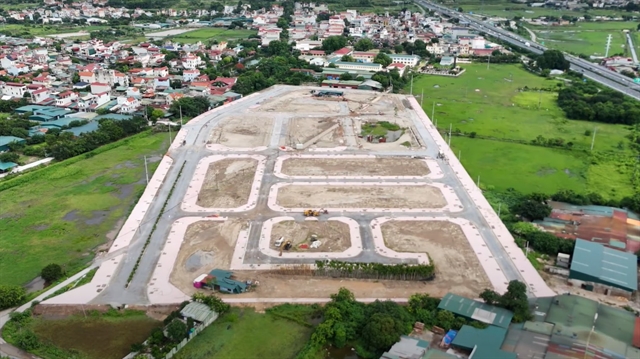 |
| An auctioned land plot in Thanh Trì on the outskirts of Hà Nội. —Photo nhadautu.vn |
However, the slowdown has not been uniform across the market, as some auctioned land continues to command elevated prices despite limited development.
In Hà Nội's suburban areas, such as Vân Hòa and Phú Lương, many plots remain vacant years after being auctioned. Only a handful of houses have been built, while other sites are used for material storage or remain overgrown with vegetation. Even so, asking prices in the secondary market have remained largely unchanged.
Vân Hòa plots that carried starting prices of around VNĐ20 million per square metre at auction are now commonly offered for up to VNĐ80 million per square metre.
Meanwhile, plots in Phú Lương auctioned for VNĐ30 million per square metre on average are being marketed at around VNĐ200 million per square metre.
The disparity suggests land prices are not always aligned with actual development. Limited resale supply, investors' willingness to hold land for the long term and expectations of future infrastructure improvements have continued to support prices, even where residential development has yet to materialise, analysts said.
While land auctions are intended to provide a transparent mechanism for allocating land resources and generating budget revenue, prolonged delays in developing auctioned sites risk undermining broader urban development objectives, they said.
According to economist Đinh Trọng Thịnh, authorities should require successful bidders to develop auctioned land within a specified timeframe and impose stricter penalties on those who fail to put the land into use as committed.
He also called for higher deposit requirements, tighter eligibility criteria for auction participants, stricter enforcement against bidders who forfeit deposits and greater transparency in planning information to help curb speculative price spikes. — VNS
Economy
 Economy
 Economy
 Economy
 Economy
 Economy
 Economy
 Economy
 Economy
 Economy
 Economy
 Economy
 Economy
 Economy
.jpg) Economy
Economy