 Society

Việt Nam, EU and Belgium seek deeper, practical cooperation
1.
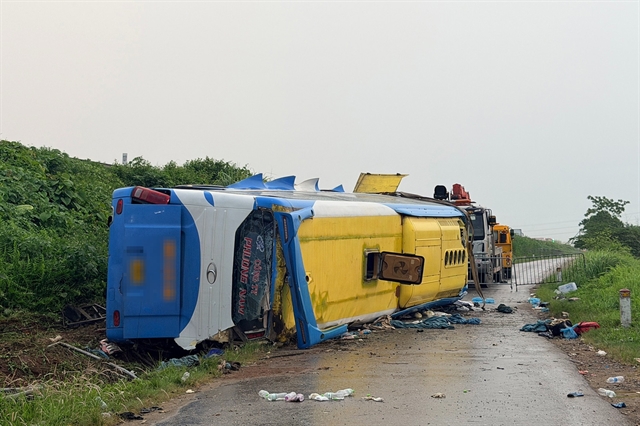 |
| The passenger bus overturned after plunging from the Pháp Vân–Cầu Giẽ Expressway onto a local service road early July 17 morning. — Photo from the police |
HÀ NỘI — Four people were killed and 28 injured after a sleeper coach plunged off the Pháp Vân–Cầu Giẽ Expressway in Hà Nội early Friday morning.
The accident occurred at around 12:15am near the Hà Vỹ underpass in Chương Dương Commune.
According to initial reports, the sleeper coach, bearing registration number 20C-117.XX, was travelling from the central province of Nghệ An to Hà Nội when it suddenly swerved to the right at kilometre marker 197+900 on the Pháp Vân–Cầu Giẽ–Cầu Bồ–Mai Sơn–National Highway 45–Nghi Sơn route.
The vehicle smashed through the expressway’s guardrails before plunging some 3.5 to 4.2m onto a local service road below.
The coach was driven by Nguyễn Văn B., born in 1983 and residing in Khai Sơn Commune in the northern province of Thái Nguyên.
At the time of the crash, the vehicle was carrying 32 people, including the driver. The passengers were part of a tour group returning from Hà Tĩnh Province and all were residents of Phú Bình Commune, Thái Nguyên Province.
The crash left three people dead at the scene, while another later succumbed to injuries in hospital.
The 28 injured passengers were taken to the Agriculture General Hospital, Thường Tín General Hospital, and Việt Đức Friendship Hospital for emergency treatment.
Following the accident, police conducted alcohol and drug tests on the driver and found no violations.
The cause of the crash remains under investigation.
The accident has renewed concerns over traffic safety on the country’s expressways, particularly during overnight journeys.
Authorities have urged drivers to strictly observe speed limits, maintain safe distances and remain fully alert behind the wheel. Long-distance coach drivers have also been advised not to drive when fatigued or after exceeding the legally permitted driving time.
Transport companies and vehicle owners have been called on to carry out regular inspections, especially of braking systems, tyres, steering and lighting equipment before each trip.
Passengers, meanwhile, are encouraged to wear seat belts where available, remain seated in designated positions and follow all safety instructions throughout their journey. — VNS
Society
 Society
 Society
 Society
 Society
 Society
 Society
 Society
 Society
 Society
 Society
 Society
 Society
 Society
 Society