 Society
Việt Nam seeks deeper role in global semiconductor value chain
1.
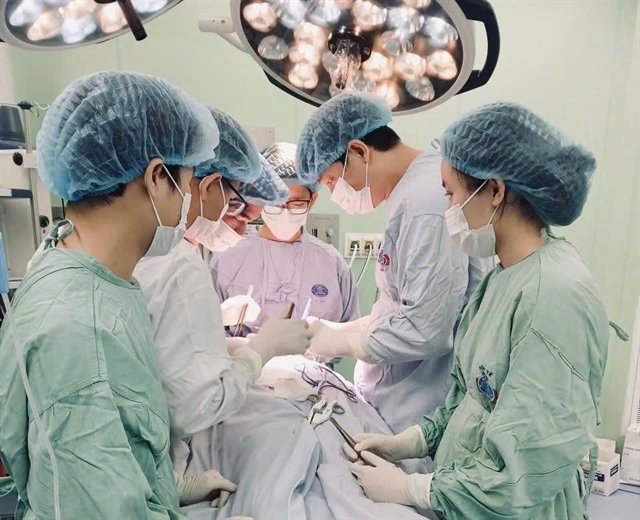 |
| Associate Professor Dr. Nguyễn Xuân Hậu, Head of the Quán Sứ 2 Department of Surgery, and his team perfom the surgery to remove the giant parotid gland tumour from the Hmông ethnic patient. — Photo courtesy of the K Hospital |
HÀ NỘI — Việt Nam's National Cancer Hospital (K Hospital) has announced that its surgical team successfully performed a surgery to remove a giant parotid gland tumour from a H'mông ethnic patient.
Due to a combination of complacency and feelings of shame, G.T.L. (a 69-year-old Hmông woman from the northern mountainous province of Tuyên Quang) did not seek a medical examination or definitive treatment, despite having noticed a tumour in her head and facial area for years.
It was only when the tumour had grown large, causing pain through compression and interfering with her daily activities, that L. finally went to K Hospital in Hà Nội for examination.
Initial examination revealed a large tumour in the patient's right parotid gland. The tumour had developed over a long period, causing noticeable deformity in the right mandibular angle and neck, which affected the patient's daily activities and quality of life.
Following in-depth testing, doctors identified a tumour in the right parotid gland region measuring over 10cm, with no abnormal peripheral lymph nodes detected. Magnetic resonance imaging (MRI) revealed a lesion in the right parotid area strongly suggestive of a pleomorphic adenoma, a common type of benign parotid tumour that can grow to a massive size and significantly impact the patient's quality of life if left untreated.
Following a clinical consultation, Associate Professor Dr. Nguyễn Xuân Hậu, Head of the Quán Sứ 2 Department of Surgery, and his team reached a consensus to perform surgery to remove the right parotid gland tumour while preserving the facial nerve (cranial nerve VII).
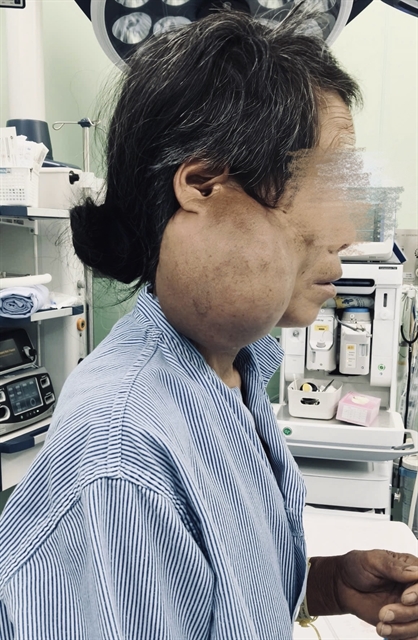 |
| Patient L has a tumour in the right parotid gland region measuring over 10 cm. — Photo courtesy of the K Hospital |
According to Dr. Hậu, parotid gland tumour surgery is consistently one of the most challenging procedures in head and neck surgery, with the greatest difficulty lying in the preservation of the facial nerve (cranial nerve VII). This nerve acts as the vital link controlling most facial expression muscles, governing movements such as smiling, speaking, closing the eyes, and general facial muscle activity.
“As the tumour enlarges, nerve branches may be displaced or become adherent to the mass; consequently, dissection requires meticulous surgical technique to ensure complete removal of the lesion while maximally preserving the facial nerve and adjacent critical structures, thereby minimising the risk of postoperative facial paralysis,” the doctor noted.
The majority of parotid gland tumours are benign; however, this does not mean one can simply monitor the tumour at home.
Continued growth of the tumour leads to progressive facial deformity, interfering with daily activities, eating, and communication. More importantly, as the tumour enlarges, surgery becomes more difficult due to altered anatomical structures, thereby increasing the risk of complications and prolonging the treatment process.
Patient L. underwent successful surgery and is continuing follow-up care.
Timely diagnosis and treatment not only facilitate a smoother surgical procedure but also increase the likelihood of preserving function, shorten recovery time and improve post-treatment quality of life.
For the surgeons, the success of a procedure lies not only in the technical removal of the lesion but also in maximising functional preservation, minimising long-term complications, and ensuring a good quality of life for the patient post-treatment. — VNS
Society
 Society
 Society
 Society
 Society
 Society
 Society
 Society
 Society
 Society
 Society
 Society
 Society
 Society
 Society