 Society
SBV to curb property price inflation, enforce lending rate rules
1.
|
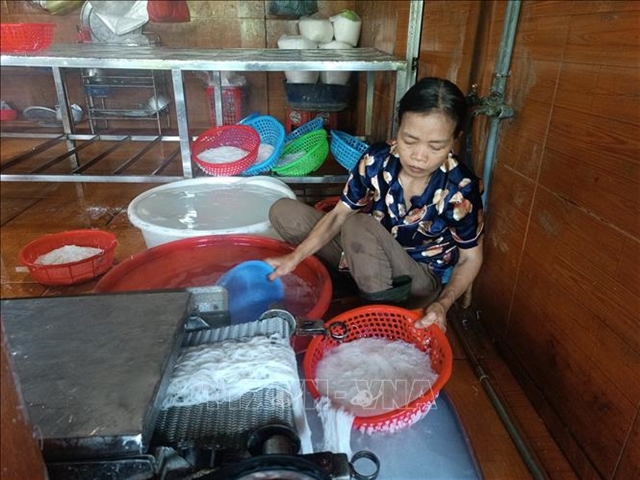
| A Vân Cù villager making rice noodles. — VNA/VNS Photo |
HUẾ CITY — Implementing Resolution 57 on breakthroughs in the development of science, technology, innovation and national digital transformation, Huế City is promoting the development of an effective connection mechanism between State management agencies, research institutions, universities, and the business community.
This is considered a solution to mobilise and bring into full play all resources of science and technology for local socio-economic development.
Traditional rice noodle villages
|
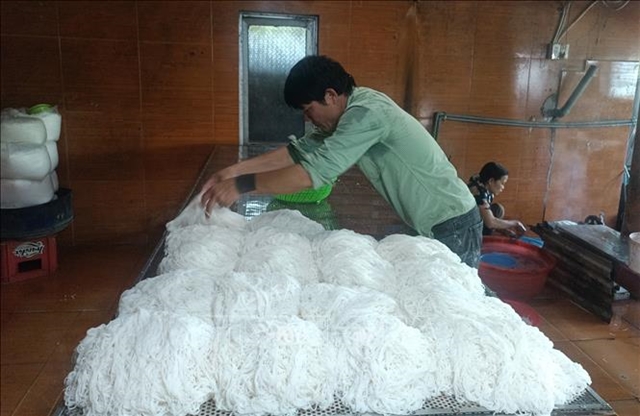
| A batch of fresh rice noodles. — VNA/VNS Photo |
The craft occupation of making rice noodles in Vân Cù Village of Kim Trà Ward is participated in by 160 households that create jobs for about 400 labourers.
What is precious is that the village's noodle-making profession is still preserved in the form of hereditary inheritance.
However, along with its achievements, the Vân Cù rice noodle-making village is facing many challenges.
Labourers under 40 account for 30 per cent of the total labourers in the village.
Moreover, the trend is that young people are no longer interested in traditional crafts.
If there is no fundamental solution to increase the income and attractiveness of the profession, the risk of a shortage of the next generation is entirely possible. Technical processes have not been standardised through scientific research, leading to product quality among households that is not really uniform and is difficult to expand in scale.
Currently, the production system is capable of meeting larger output, but in reality, it is only exploiting about 50 per cent of capacity.
Châu Viết Thành, Party secretary of Kim Trà Ward, said a hurdle that Vân Cù Village has been facing is a product preservation time of only about 24 hours, so it is difficult to expand the market.
Not to mention, most households do not have a traceability system, have not applied e-commerce systematically, and have not effectively exploited digital platforms to promote products and connect markets.
Thành hopes that scientists will research to extend the preservation time of Vân Cù vermicelli products, but still retain the traditional flavour and absolutely ensure food safety as well as complete the production process towards standardisation, and develop technical standards on raw materials, water sources, food hygiene and safety.
Along with that, the local authority wishes to support scientists to digitalise the entire value of the craft village. In particular, each product of the Vân Cù rice noodles will have a QR code to help customers know the origin and cultural stories behind the products.
'Three-party' connection
The reality in Vân Cù Village shows that for science and technology to become a driving force for development, appropriate research topics and an effective connection mechanism between the State, scientists and businesses are needed.
This is also a requirement for the implementation of Resolution 5 in Huế City.
Asso. Prof., Dr. Trương Tấn Quân, principal of Huế’s Economics University, said: “Implementing innovation in the spirit of the resolution, the management mechanism for scientific and technological activities has undergone profound changes.”
“In particular, the relationship between businesses, scientists and the government is the key to putting science and technology into practice, bringing scientific research results into reality through commercialising,” Quân said.
“This is a way for science, technology and innovation to come into reality and operate effectively,” he said.
Sharing the same point of view, Dr. Đặng Thanh Phú, vice president of the Huế Union of Science and Technology Association, said that in recent years, Huế City has continuously led the country in digital transformation.
Hue-S platform has become a popular digital infrastructure, integrating public services and interacting between the government, people and businesses on a single touch point, Phú said.
“When the two-tier government model came into operation, it was the digital platform prepared in advance that helped the city adapt quickly. Empirical evidence shows that the digital infrastructure here has reached a certain maturity,” Phú said
“With these advantages, the city should make use of the infrastructure and people’s usage habits on the Hue-S platform to integrate technological supply-demand connection,” he said.
This means businesses discuss issues, scientists offer solutions, and State agencies provide support policies, he said.
“The ‘three-party’ connection is only truly effective when ‘the weakest technology party’ – micro-sized businesses, co-operatives and traditional craft villages – is capable of joining,” said Phú.
According to Nguyễn Xuân Sơn, director of the city’s Department of Science and Technology, last year, the Law on Science, Technology and Innovation opened up new thinking for development.
In the new model, the three parties join from the beginning and accompany each other throughout the process, said Sơn.
Specifically, the State is the place to determine the problems that need to be solved, not theoretical problems, but problems stemming from local development requirements.
From those problems, scientists research the nature of the problem, apply AI, big data, digital technology and new scientific achievements to build highly applicable solutions.
And right from the early stages, businesses participate in the research process; provide feedback from the market's perspective, invest resources to perfect technology, test products, organise production and bring research results to users.
At that time, the gap between the laboratory and the market is gradually narrowed; the gap between research and economic development is also gradually eliminated.
Sơn said that to realise that linkage model, the city has built the Three-Party Platform – a digital infrastructure connecting the government, scientists and businesses in a unified innovation ecosystem.
“In the platform, the State announces the problems that need to be solved, scientists propose ideas, register for research and develop solutions, and enterprises choose suitable technologies to invest, complete and commercialise,” Sơn said.
“All information is connected on the same platform. And all opportunities for co-operation are opened openly, transparently and conveniently,” he said.
What is most important is that the platform not only connects people to people, but also connects an entire innovation value chain.
The economic value created will continue to return to investment in research, creating a continuous cycle of development between science, technology and economics.
That is also the vision that Huế is aiming for, building an open innovation ecosystem, where the government, scientists and businesses work together on a unified digital platform where data is shared, knowledge is connected, technology is developed and value is spread, the director said. — VNS
Society
 Society
 Society
 Society
 Society
 Society
 Society
 Society
 Society
 Society
.jpeg) Society
Society
 Society
 Society
 Society
 Society