 Society
Two Australian entertainment names revealed behind the scenes of Symphony of the Sea Season 3 in Phú Quốc
1.
|
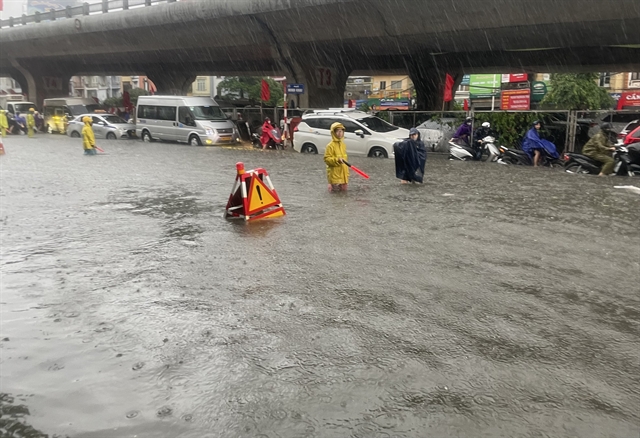
| Minh Khai Street in Hà Nội is inudated as Typhoon Kajiki causes heavy rainfall in the capital city in August 2025. — VNA/VNS Photo Trần Việt |
HÀ NỘI — How to improve Hà Nội’s water drainage system was among the key issues addressed at the mid-year working session of the capital city’s People’s Council that started on Wednesday.
Leaders of relevant departments answered questions from the council’s delegates regarding the plan for the system’s improvement, drainage infrastructure in urban areas and the effectiveness of regulating lakes, among others.
Lê Văn Đức from Group 9 asked the Department of Planning and Architecture to clarify the plans to improve the city’s drainage system as it has become outdated.
According to the capital’s drainage plan approved by the city’s People’s Council in 2012, the drainage system’s parameters were designed based on rainfall of approximately 310 millimetres over two days, which was expected to happen only once every 10 years.
“However, in recent years, there have been several extreme events when rainfall exceeds 500-600 millimetres in a single day, far beyond the system’s capacity, leading to prolonged flooding in many areas,” said Đức.
Responding to the question, Director of the Department of Planning Nguyễn Trọng Kỳ Anh acknowledged that while the plan has been adjusted and perfected over the past 13 years, the current drainage system only meets about 20 per cent of the required capacity to handle heavy rainfall that occurred recently.
Only about 20 per cent of the planned regulating lakes and drainage works in the city have been built, and only about 18 per cent of the areas planned for the lakes have been covered.
“We are coordinating with the Department of Construction to review these issues,” Anh said.
Water, wastewater drainage and ground elevation for certain areas in the city have been identified as part of the technical infrastructure planning under the Law on Urban and Rural Planning, he added.
The construction department will lead the development of this critical infrastructure, in collaboration with the planning department.
Accordingly, progress is being accelerated for 13 critical drainage works, including six regulating lakes and the renovation of the network of canals, sewers and pumping stations.
Details on the tasks and implementation roadmap are expected to be approved and publicly announced in September.
Important rivers that play a crucial role in water drainage, such as Tô Lịch, Kim Ngưu, Nhuệ and Đáy will also be renovated.
In addition, the Department of Planning has also issued a plan to implement the Capital Master Plan with a 100-year vision, in which the total area of regulating lakes in Hà Nội has been set to reach over 8,000 hectares, an increase of about 20-25 per cent compared to the previous plan.
A system of underground water reservoirs and drainage works will be built, which will further increase the city’s water drainage capabilities.

|
| The fifth working session of the 17th People's Council of Hà Nội starts in the capital city on Wednesday. — VNA/VNS Photo Trung Nguyên |
Drainage works in urban areas
Responding to a question from Trần Anh Tuấn from Group 22 regarding the completion and connection of drainage infrastructure in urban areas, Director of the Department of Construction Nguyễn Phi Thường said that the department has reviewed the infrastructure at all 52 urban and residential areas in the city.
Drainage works have been completed for 26 areas and handed over to the city, while the work for the remaining 26 areas will be completed by year-end.
Regarding the requirement for investors of these areas to complete the entire drainage system consisting of regulating lakes, pumping stations, drainage pipes, and connection points in urban areas, Thường proposed not to accept or put the areas into use until these systems are built.
Regulating lakes
Nguyễn Trung Nam from Group 18 asked the Department of Finance to clarify the effectiveness of the regulating lakes and parks that were built with the city’s budget.
“Besides the goals of water drainage and landscape creation, a clear assessment of what else this infrastructure can be used for should also be conducted to create additional resources and contribute to the city's growth,” said Nam.
Clarifying this concern, director of the finance department Nguyễn Ngọc Tú said that the department participated in the whole appraisal process for these public investments, from policy preparation to implementation.
“These projects not only reduce flooding and improve the environment but also contribute to the city’s overall infrastructure, which will help attract investment,” he said.
Besides projects implemented according to the usual plan, the city also carries out a number of urgent projects to promptly address emerging issues, which are considered based on proposals from specialised agencies and are carefully evaluated for their necessity and investment efficiency, Tú added.
The finance department pays special attention to controlling efficiency and preventing lax management of investment capital when appraising these projects, he said.
"The Department of Finance affirms that all drainage infrastructure and projects in the past have been evaluated and measured based on their contribution to the city’s budget and overall development," Tú said.
According to the Department of Construction, Hà Nội currently has 3,501 natural lakes and ponds, an increase of 337 compared to 2023, to ensure water storage and natural drainage regulation. — VNS
Society
 Society
 Society
 Society
 Society
 Society
 Society
 Society
 Society
 Society
 Society
 Society
 Society
 Society
 Society