 Society

Top Vietnamese leader meets with Belgian Senate Speaker, House President
1.
|
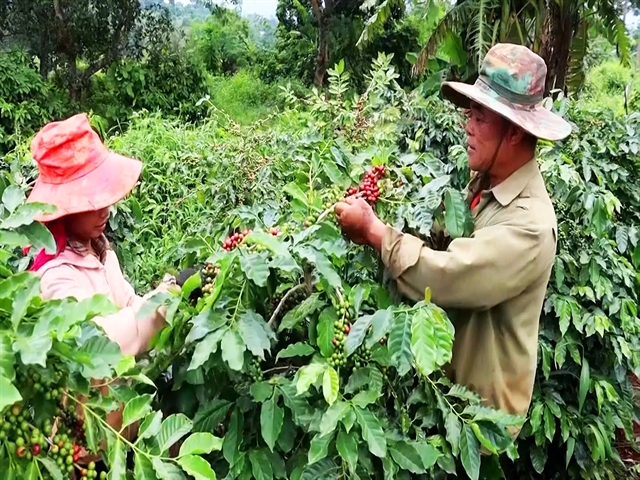
| Farmers in Quảng Trị central province harvest coffee. Farm household incomes rose 30-150 per cent after adopting regenerative practices under Nescafé Plan. — VNA/VNS Photo |
HÀ NỘI — The coffee industry is ramping up efforts to meet the EU Deforestation Regulation (EUDR), with a stronger focus on farm-level changes to cut emissions and boost traceability, industry officials said.
Experts say EUDR is both a compliance hurdle and a chance to lift the value of Vietnamese beans, with farmers central to the shift.
At a recent workshop on promoting sustainable coffee development, Phạm Phú Ngọc, director of the Agricultural Development Programme and Nescafé Plan in Việt Nam, chief representative of the Nestlé Vietnam office in the Central Highlands, said Nestlé is prioritising three areas, including EUDR compliance, shrinking its carbon footprint and rolling out regenerative farming.
Rather than deploying 17 regenerative agriculture practices at once, the Nescafé Plan programme groups them into three pillars, including soil health, efficient water use and biodiversity.
Farmers are urged to keep ground cover, limit tillage and mow instead of using herbicides – steps that improve soil fertility and water retention and lower the risk of glyphosate residues in exports to the EU and US.
The programme promotes simple tools to track soil moisture and optimise irrigation.
Nestlé is working with the Western Highlands Agriculture and Forestry Science Institute (WASI) on drought-tolerant varieties to stretch irrigation cycles to 40–60 days, potentially cutting water use by 40–60 per cent if trials succeed.
Intercropping, agroforestry and multi-layer canopies are encouraged to provide shade, stabilise microclimates, reduce pests and pesticide use, and diversify farmer incomes.
Ngọc said the aim is to build farmer capacity, not dependence. A network of about 300 farmer leaders and reference farms supports farmer-to-farmer training. Nearly 500,000 farmer attendances have been trained in sustainable methods, with household incomes up 30–150 per cent and average yields rising from about 2 tonnes to 3–3.7 tonnes per hectare.
Nestlé and WASI have supplied more than 100 million seedlings to replant over 100,000ha of ageing coffee.
Traceability push
With more than 23,000 participating households, expected to reach about 26,000 by end-2026, the Nescafé Plan programme in Việt Nam has mapped over 40,000 plot polygons to define farm boundaries and show no link to post-cutoff deforestation under EU rules.
“The mapping demands major time, manpower and cost,” Ngọc said.
Polygon data is managed on a digital platform and cross-checked with cadastral records and current land-use maps for EUDR risk assessments. End-to-end traceability now runs from farms and buying points to factories and final customers.
Tighter environmental rules worldwide mark a turning point for the coffee sector, said Tô Xuân Phúc, executive director of the Forestry Policy, Finance and Trade Programme at Forest Trends.
EUDR and net-zero targets are now urgent requirements, he said, adding that transparent supply chains, higher quality and low-emission production can strengthen Việt Nam’s market position.
Phúc said the question was no longer whether to implement the EUDR but how quickly and to what extent.
Integrating traceability, emissions cuts and regenerative farming into a single strategy would help retain EU access and build a low-emission Vietnamese coffee brand globally.
Việt Nam exported about 1.1 million tonnes of coffee in the first half of 2026, earning US$4.78 billion, according to the Ministry of Agriculture and Environment.
Volume rose 9.7 per cent but value fell 14.4 per cent as average export prices slipped to about $4,435 per tonne.
The EU takes more than 40 per cent of Việt Nam’s coffee exports, which enjoy a 0 per cent tariff under the EVFTA. — VNS
Society
 Society
 Society
 Society
 Society
 Society
 Society
 Society
 Society
 Society
 Society
 Society
 Society
 Society
 Society