 Society

Top Vietnamese leader meets with Belgian Senate Speaker, House President
1.
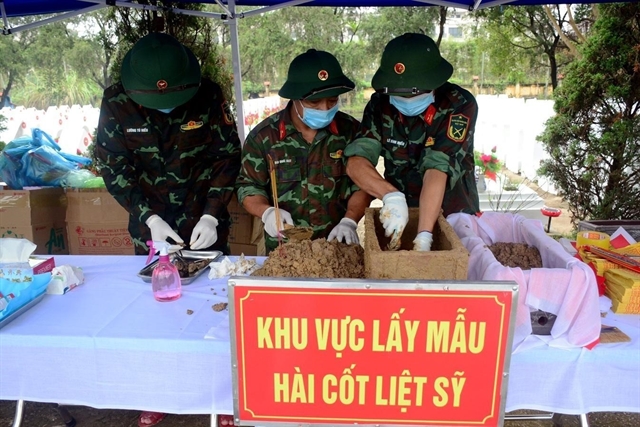 |
| Soldiers carry out DNA examination at the Hàm Rồng Martyrs’ Cemetery. — VNA/VNS Photo Khiếu Tư |
THANH HÓA — More than 1,000 unidentified war martyrs' remains at Hàm Rồng Martyrs’ Cemetery in the north-central province of Thanh Hóa are undergoing DNA identification as authorities intensify efforts to restore the identities of those who sacrificed their lives for the nation.
The provincial Steering Committee 515, responsible for the search for, recovery and identification of war martyrs’ remains, launched a campaign on Monday to collect biological samples from 1,033 unidentified remains at the cemetery for DNA analysis. The programme began with a flower and incense offering ceremony to honour the fallen heroes.
The sampling process will run from August 3 to 25. DNA analysis is expected to strengthen the national database and improve the ability to match unidentified remains with surviving relatives, gradually restoring the names of fallen soldiers while promoting Việt Nam’s enduring tradition of gratitude towards those who gave their lives for national independence and freedom.
The initiative forms part of the nationwide 500-day campaign to accelerate the search for, recovery and identification of war martyrs’ remains through DNA testing.
Hàm Rồng Martyrs’ Cemetery contains 1,943 graves, of which 1,033 remain unidentified and require biological sampling for DNA examination. To carry out the task, the provincial Steering Committee 515 has deployed eight sampling teams to work simultaneously across the cemetery, ensuring strict compliance with technical procedures throughout the collection, digital recording, documentation, sealing, preservation and transfer of samples.
The campaign has mobilised personnel from the provincial Military Command, the departments of home affairs and health, the provincial Centre for Forensic Medicine and Medical Assessment, together with local authorities. Officials said every stage of the process is being conducted scientifically and meticulously to ensure accuracy while preserving the dignity of the cemetery and the martyrs’ graves.
Each sample collected represents not only forensic evidence for DNA analysis but also renewed hope for families seeking to learn the fate of their loved ones. The remains are handled with the utmost care and preserved in accordance with regulations before being transferred to specialised agencies for examination.
According to the provincial Steering Committee 515, the campaign has so far been implemented at 17 of the 25 martyrs’ cemeteries in Thanh Hóa. Authorities have exhumed 604 of 2,955 graves, with 452 yielding samples suitable for DNA testing, while 152 were unsuitable because the remains had decomposed or become carbonised.
A total of 185 samples have been transferred to the Military Institute of Forensic Medicine, including 166 from cemeteries in Thanh Hóa and 19 from the remains of Vietnamese war martyrs repatriated from Laos.
The provincial Military Command will continue accelerating the programme at the remaining cemeteries, with the goal of completing all planned sampling in line with the roadmap under the nationwide campaign. — VNA/VNS
Society
 Society
 Society
 Society
 Society
 Society
 Society
 Society
 Society
 Society
 Society
 Society
 Society
 Society
 Society