 Society

Top Vietnamese leader meets with Belgian Senate Speaker, House President
1.
|
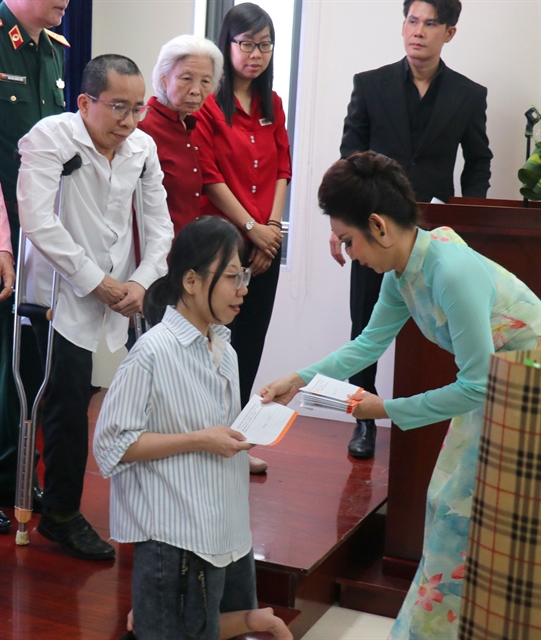
| A delegate gives gifts to Agent Orange victims in HCM City. — VNA/VNS Photo Thanh Vũ |
HÀ NỘI — Sixty-five years after the Agent Orange (AO) disaster in Việt Nam, the legacy of war still lingers. Yet from those losses, many inspiring stories have emerged – people full of resilience, compassion and a desire to serve the community.
In one spacious HCM City courtyard, a three-wheeled motorbike came to a stop. From her seat, 29-year-old Phạm Thị Thu Thủy carefully lowered both knees to the ground before nimbly making her way into the meeting room.
Few would guess that the gentle young teacher, always wearing a warm smile, is a victim of AO. She was abandoned by her mother soon after birth and grew up with severely disabled legs.
Cared for by aunts and uncles at a shelter, and by doctors and nurses at the Hòa Bình Village compassionate care centre in HCM City's Từ Dũ Hospital, Thủy considers the hospital her second home.
It was this love that gave her the strength to pursue her education with determination. After years of effort, Thủy graduated from the Faculty of Special Education at the HCM City University of Education and chose to become a teacher for autistic and disabled children.
For Thủy, teaching children with special needs requires not only a tailored lesson plan, but also patience and empathy. Every pupil is a world of their own, and teachers must closely observe their emotions, interests and ability to retain information to choose the most suitable education approach.
Looking back on the road she has travelled, Thủy sees her growth as the crystallisation of compassion. That is why she hopes to remain engaged in special education, so that she can pass on to children the resilience that she nurtured in her own life.
“Teaching is not just a job; it is also a way to pay it forward and to give more faith to children in circumstances like mine,” Thủy said.
In a similar case, Nguyễn Đức was born conjoined with his twin brother Việt, two AO victims once joined at the abdomen and pelvis. They went on to become a symbol of Vietnamese medical achievement after a historic separation surgery in 1988.
But behind that miracle were more than 10 major and minor operations, long months of treatment and Đức’s relentless struggle with the war’s aftereffects at Hòa Bình Village.
“To get the chance to study, integrate with society and have a job is a great blessing. I returned to work at Hòa Bình Village to help care for less fortunate children, in the same way I once received,” Đức said.
Beyond his work in caring for AO victims, Đức has also become a bridge for friendship exchanges between Việt Nam and Japan, founding the non-profit organisation Duc Nihon and becoming a Peace Ambassador in Japan.
After travelling to Japan more than 50 times, he has shared his story with students and international friends to illustrate the value of peace and the responsibility to preserve it.
What Thủy and Đức have in common is not only the legacy of AO, but also their choices to live positively despite difficulty and loss. One spreads love in a special classroom, while the other takes his story beyond national borders to share a message of peace.
Their stories were told at a gathering on July 28 to mark the Day for Victims of Agent Orange and the 65th anniversary of the AO Disaster in Việt Nam on August 10, organised by the HCM City Association of AO/Dioxin Victims.
Pursuit of justice
|
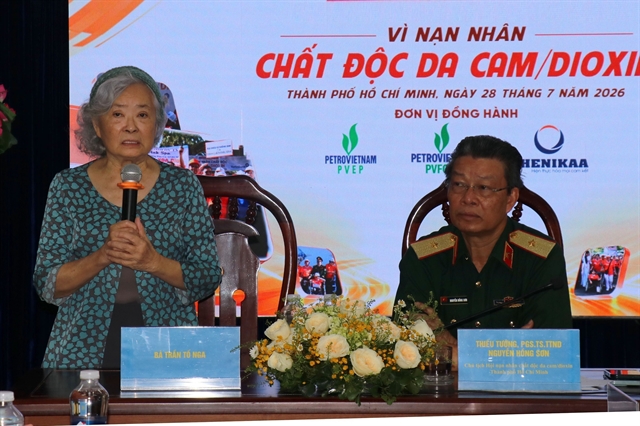
| Trần Tố Nga speaks during a meeting with Agent Orange victims. — VNA/VNS Photo Thanh Vũ |
At 85, her hair now fully white, Trần Tố Nga was once a fearless reporter for the Liberation News Agency before becoming a plaintiff in a lawsuit against chemical corporations in France.
For many years, she covered fierce battlefields such as Củ Chi, Bình Long and the Trường Sơn trail – areas heavily sprayed with chemical agents during the war. It was during that period that she and her children came to bear the consequences of dioxin in their bodies.
In 2009, she filed suit against the chemical companies that produced herbicides used by the US military in Việt Nam. Since then, the case has gone through many hearings and appeals, but for her it has never simply been a matter of winning or losing.
“I'm pursuing the journey to seek justice not only for myself, but for millions of Vietnamese AO victims. As long as I still have health, I will see it through to the end,” Nga confirmed.
Most recently, the decision by the French Court of Cassation to refer the case to the Full Court – the highest bench in the French judicial system – has been regarded by many experts as an exceptionally rare legal development.
For Nga, this is not only a positive sign for the case, but also an opportunity for the world to continue recognising the long-term consequences of AO for people and the environment.
What moved her most was the empathy of the international community.
“There are people in France, Belgium or Switzerland who do not know me, yet still send me 10 or 20 euros so that I can continue the case. The amount is not large, but it is sent in trust and solidarity, and it gives me more strength to go on,” she said.
After nearly 20 years pursuing the lawsuit, what still weighs most heavily on her heart are the people she has met along the way. She brought the case on their behalf. What she seeks is not only a court ruling, but also an awakening of conscience and responsibility towards the victims who continue to suffer the consequences of war.
If the journey to seek justice is a pledge to the past, then the dream of an 'Orange Village' is an aspiration she has entrusted to the future. For Nga, what AO victims need is a place where they can receive healthcare, rehabilitation and vocational training, and where they can work and live independently with full human dignity.
An 'Orange Village' dream
Sixty-five years after the AO disaster in Việt Nam, the consequences of war remain visible and continue to affect millions of people across generations.
According to the HCM City Association of AO/Dioxin Victims, between 1961 and 1971 the US military carried out nearly 20,000 spraying missions, releasing around 80 million litres of chemical agents over southern Việt Nam, more than 61 per cent of which was AO containing dioxin.
To date, around 4.8 million Vietnamese people are estimated to have been exposed, and millions are still living with illness, congenital deformities and long-lasting aftereffects.
Speaking at the July 28 gathering, Major General Nguyễn Hồng Sơn, chairman of the HCM City Association of AO/Dioxin Victims, said: “What we hope for is not only support for the victims, but also helping them become masters of their own lives. It is precisely the inspiring examples of AO victims that will continue to spread the spirit of overcoming hardship within the community.”
Out of that concern, the association has put forth the idea of an 'Orange Village' model with three core goals: healthcare, life and skills education, and creating conditions for victims to learn a trade, work, develop their abilities and gradually integrate into society.
“Our greatest hope is that the younger generation at home and our international friends will continue to spread a message of compassion, stand alongside the journey for justice and join hands to realise the dream of an ‘Orange Village’ – a place where no one is left behind,” Sơn said.
From Nga’s steadfast journey to the aspiration to build an 'Orange Village' for AO victims, there runs a common thread: the past must be confronted with justice, while the future must be built on compassion and solidarity.
That is also the deepest message those living with the legacy of war are sending to the community – turning pain into motivation and loss into a desire to contribute, so that no one is left behind. — VNS
Society
 Society
 Society
 Society
 Society
 Society
 Society
 Society
 Society
 Society
 Society
 Society
 Society
 Society
 Society