 Society

Top Vietnamese leader meets with Belgian Senate Speaker, House President
1.
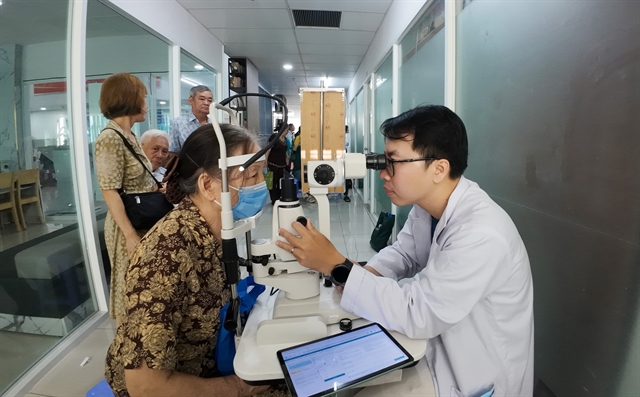 |
| Free health check-up for citizens in HCM City. — VNA/VNS Photo |
HÀ NỘI — Localities have introduced synchronised and flexible measures to address shortages of healthcare personnel, improve organisational structures and enhance the quality of grassroots healthcare services.
The move is in keeping with the spirit of the Politburo's Resolution No. 72-NQ/TW.
Central Đà Nẵng City has issued a decision to implement Resolution 72 by transferring preventive healthcare, population management and commune health station functions from regional health centres to the direct management of commune- and ward-level people's committees.
Trần Thanh Thủy, director of Đà Nẵng’s Department of Health, said the reform was intended to improve administrative efficiency while strengthening the initiative of local governments in mobilising resources.
The decentralisation would also allow the local healthcare system to respond more flexibly to community needs, thereby improving the quality of healthcare services. Đà Nẵng aimed to increase staffing to four to five doctors at each commune health station by 2027.
Meanwhile, northern Hưng Yên Province has adopted a more decisive approach to addressing the shortage of doctors at the grassroots level by reassigning more than 400 healthcare workers, including 100 general practitioners, to commune- and ward-level facilities.
Nguyễn Thị Ánh, director of the provincial Department of Health, said the move was not a temporary solution but a structural reallocation of qualified personnel to ensure that residents could access quality healthcare close to home. The province also assigned 22 general hospitals to mentor and provide direct professional guidance to local health stations.
To develop a multi-tiered, multi-polar and multi-centre healthcare system that will ease pressure on top-level hospitals, HCM City is gradually transforming regional health centres into "basic-level hospitals".
The city has dissolved 25 health centres without inpatient beds while retaining the inpatient functions of 13 regional health centres to continue providing hospitalisation and primary healthcare services.
Tăng Chí Thượng, director of the municipal Department of Health, said these basic-level hospitals would become the primary treatment facilities at the local level, providing emergency care and chronic disease management while reducing the burden on tertiary hospitals.
In remote and mountainous areas inhabited by ethnic minority communities, primary healthcare has also been strengthened through support from social organisations and volunteers.
In Trung Lý Commune of Thanh Hóa Province, for example, the Thanh Physicians Club in Hà Nội organised free medical examinations and medicine distribution for hundreds of disadvantaged residents while providing first-aid training to village healthcare workers to better protect local people during emergencies.
Alongside strengthening primary healthcare, Resolution 72 also emphasises the development of specialised medicine, scientific research, technological innovation and digital transformation to improve the quality of medical services and gradually master advanced medical technologies.
This direction was reaffirmed at the Việt Nam-France High-Level Conference on strengthening cooperation of strategic technologies and strategic technology products for the development of next-generation vaccines in Việt Nam held in Hà Nội on July 9.
National Assembly Vice Chairwoman Nguyễn Thị Thanh said the COVID-19 pandemic had demonstrated that achieving self-reliance in vaccine technology was not merely a healthcare objective but also a matter of health security, human security, and socio-economic stability.
She noted that the Politburo had adopted the strategic Resolutions No 57-NQ/TW and No. 72-NQ/TW to fundamentally shift the healthcare system from a treatment-centred approach toward proactive disease prevention while identifying next-generation vaccines as a national strategic technology product.
The National Assembly had also removed institutional bottlenecks by adopting Resolution No. 193/2025/QH15, which pilots special mechanisms and policies to promote breakthroughs in science and technology, innovation, and national digital transformation, she said.
Minister of Health Đào Hồng Lan said mastering the research and production of high-quality vaccines would require comprehensive investment in research and development, quality testing, regulatory approval and effective public-private partnership models.
The ministry was developing a list of strategic technologies and expected that cooperation among policymakers, businesses, and international organisations would foster a comprehensive, multidisciplinary approach to advancing Việt Nam’s vaccine manufacturing industry.
At the local level, many provinces have already begun translating these national strategies into concrete achievements in specialised healthcare.
In Quảng Ninh Province, the healthcare sector has exceeded central government targets by establishing 12 specialised medical centres at major hospitals.
Bùi Mạnh Hưng, director of the provincial Department of Health, said local hospitals had mastered nearly 80 per cent of the techniques used at central-level hospitals, including open-heart surgery, cardiovascular and neurovascular interventions, organ transplantation and successful treatment of extremely premature infants weighing as little as 600 grammes.
As a result, only 0.59 per cent of patients required referral to central hospitals during the first six months of 2026, among the lowest rates nationwide.
Quảng Ninh had also taken the lead in digital transformation by implementing electronic medical records across all public and private hospitals and was preparing to deploy artificial intelligence (AI) software to assist in interpreting X-ray images.
Meanwhile, free medical examination and treatment programmes continue to expand in localities including Cần Thơ, Đồng Tháp, Cà Mau and Huế.
Digital healthcare initiatives are also advancing through the Electronic Health Record integrated into the VNeID platform, enabling more systematic and unified management of medical data.
Regular health screenings allow diseases to be detected earlier, reducing financial burdens on patients and easing pressure on higher-level hospitals. These efforts represent a key strategy for building a healthier population while optimising the use of the nation's healthcare resources. — VNS
Society
 Society
 Society
 Society
 Society
 Society
 Society
 Society
 Society
 Society
 Society
 Society
 Society
 Society
 Society