 Society

SCEX completes level 4 information system security assessment, moving closer to official operations
1.
|
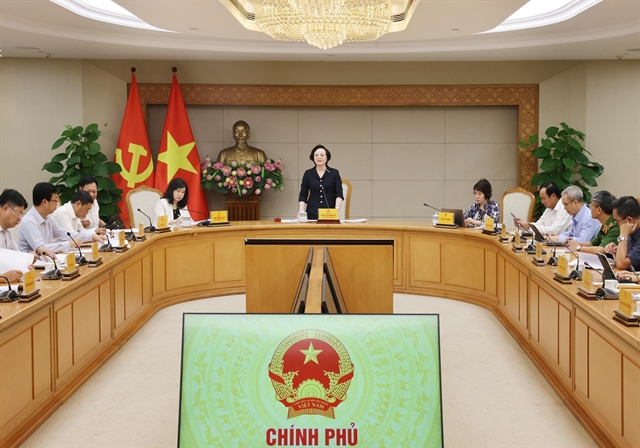
| Deputy Prime Minister Phạm Thị Thanh Trà chairs a Central Interministerial Steering Committee on Food Safety meeting on Tuesday. — VNA/VNS Photo |
HÀ NỘI — Deputy Prime Minister Phạm Thị Thanh Trà has ordered a tougher crackdown on food safety violations after Việt Nam recorded 58 food poisoning incidents in the first half of 2026 that sickened 1,573 people and killed 10.
The figure marks a jump of 23 food poisoning cases from just one year earlier, or a rise of 66 per cent.
Chairing a meeting of the Central Interministerial Steering Committee on Food Safety on Tuesday, Trà said 12 of those incidents occurred in school cafeterias, and that the number of people sickened had increased markedly.
"Schools are supposed to be the place where children get the most careful, thorough care. Violations there are putting their health at risk," Trà said, calling for firm action on the issue in the months ahead.
Deputy Minister of Health Đỗ Xuân Tuyên said the ministry inspected 118,009 food establishments and found 5,695 – or 4.8 per cent – in violation in the first half of the year. Of those, 3,772 businesses were sanctioned, and 3,571 were fined a combined VNĐ20 billion (US$762,000).
Meanwhile, agricultural regulators separately inspected nearly 3,900 farm-input and agro-forestry-fishery businesses, fining 360 of them more than VNĐ8.8 billion ($335,000).
Market surveillance forces, working with e-commerce platforms, also ordered the removal of 14,102 online storefronts and 3,798 product listings tied to counterfeit health supplements, fake functional foods and substandard milk.
Despite these numbers, Tuyên said food safety standards remained fragile and still fell short of rising consumer expectations and export requirements. Value chain production links were still weak, and food sold online remained hard to monitor because sellers and product origins were often difficult to trace, he added.
Trà credited the system with meeting many of the targets set since 2021, saying the first half of 2026 brought "clear positive shifts".
She pointed to marked improvement in public communication, which she said helped shift behaviour and raise awareness, alongside a more aggressive enforcement push with a real deterrent effect.
Particular praise was given to the Ministry of Public Security for cracking down on companies breaking food safety laws, with several enforcement metrics far outpacing last year's – in some cases by more than 200 per cent.
The deputy PM also credited the Ministry of Culture, Sports and Tourism's oversight of food advertising, the Ministry of Industry and Trade's regulation of e-commerce sales, and steady progress streamlining food safety laws.
But she also flagged several problems still standing in the way, including continued difficulty in regulating food sales and advertising on e-commerce platforms and social media, as well as a shortage of staff and funding at the commune level that leaves local governments ill-equipped to manage food safety in their areas.
Trà urged ministries and agencies to treat food safety as a driver of economic development and a key factor in national competitiveness. It was not an issue for the health ministry alone, but a responsibility for the entire political system, she said.
As for dividing up responsibility, she said the central Government should focus on building institutions, policy and strategy, while local governments handle implementation and day-to-day management, with provincial and commune-level chairs held primarily accountable.
Consumer trust should be the ultimate measure of success, according to Trà.
The Government leader backed a proposal for a national communication campaign on food safety and called for scaling up grassroots self-management models, including a 'whole population says no to unsafe food' push and a '5 No's, 3 Clean, 3 Secure' household initiative, by folding them into existing national target programmes.
Trà also handed down a round of follow-up assignments.
The Ministry of Health is to finish drafting a revised Food Safety Law and propose a training programme for provincial- and commune-level officials; the Ministry of Justice and other agencies are to review related laws to clear bottlenecks; and local authorities are to move aggressively to prevent further school poisoning incidents.
The Ministry of Health and the Ministry of Agriculture and Environment are to build a shared national food safety database tracking products from farm to table, while the Ministry of Finance is to help ensure commune-level governments have adequate annual budgets for basic oversight.
The deputy PM also directed the Ministry of Public Security to intensify its crackdown on counterfeit, imitation and substandard goods, particularly food products, and told the Ministry of Health to focus inspections on schools, street food vendors and small food service operators in rural areas. — VNS
Society
 Society
 Society
 Society
 Society
 Society
 Society
 Society
 Society
 Society
 Society
 Society
 Society
 Society
 Society