 Society
Thầy Thím Temple Festival honours coastal heritage
1.
|
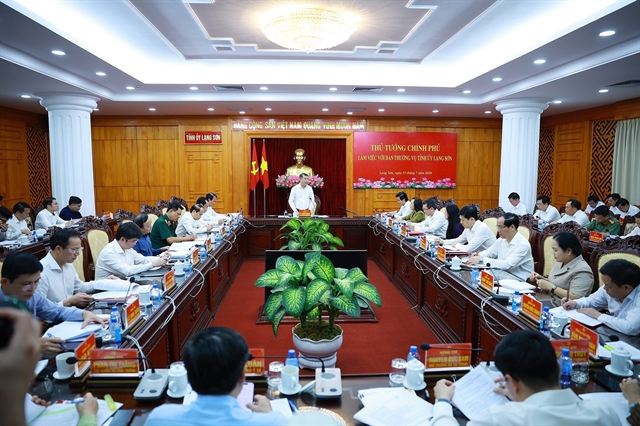
| Prime Minister Lê Minh Hưng speaks at the working session to review Lạng Sơn's socio-economic performance for the first half of 2026 on Wednesday. — VNA/VNS Photo |
LẠNG SƠN — Prime Minister Lê Minh Hưng told officials in the northern border province of Lạng Sơn on Wednesday that its economy needs a broader base that leans less on cross-border trade and more on industry and tourism.
PM Hưng made the point during a working session with the Standing Board of Lạng Sơn's provincial Party Committee to review the province's socio-economic performance for the first half of 2026.
The province's first-half numbers were headlined by rapid growth in trade and revenue. Import-export turnover through its border crossings hit US$57 billion, up a sharp 42 per cent from a year earlier and equal to 11 per cent of Việt Nam's total trade volume.
Provincial fiscal revenue topped VNĐ15 trillion ($571 million), or 112 per cent of the full-year target – the first time any Vietnamese locality has hit its annual budget-collection goal six months ahead of schedule, and a first for Lạng Sơn.
Public investment disbursement reached 39 per cent of the annual plan, placing the province 13th nationally among Việt Nam's 34 provinces and cities, above the national average.
Officials also pointed to progress on the Hữu Nghị–Chi Lăng Border Gate Expressway and a network of 11 boarding schools for border communes, four of which are due to complete their first phase of construction by August 30.
They said the province had unblocked 77 of 104 stalled projects, transitioned smoothly to the new two-tier local government model and finished eliminating substandard housing, handing over 1,340 new homes.
They also said the province had mounted a vigorous push, as part of a nationwide 500-day campaign, to locate, recover and identify the remains of soldiers killed during the wars.
Deputy Finance Minister Nguyễn Đức Tâm said Lạng Sơn's budget surge came almost entirely from border trade rather than a broader tax base, leaving the province's economy unbalanced and exposed to swings in cross-border commerce.
Hitting the full-year growth target of 10.6 per cent, he said, would require growth above 13 per cent in the second half alone – a high requirement, he added, given that construction activity is currently running well behind last year's pace.
Deputy Minister of Industry and Trade Phan Thị Thắng urged the province to get more value out of the land around its border crossings, converting a share of the goods that currently just pass through into local processing and packaging operations before they're exported.
|
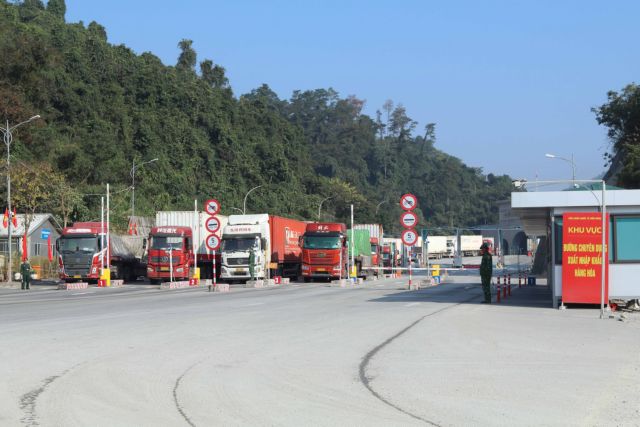
| Trucks carrying export goods queue at the Hữu Nghị International Border Gate in the northern province of Lạng Sơn. — VNA/VNS Photo |
She called for investment in high-tech cold storage, irradiation facilities, inspection and testing centres and preliminary processing plants at the gates, arguing that better logistics and warehouse infrastructure would diversify the local economy and give Lạng Sơn's exports an edge.
PM Hưng, for his part, was more direct in his assessment.
Lạng Sơn's economy, he said, remains too dependent on border trade, gate-related services and other low-value activities; it has few high-quality tourism offerings to speak of; and its industrial base still leans on mining and construction materials rather than higher-value manufacturing.
He also singled out the province's slow pace of administrative reform as a real obstacle to investment, noting Lạng Sơn ranks near the bottom nationally on administrative efficiency measures.
Looking ahead, the Government leader told the province to turn its targets into concrete action plans and push for 10.6 per cent growth this year, built around a development model that plays to its strengths as a border province.
"Lạng Sơn needs to focus on attracting industrial and tourism projects and get them moving quickly," Hưng said.
He called for fast implementation of the province's newly approved master plan, organised around what he called 'one development axis, two economic corridors and three socio-economic regions,' alongside updated urban and rural planning.
He also told officials to review existing industrial-cluster plans as a basis for attracting new investment, and to run targeted investment-promotion campaigns aimed at both domestic and Chinese investors.
On infrastructure, the Government chief pressed for faster disbursement of public investment funds, with a target of 100 per cent by the end of 2026.
He flagged more than VNĐ1 trillion ($38 million) in carried-over funds that remain just 13 per cent disbursed, and called for priority funding for strategic transport links – the Hữu Nghị-Chi Lăng, Lạng Sơn-Thái Nguyên and Lạng Sơn-Tiên Yên Expressways, plus the planned standard-gauge railway linking Hà Nội and Đồng Đăng.
PM Hưng also directed the province to carry out Politburo Resolution 57 and turn tourism into a pillar industry, tied to the UNESCO Lạng Sơn Global Geopark, the Mẫu Sơn National Tourism Area and the province's distinctive border-tourism attractions. — VNS
Society
 Society
 Society
 Society
 Society
 Society
 Society
 Society
 Society
 Society
 Society
 Society
 Society
 Society
 Society