 Society

Việt Nam has five Halal certification bodies recognised by Malaysia
1.
.jpeg) |
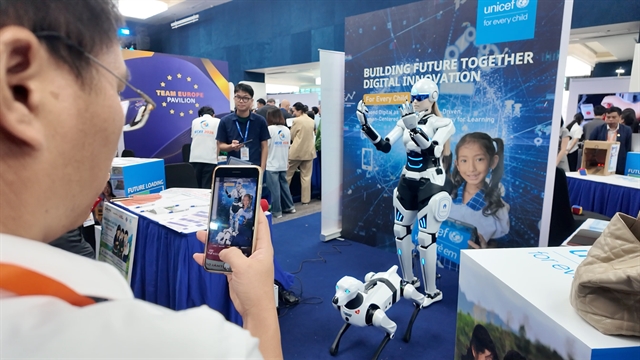
| Delegates learn about new technological solutions at a digital transformation event recently held in HCM City. The city aims to allocate 4.2 per cent of its budget to boost the data economy and innovation. — VNA/VNS Photo |
HCM CITY — HCM City is drafting a comprehensive set of policies aimed at establishing a science and innovation hub, expanding smart city initiatives, and accelerating the data economy to drive sustained double-digit economic growth.
The plans were outlined at a review conference held on July 15 by the municipal Steering Committee for Science, Technology, Innovation, and Digital Transformation to assess progress in the first half of 2026 and set priorities for the second.
Aligned with the Urban Development Bill, the package will focus on creating a dedicated science, technology, and innovation zone.
It will introduce tax incentives for businesses, scientists, and technology experts, expand support for innovative start-ups, promote the commercialisation of research, and complete the legal framework for venture capital funds.
The city government said the measures are intended to remove institutional bottlenecks and mobilise both public and private resources.
To support these ambitions, it has earmarked VNĐ12.7 trillion (US$483.6 million) for science, technology, innovation, and digital transformation in 2026, equivalent to 4.2 per cent of its total budget.
This includes VNĐ9.5 trillion (US$361.7 million) for recurrent spending and VNĐ3.2 trillion ($121.8 million) for capital expenditure.
Growing start-up, technology ecosystem
Nguyễn Mạnh Cường, vice chairman of the People's Committee, said the city completed 183 of the 290 tasks assigned by the central Government and its own steering committee in the first half of the year, with no overdue assignments.
All communes have completed the procurement of information technology infrastructure to standardise government operations.
The city ranks second nationwide in the Provincial Innovation Index and has entered the world's top 100 start-up ecosystems for the first time, climbing 12 places from 2025 and reaching that target four years ahead of schedule.
Its start-up and innovation ecosystem is now valued at about $7.5 billion, the largest in Việt Nam.
 |
| Nguyễn Mạnh Cường, vice chairman of the HCM City People’s Committee, presents a summary report at the review conference of the municipal Steering Committee for Science, Technology, Innovation, and Digital Transformation on July 15. — Photo www.sggp.org.vn |
The city has also launched a strategic technology development plan covering nine technology sectors and 26 products.
It has already set up a comprehensive database tracking research capacity and human resources in key fields such as artificial intelligence, semiconductors, robotics, cloud computing, biotechnology, and cybersecurity.
It has established a venture capital fund as a joint-stock company with charter capital of VNĐ500 billion ($19 million), to be increased to VNĐ5 trillion ($190.4 million).
Infrastructure, data economy boost
The city has attracted more than $1.4 billion in foreign investment in high-tech, including hyperscale data centres by Starmason and Evolution.
Digital infrastructure is also expanding rapidly.
The city now has more than 8,500 5G base stations, or 22.5 per cent of the country’s total number, which provide coverage to more than 95 per cent of its population.
The country's first dedicated private 5G network is being trialled at the Quang Trung Software Park.
Authorities are planning to invest more than VNĐ3 trillion ($115 million) to upgrade data centres, shared digital platforms, intelligent operations centres, and cybersecurity facilities, and develop a master plan for an integrated camera platform.
Under national digital transformation programmes, the city has issued more than 8 million citizen identity cards, covering 98.2 per cent of eligible residents, and activated more than 7 million electronic identity accounts.
Six of its 13 priority databases, including those for land administration and civil registration, are now fully operational.
To ensure long-term sustainability, it is promoting a three-way partnership linking government, universities, and businesses.
Human resource development also remains a priority. More than 10,400 civil servants received digital skills training in the first half of 2026, while 5,947 community digital technology teams supported digital literacy programmes at the grassroots level. — VNS
Society
 Society
 Society
 Society
 Society
 Society
 Society
 Society
 Society
 Society
 Society
 Society
 Society
 Society
 Society