 Society

Việt Nam Film Pavilion opens at Busan film market to boost international cooperation
1.
|
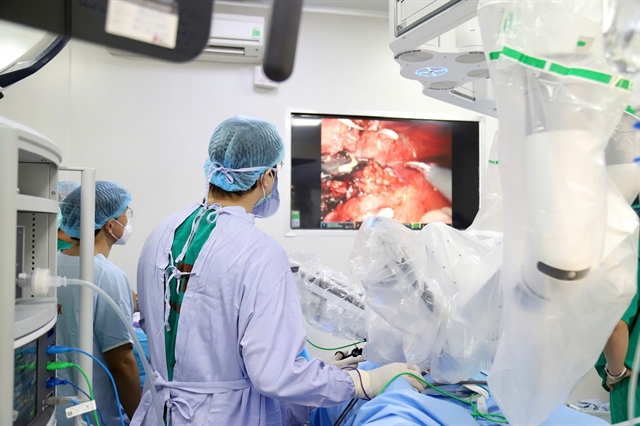
| A surgical team performing a laparoscopic operation for esophageal cancer at K Hospital. — Photo courtesy of the hospital |
HÀ NỘI — The National Cancer (K) Hospital has launched a basic robot-assisted surgery training course for a large number of surgeons from hospitals nationwide.
This is the first training course in Việt Nam designed to cover robotic surgery for the treatment of cancers across multiple specialties, including gastroenterology, urology, gynaecology, head and neck and thoracic surgery.
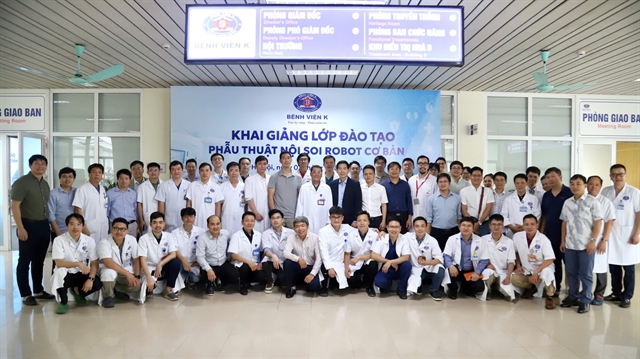
The course features a comprehensive curriculum and brings together leading domestic and international experts to standardise skills and provide updates on the latest advancements in robotic cancer surgery. Taught by leading local and international experts in surgical oncology, the training is attended by doctors from cancer treatment facilities across the country.
Professor Dr Lê Văn Quảng, director of K Hospital, said that robot-assisted laparoscopic surgery is considered the pinnacle of modern surgical technology. This technique builds upon the advantages of traditional laparoscopic surgery while overcoming many of its limitations, enabling surgeons to perform complex manoeuvres with greater precision.
“Organising this training course plays a vital role in updating knowledge, enhancing professional expertise and promoting the effective application of advanced techniques in cancer treatment. As a leading specialised oncology hospital, K Hospital identifies the development of highly skilled workers and the transfer of medical techniques as key priorities in improving the quality of patient care,” Dr Quảng said.
During the training course, participants directly observed a robot-assisted laparoscopic surgery for oesophageal cancer under the guidance of Associate Professor Dr Lâm Việt Trung, deputy director of Chợ Rẫy Hospital in HCM City.
The procedure was performed collaboratively by surgical teams from K Hospital and Chợ Rẫy Hospital, enabling participants to gain insight into the implementation of robotic techniques in clinical practice.
The patient, 62-year-old M.V.T. from the central province of Thanh Hóa, was admitted due to persistent dysphagia. Endoscopy revealed a large, necrotic ulcerative lesion occupying approximately half the circumference of the lower oesophagus. Biopsy results confirmed a diagnosis of oesophageal squamous cell carcinoma.
|
| Lectures and trainees participating in the basic robot-assisted laparoscopic surgery training course. — Photo courtesy of the hospital |
During the surgery, the team performed an oesophagectomy and radical lymph node dissection using the 11th-generation Da Vinci robotic system. The surgeons completely removed the tumour and dissected lymph nodes along both recurrent laryngeal nerves without damaging critical neural and vascular structures.
Dr Trung said that oesophageal cancer surgery is one of the most challenging surgical procedures, as it requires simultaneous intervention in both the thoracic and abdominal cavities, with the surgical site located in proximity to the heart, major blood vessels, and other vital structures.
“Robotic surgery helps overcome the limitations of open surgery and conventional laparoscopy by offering flexible access within confined spaces, as well as precise and stable manoeuvrability,” said Dr Trung.
The robotic system provides high-resolution 3D imaging, enabling surgeons to clearly visualise anatomical structures and distinguish the boundaries between cancerous and healthy tissue following chemoradiotherapy.
Robotic arms offer flexible manoeuvrability, facilitating precise tumour dissection and thorough lymph node clearance while minimising the risk of injury to the recurrent laryngeal nerve and major blood vessels, according to Dr Trung.
In addition to its oncological efficacy, robotic surgery reduces blood loss and post-operative pain, shortens hospital stays and facilitates a quicker recovery, allowing patients to resume normal eating and daily activities sooner.
Experts said that combining preoperative chemoradiotherapy with robotic surgery is paving the way for personalised treatment approaches for cancer patients, enhancing the potential for curative treatment while maximising the preservation of quality of life.
Through the training programme, K Hospital has reaffirmed its leading role in training, technology transfer and the application of modern surgical technologies, helping to enhance the professional capabilities of surgeons, foster the development of robotic surgery in Việt Nam and expand access to advanced treatment techniques for cancer patients. — VNS
Society
 Society
 Society
 Society
 Society
 Society
 Society
 Society
 Society
 Society
 Society
 Society
 Society
 Society
 Society