 Society

AI and EV Boom Draws $690 Million in Advanced Materials Investment Plans to Thailand
1.
|
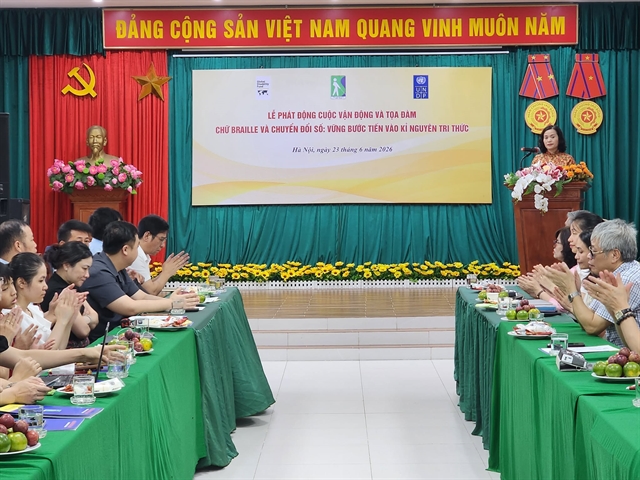
| The seminar on Braille literacy and digital transformation on Tuesday. — VNS Photo Lê Việt Dũng |
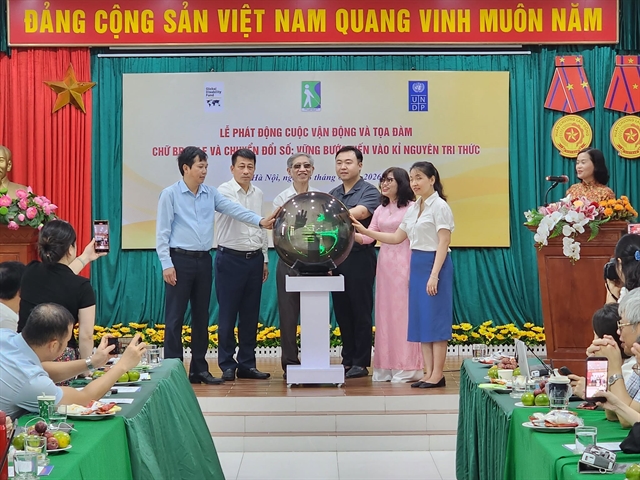
HÀ NỘI — The Vietnam Blind Association launched a national campaign on Tuesday to promote Braille literacy alongside digital technology adoption, framing the two as complementary tools rather than competing alternatives for the visually impaired.
The campaign, titled 'Braille and Digital Transformation: Confidently Stepping into the Era of Knowledge', was unveiled at a seminar of the same name attended by Vietnamese officials and international representatives participating via videoconference.
"Braille has long been a symbol of intellectual empowerment, the right to education and the independence of visually impaired people," said Vietnam Blind Association Vice President Đinh Việt Anh in her opening remarks.
"It is precisely the combination of Braille's enduring foundation and the achievements of modern technology that is creating greater conditions for visually impaired people to advance on their journey of knowledge and self-development."
Presenting the campaign plan, Anh traced Braille's more than 200-year history as the foundational tool through which blind people access information, develop critical thinking and achieve self-reliance. She argued that the rise of digital technology and artificial intelligence had not diminished that role, but expanded it.
"Digital technology does not replace Braille; it supplements and accompanies it, helping visually impaired people develop their abilities, confidently integrate into society and contribute to the community," she said.
The association set concrete targets for the drive: a full rollout across all 34 provinces and cities, mandatory Braille proficiency and basic digital skills for all key association officials at every level, and a 20 per cent increase each term in the number of members participating in training classes.
|
| Organisers touch a ceremonial orb to launch the campaign. — VNS Photo Lê Việt Dũng |
The campaign's broader objectives include promoting lifelong learning, strengthening digital skills and improving members' capacity to adapt to modern society.
It has been launched as a response to a global push by the World Blind Union and the International Council on Education of People with Visual Impairment, whose joint campaign operates under the banner 'More Braille, More Empowerment'.
Việt Nam's campaign also aims to support efforts to get UNESCO to recognise Braille as an intangible cultural heritage of humanity, and aligns with the Government's national digital transformation agenda.
President of the World Blind Union Santosh Kumar Rungta addressed the seminar online and pushed back against what he called a growing but mistaken belief that technology has made Braille obsolete.
Invoking Helen Keller, who described Braille as a liberator and a key to unlocking the prison of darkness, Rungta said the script remains indispensable for reading, writing, communication and employment. He challenged the notion that audio technology and computers could substitute for Braille, drawing a direct analogy to mainstream education.
He cited the United Nations Convention on the Rights of Persons with Disabilities, arguing that denying visually impaired children access to Braille literacy constitutes prohibited discrimination.
"If a sighted child has the right to read and write in ink, we have the right to read and write in Braille," he said.
Rungta said refreshable Braille displays and embossers have made the script more accessible in digital form, but noted that hard-copy Braille remains costly and not always widely available.
He outlined three areas the World Blind Union is prioritising: advocacy to make Braille mandatory in schools and inclusive education settings, information sharing among member countries on availability and accessibility, and research into how digital transformation and Braille can advance in tandem.
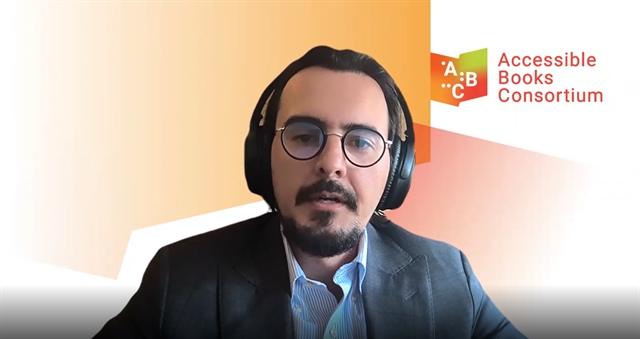
Santiago Streeter, representing the Accessible Books Consortium, the operational arm of the WIPO-administered Marrakesh Treaty, described the treaty's dual mandate: allowing authorised entities to produce accessible-format copies of literary works and permitting cross-border exchange of those copies for the benefit of print-disabled readers.
|
| Santiago Streeter, representing the Accessible Books Consortium, addresses the seminar via videoconference. — VNS Photo Lê Việt Dũng |
Established in 2014, the consortium's global catalogue now includes more than 150 participating authorised entities and nearly 1.2 million titles in 80 languages, among them over 100,000 digital Braille titles and 17,000 Braille music scores.
Streeter said the consortium also trains partner organisations in accessible book production and works to embed accessibility into publishers' digital workflows from the outset.
He noted that the Vietnam Blind Association, with support from an Australian government-funded project, is nearing completion of 100 digital books in accessible formats and 150 copies in printed Braille for distribution to print-disabled students nationwide.
"The students who will read these books in Braille or through a screen reader are living proof that a more inclusive world of knowledge is being built right now, here in Việt Nam," Streeter said.
Phạm Vĩnh Thái, editor-in-chief of the Vietnam Education Publishing House, said the publisher is converting printed textbooks to accessible e-books free of charge, in line with provisions in the Ministry of Education and Training Circular 22 that emphasise digital technology as a support mechanism for visually impaired learners.
He said the publisher has collaborated with major data firms to ensure the e-books remain fully free of charge.
Three textbook series – 'Connecting Knowledge with Life', 'Creative Horizons' and 'Kite' – have already been converted to Braille for use in major cities including Hà Nội, Đà Nẵng and HCM City, Thái said, adding that the publisher is prepared to expand the work under the new ministerial directive.
The seminar concluded with an awards ceremony for a presentation competition titled 'The Journey of Conquering Knowledge, Reaching for the Future'. — VNS
Society
 Society
 Society
 Society
 Society
 Society
 Society
 Society
 Society
 Society
 Society
 Society
 Society
 Society
 Society