 Society

SBV to curb property price inflation, enforce lending rate rules
1.
|
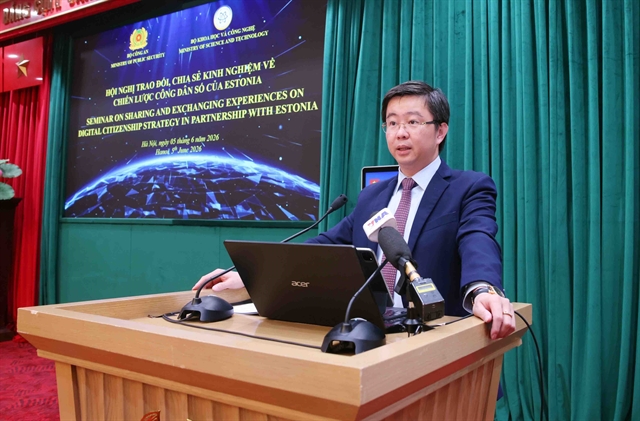
| Deputy Minister of Science and Technology Bùi Hoàng Phương speaking at the event. — VNA/VNS Photos |
HÀ NỘI — The Ministry of Public Security, in coordination with the Ministry of Science and Technology, hosted an international seminar in Hà Nội on Friday to exchange experiences on digital citizenship strategy in partnership with Estonia as Việt Nam is advancing towards a digital government, digital economy and digital society.
Addressing the event, Deputy Minister of Science and Technology Bùi Hoàng Phương said Việt Nam has made significant progress in national digital transformation within a relatively short period.
He noted that the country has established a relatively comprehensive digital legal framework while digital infrastructure, national databases and digital identity platforms have been steadily developed. Citizens, businesses and state agencies are increasingly adopting digital technologies, particularly strategic ones such as artificial intelligence and big data.
The Government has also introduced many mechanisms and policies to attract high-quality information technology professionals, including overseas Vietnamese and foreign experts, to support the country’s digital transformation efforts.
However, Phương stressed that people remain the central factor in the process.
“A digital government can only be truly efficient when citizens actively use public services," he said, adding that a digital economy can only grow when people and businesses participate in economic activities in the digital environment, and a digital society can only take shape when digital skills and digital interactions become part of everyday life.
For that reason, Việt Nam has identified the development of digital citizenship as a core component of its national digital transformation agenda.
Despite notable achievements, he acknowledged challenges, including gaps between policy and implementation, infrastructure investment and the value generated from such infrastructure, as well as public trust in digital services.
Digital transformation, the official said, is not simply about digitising old processes but about creating new ways of working through technology to deliver greater efficiency.
Phương expressed his belief that Estonia’s experiences would provide valuable insights for Việt Nam, given the European nation’s global reputation as a pioneer in digital government and digital citizenship.
|
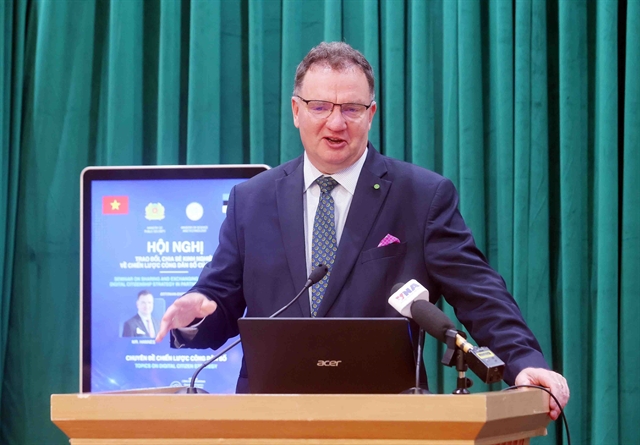
| Hannes Astok, Executive Director and Chairman of the Management Board at the Estonian e-Governance Academy. |
Sharing Estonia’s experiences, Hannes Astok, Executive Director and Chairman of the Management Board at the Estonian e-Governance Academy, shared his country’s journey in building a digital government, digital society and digital citizenship ecosystem.
Estonia, he noted, also faced challenges related to digital identity, data access and social media, eventually concluding that the Government and its agencies are best positioned to provide secure and reliable electronic identity systems.
A report presented at the conference showed that Việt Nam and Estonia share similar approaches to digital citizenship development, placing citizens at the centre of digital transformation and using electronic identity systems and resident databases as foundations for online public services and digital transactions.
However, Estonia has advanced further in creating an integrated digital ecosystem where data is automatically shared among agencies under the “once-only” principle, meaning citizens only need to provide information once.
The Estonian experience also shows that digital citizenship is not solely a technological issue but one involving governance, public trust and digital culture. The country places strong emphasis on personal data protection, digital literacy, universal internet access and the routine use of online services.
Experts suggested Việt Nam continue developing interconnected data platforms, reducing data fragmentation among agencies, strengthening personal data protection, improving digital skills and enhancing public confidence in online transactions. They also recommended expanding VNeID into a multi-service platform beyond electronic identification.

|
| Sen. Lieut. Gen. Nguyễn Văn Long, Deputy Minister of Public Security. |
Concluding the conference, Sen. Lieut. Gen. Nguyễn Văn Long, Deputy Minister of Public Security, described Estonia’s practical experiences as a valuable source of reference for Việt Nam in developing and refining its national digital citizenship strategy.
He called on the two countries to strengthen cooperation through training programmes and workshops on digital citizenship, data governance, electronic identification, cybersecurity, and digital government development. He also suggested Estonia continue sharing expertise in building and operating common digital platforms, databases and data sharing mechanisms while increasing expert exchanges and joint research to support Việt Nam's digital transformation efforts. — VNA/VNS
Society
 Society
 Society
 Society
 Society
 Society
 Society
 Society
 Society
 Society
 Society
 Society
 Society
 Society
 Society