 Society

ECO Expo Asia opens at Hong Kong AsiaWorld-Expo in late October
1.
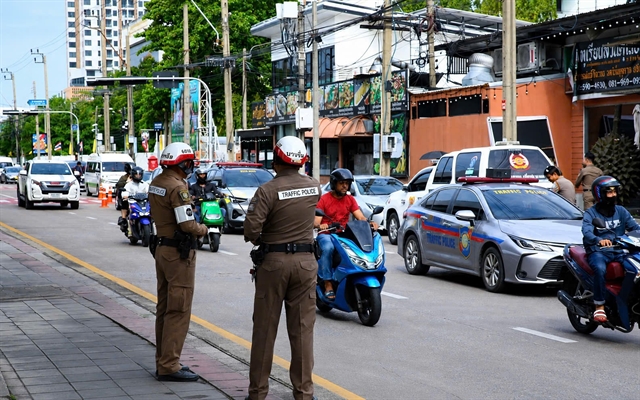 |
| Police on duty on a street in Bangkok, Thailand. — XINHUA/VNA Photo |
HÀ NỘI — “My name is Hara Y Siêu. I am an ethnic Ede man from Phú Yên Province. I came to Thailand in 2019,” Y Siêu began, recounting a migration journey driven by dreams of changing his life seven years ago.
In 2019, attracted by promises, persuasion and images on Facebook portraying the relaxed, comfortable life of the Ede community in Thailand, as well as the prospect of onward travel to a third country, Y Siêu, 29, decided to take his two young children and his wife, who was pregnant with their third child, and leave Sông Hinh in Phú Yên Province (now part of Đắk Lắk Province following an administrative merger) for the so-called promised land of Thailand.
After saving more than VNĐ40 million (US$1,500), Y Siêu handed the money to a group of brokers so his family could be smuggled overland through Cambodia into Thailand and then taken to Bang Yai District in Nonthaburi Province, which had been presented as a place where members of the Ede community lived.
However, once in Thailand, Y Siêu discovered that reality was far removed from the rosy picture presented online. The promises of leaving home to change one’s destiny proved false. His family soon learned the hardships of living without documents and of being undocumented migrants.
With no contacts and no work, they lived in constant fear of arrest by local authorities for illegal residence and of being fined. Their existence was precarious, confined to a cramped rented room housing five family members.
Y Siêu said that after five months in Thailand, he managed to find work as a porter, but in some months, he was called to work only seven or eight days.
On days without work or income, he had to go to a temple to ask for food for his wife and three children.
Although he later obtained a refugee card, his wife was arrested by Thai police last year for illegal residence and spent several months in an immigration detention centre (IDC) before being released on bail, subject to monthly check-ins with the authorities.
Obey the laws
Speaking to Vietnam News Agency reporters in Bangkok, Pastor Pornchai Kamosin, who has provided legal assistance to many Vietnamese ethnic detainees in Thailand, said Thai authorities had stepped up operations targeting foreigners residing illegally and those working unlawfully, making bail extremely difficult to obtain.
Having met many detained Vietnamese ethnic people in IDCs, Pastor Pornchai said numerous cases involved people who had been lured or deceived into coming.
“I understand that each person who comes here must pay the guide around 5,000 to 6,000 baht ($150-180) and there are additional expenses along the route,” he said.
“Those who recruit will deceive ethnic people with promises that life here will be more comfortable, that there will be work and money to spend and that they will be able to go to a third country. But reality is different. People spend money to get here and then find no work, no money to live on and no comfort at all. They cannot even pay the rent, so how can they support their wives and children? Once here without money or work, they do not know how they will survive,” he said.
Pastor Pornchai advised Vietnamese people considering travelling to Thailand, especially those of faith, that God teaches people to obey the laws of the country in which they live and that Vietnamese citizens must obey Vietnamese law.
If they were faithful and worshipped God, he said, people should remain in Việt Nam rather than heed inducements to come and live in Thailand illegally.
He added that the United Nations High Commissioner for Refugees (UNHCR) was now rarely issuing refugee cards. Many people who have stayed in Thailand for three or four years still have not received refugee status and, when arrested, cannot secure bail.
Recently, Thailand has tightened border controls and stepped up efforts to intercept illegal entries amid intensified activity by cross-border scam networks seeking to smuggle people into the country via informal routes, particularly as several countries in the region increase crackdowns and prosecutions targeting online fraud gangs.
The Thai government has also intensified campaigns against illegal migrant labour, arresting and deporting foreigners residing unlawfully.
Thanks to public awareness efforts by authorities through social media outreach, engagement with relatives and community figures and measures to address difficulties and concerns, many Vietnamese ethnic people in Thailand, including Y Siêu, have come to realise they were deceived by individuals who encouraged them to leave their homeland.
Fleeing abroad under such inducements is misguided and runs counter to the interests of the individual, their family and their community.
After seven years of living as undocumented and insecure migrants, Y Siêu's only wish now is to return to Việt Nam, particularly after learning that those who request repatriation receive assistance from Vietnamese authorities in completing the necessary procedures to return legally.
Y Siêu said his parents and siblings back home had raised funds to buy plane tickets for his family of five to return.
Vietnamese authorities are also providing support to help people like him return to their homeland, families and country.
“I want to tell everyone who may be thinking of coming here to reconsider. I’ve lived here for seven years and it has been very hard,” Y Siêu confessed.
“I feel that you should not come here; I really regret coming. Home is best. Staying and making a living at home, developing at home, is the best thing.” — VNS
Society
 Society
 Society
 Society
 Society
 Society
 Society
 Society
 Society
 Society
 Society
 Society
 Society
 Society
 Society