 Society

Agoda Makes Bangkok Its Largest Office Worldwide, with More Than 4,500 Staff
1.
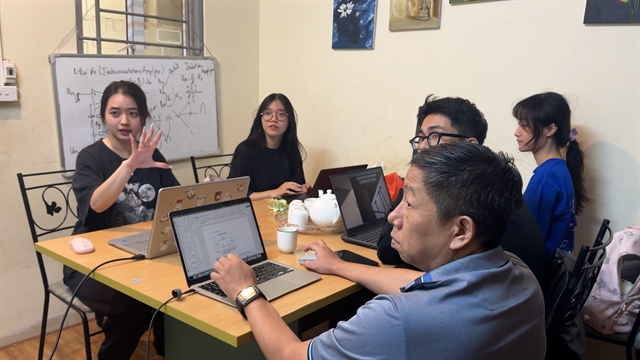 |
| A group of students presents their project progress to Dr Kiên at his home laboratory in Hà Nội. VNS Photo Lê Hương |
By Lê Hương
Every Saturday afternoon, a modest three-storey house tucked away in a narrow alley in Hà Nội springs to life.
On the second floor, groups of students squeeze into a room measuring less than 10 square metres, taking turns to present project updates and discuss technical challenges. Downstairs, the hum of 3D printers, soldering irons and animated conversations fills the air.
It is not a state-of-the-art laboratory at a university or research institute. Yet for nearly two decades, the house has served as a second home for generations of students from Hà Nội University of Science and Technology (HUST) — a unique innovation workshop where ideas are nurtured, failures are embraced and scientific ambitions begin to take shape.
For Dr Nguyễn Phan Kiên, Vice Director of the Institute of Health Science and Technology at HUST, it all began quite naturally.
“It was probably around 2008 or 2009. I had a lab at the university, but after completing my PhD, I loved building things, so I brought some of the equipment I had invested in back home for my own research. Students started coming over, they liked it and they kept coming. I guided them and provided the tools they needed,” he said.
What began as a small personal workspace gradually evolved into a student laboratory. The ground floor was converted into a technical workshop, a separate room housed 3D printers and mechanical equipment and the second floor became a venue for meetings, presentations and project discussions.
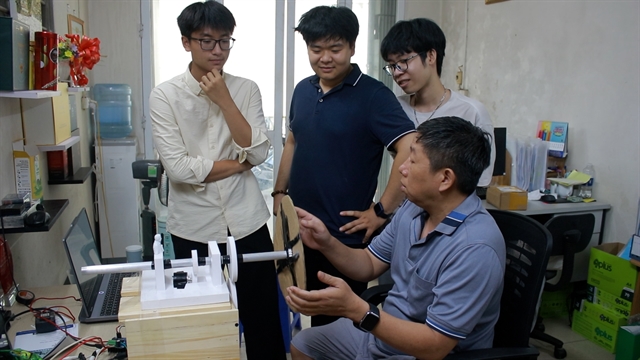 |
| Dr Kiên works with another group of students on their research project at his home laboratory in Hà Nội. VNS Photo Lê Hương |
“Engineering is addictive. Students want a comfortable and flexible space to work. That’s why they come here. If they need something, they can use it. I can keep the place open whenever necessary. If they want to stay overnight, they can. Sometimes they do,” he said.
Over the years, students from generations K43 to K69 at HUST have passed through the small house. Many have gone on to become engineers, researchers, entrepreneurs and specialists working at major hospitals across the country.
Yet for Dr Kiên, the true measure of success is not patents or awards.
“To me, every invention is a life lesson. Students only understand the value of learning when they get to build something real, make genuine mistakes and fix them themselves.”
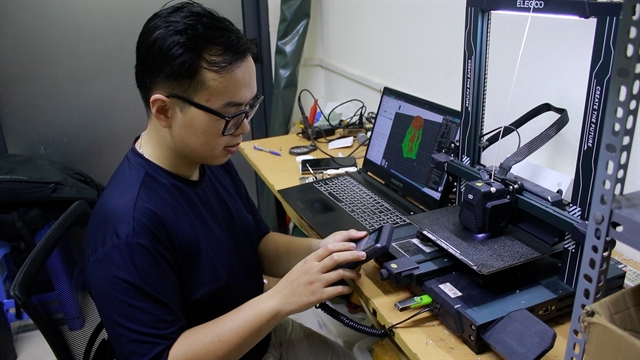 |
| A student uses a 3D printer at Dr Kiên’s home laboratory in Hà Nội. VNS Photo Lê Hương |
Learning through hands-on experience
Inside the lab, third-year biomedical engineering student Nguyễn Hoàng Anh and his teammates are racing to complete a rehabilitation steering-wheel device designed for patients with upper-limb weakness.
The project has been underway for three months and is approaching its deadline.
“At Kiên’s lab, we have everything we need, such as 3D printers, electronic boards, support circuits and soldering equipment,” Hoàng Anh said.
But for him, the greatest value extends beyond the equipment itself.
“Working here is wonderful because we learn how to collaborate, share knowledge and exchange experience. For a project like this, team cohesion is incredibly important.”
Nearby, fourth-year student Nguyễn Đức Quang Minh is working on a project to extract foetal electrocardiogram signals from sensors placed on a pregnant woman's abdomen.
“It feels more personal here. Kiên is always available to guide us. Whenever we make mistakes, he helps us identify and correct them,” Minh said.
Like many engineering students, Minh believes the gap between theory and practice can be one of the greatest challenges in university education.
 |
| Dr Kiên (second from left) guides students in his home laboratory. VNS Photo Lê Hương |
“Theoretical knowledge helps us understand the concepts behind what we are doing but it remains on paper. Only through practice can we truly understand and apply what we have learned,” Minh said
That philosophy lies at the heart of Dr Kiên's teaching approach.
“Einstein once said that knowledge comes from experience. Universities provide fundamental knowledge. From that foundation, students must learn how to think, solve problems and apply what they have learned,” Minh said.
For that reason, first- and second-year students joining his group often begin with simple electronic circuits before progressing to larger projects.
“Once they understand the theory, they start building things immediately. If you never do it yourself, you never truly understand,” Minh said.
A pioneer in biomedical engineering
Dr Kiên graduated from HUST's School of Electronics and Telecommunications in 1999, earned a master's degree in 2002 and completed his PhD at Japan's Shibaura Institute of Technology in 2008.
He could have continued pursuing a conventional career in electronics engineering. Instead, he chose a path that was largely unexplored in Việt Nam at the time: medical electronics, which later evolved into biomedical engineering.
“At that time, hardly anyone was working on it systematically. But I thought that if nobody started, the field would remain a blank space forever,” Minh said.
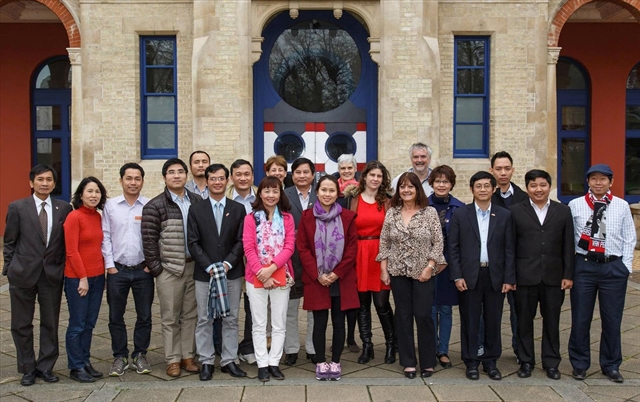 |
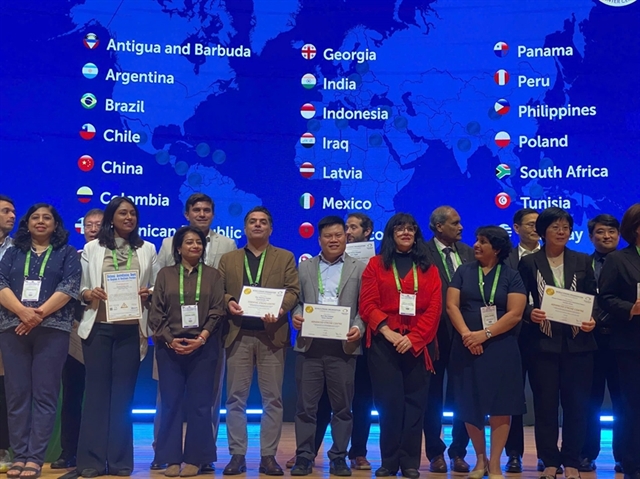
| Dr Nguyễn Phan Kiên (first right) was selected for the Leaders in Innovation Fellowships (LIF) programme run by the UK's Royal Academy of Engineering and funded by the Newton Fund. Photo Courtesy of Dr Nguyễn Phan Kiên |
That decision made him one of the pioneers who helped lay the foundation for biomedical engineering education and research in Việt Nam.
For him, the field carries a unique responsibility because it directly affects human lives.
“If a phone distorts someone’s voice, people can still understand each other. But if an ECG signal is distorted, doctors may misinterpret the condition and make critical medical decisions. That is why mistakes are unacceptable,” Minh said
As a result, he consistently reminds students about precision, responsibility and professional ethics.
“Just like medicine, biomedical engineering requires a sense of responsibility. Our work ultimately serves people, so we cannot settle for ‘good enough,” Minh said.
Third-year student Nguyễn Ngọc Thuỳ Trang said this is one of the most important lessons she has learned from him.
“He is extremely strict about data accuracy because it directly affects both doctors and patients. I have learned from him the importance of processing data carefully and striving for the highest possible accuracy,” Minh said.
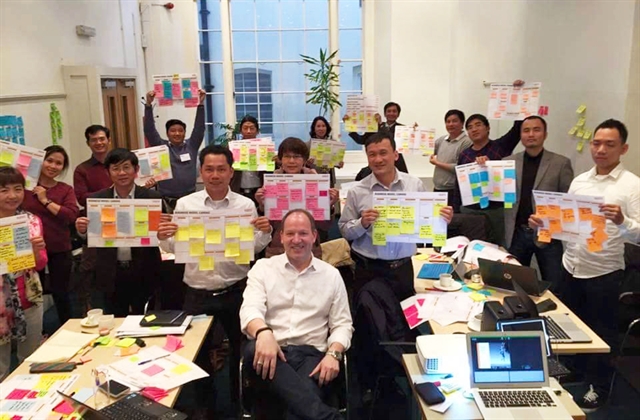 |
| Dr Nguyễn Phan Kiên was selected for the Leaders in Innovation Fellowships (LIF) programme run by the UK's Royal Academy of Engineering and funded by the Newton Fund. Photo Courtesy of Dr Nguyễn Phan Kiên |
Where Dreams Continue to Grow
Alongside teaching, Dr Kiên has developed more than 40 commercialised inventions and contributed to over 10 products that supported Việt Nam’s fight against COVID-19.
During the pandemic, the lights in his home laboratory often stayed on until dawn.
“We developed more than ten products, ranging from simple protective equipment to devices capable of eliminating SARS-CoV. During that period, students and I worked through countless nights together,” he said.
“I was truly happy. As soon as we finished a product, hospitals came to collect it.”
Yet when asked about his proudest achievement after more than 20 years in science and engineering, he does not mention patents, research papers or successful products.
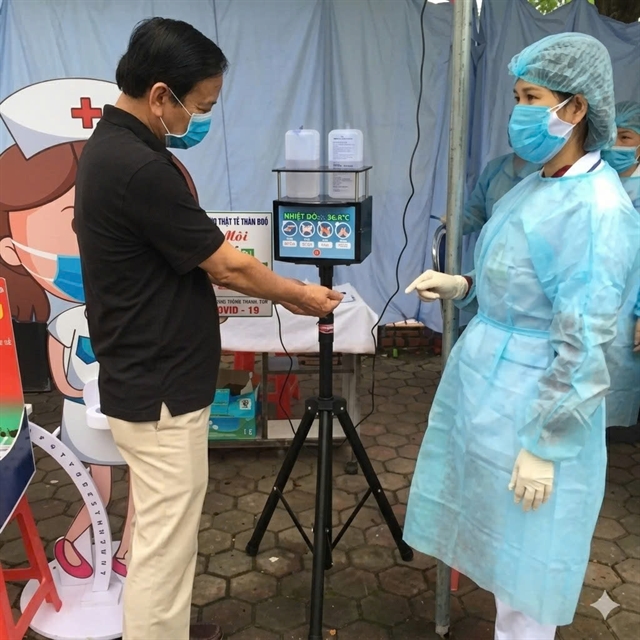 |
| A disinfection device developed by Dr Kiên and his research team during the COVID-19 pandemic. Photo Courtesy of Dr Nguyễn Phan Kiên |
Instead, he talks about his students.
“Some of them now have their own companies, their own inventions and export orders for products they designed,” Minh said
Perhaps that is the greatest accomplishment of the small laboratory hidden in a Hà Nội alleyway.
It is a place where first-year students learn how to hold a soldering iron, where research teams spend sleepless nights perfecting prototypes, and where one lecturer has opened the doors of his home to students for nearly two decades.
In a bustling city, the lab may not be the most advanced or best equipped. But it contains something more enduring than machines: a belief that science only has meaning when it is created by people who are willing to learn, to share, and to use knowledge to serve society.
And from this modest house, countless dreams of HUST students have taken flight. VNS
|
| An automatic temperature screening device developed by Dr Kiên’s research team during the COVID-19 pandemic. Photo Courtesy of Dr Nguyễn Phan Kiên |
Society
 Society
 Society
 Society
 Society
 Society
 Society
 Society
 Society
 Society
 Society
 Society
 Society
 Society
 Society