 Life & Style

SBV to curb property price inflation, enforce lending rate rules
1.
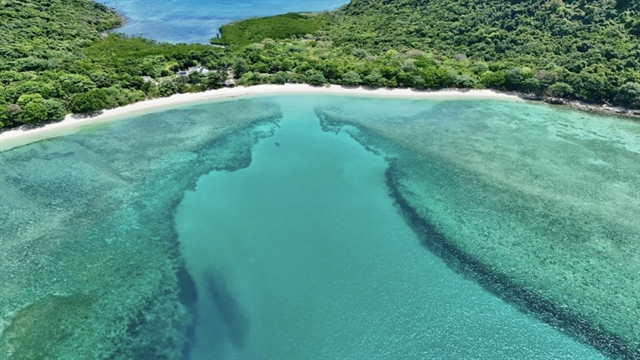 |
| Aerial view of Bảy Cạnh Island, home to one of Côn Đảo National Park's most important sea turtle nesting beaches. — Photo courtesy of Côn Đảo National Park |
HCM CITY — Pristine beaches, crystal-clear waters and rich marine biodiversity have long made Côn Đảo one of Việt Nam's most distinctive island destinations.
Today, the archipelago is strengthening its appeal by developing a tourism model that places nature conservation at its core, with sea turtle protection emerging as one of its most unique visitor experiences.
Every year, from April to November, beaches across Côn Đảo National Park welcome female sea turtles returning from long ocean migrations to lay their eggs. The nesting season has become a highlight of the island's tourism calendar, offering visitors the rare opportunity to observe turtles nesting at night and later release hatchlings into the sea under the guidance of park rangers.
The peak nesting season falls between July and September, when dozens of turtles come ashore each night. Rangers work around the clock on islands such as Bảy Cạnh, Cau, Tre Lớn and Tài to protect nesting females, relocate eggs to secure hatcheries and monitor the incubation process.
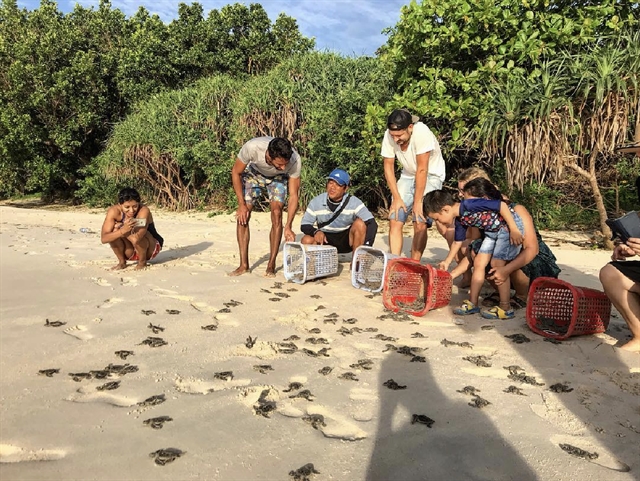 |
| Visitors release newly hatched sea turtles onto the beach as part of a conservation programme, helping the hatchlings begin their journey to the sea. — Photo courtesy of Côn Đảo National Park |
According to Côn Đảo National Park, the archipelago is home to 18 nesting beaches, with more than 85 per cent of all sea turtles breeding in Vietnamese waters returning here. This makes Côn Đảo one of Southeast Asia's most important sea turtle nesting sites.
Once a turtle has laid her eggs, park staff carefully measure and tag the animal before transferring the eggs to artificial hatcheries, where temperature and humidity are closely monitored. The controlled environment helps protect the eggs from tides, predators and extreme weather conditions.
After an incubation period of around 45 to 65 days, hatchlings emerge from the sand and are released into the ocean. Thanks to this scientific conservation process, the hatching success rate has reached about 87 per cent, the highest recorded in Việt Nam. As a result, Côn Đảo has become the country's leading location for releasing baby sea turtles back into the wild.
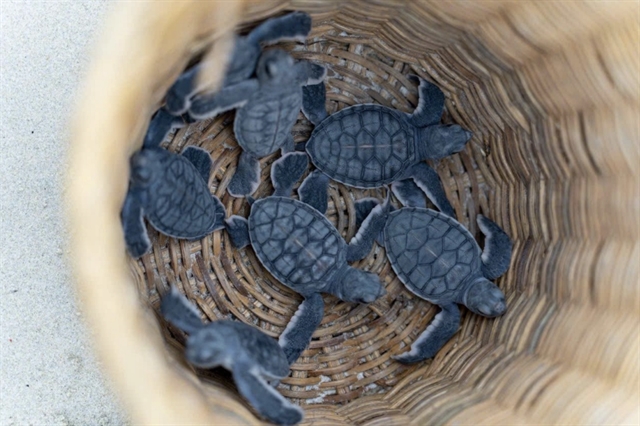 |
| Newly hatched green sea turtles are prepared for release into the sea as part of Côn Đảo's long-running conservation programme. — Photo courtesy of Côn Đảo National Park |
The conservation programme has also created a distinctive tourism product that attracts environmentally conscious travellers. Visitors can join overnight turtle-watching tours with park rangers or take part in hatchling release activities, gaining first-hand insight into wildlife conservation while experiencing one of nature's most remarkable spectacles.
The programme's success is reflected not only in visitor interest but also in the recovery of the turtle population. When conservation efforts began in 1993, only about 220 nesting female turtles were recorded across the archipelago. By 2025, that figure had risen to 987.
Over the past three decades, park rangers have protected nearly 44,000 nests, safeguarded more than 3.8 million eggs and released almost 2.9 million hatchlings into the sea. To strengthen conservation, the national park is also applying modern technologies, including electronic tagging, digital databases, artificial intelligence, the Internet of Things, Photo-ID identification and satellite tracking to better understand turtle migration patterns.
Sea turtle conservation forms part of Côn Đảo's broader strategy to develop sustainable ecotourism while preserving the island's natural assets. According to the local administration, the destination welcomed more than 410,000 visitors in the first six months of 2026, many of whom participated in turtle-related experiences at the national park
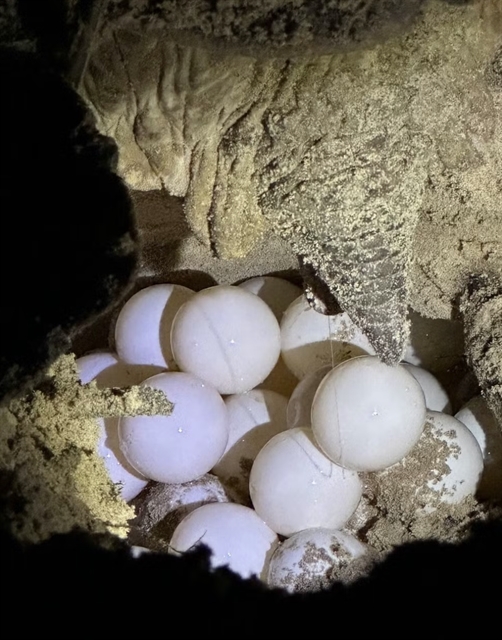 |
| A female sea turtle lays her eggs on a beach in Côn Đảo National Park before rangers carefully relocate the clutch to a protected hatchery. — Photo courtesy of Côn Đảo National Park |
Tourism growth has remained strong. During the first half of the year, international arrivals approached 24,000, an increase of 62 per cent year-on-year, while tourism revenue exceeded VNĐ2 trillion, up 15 per cent from the same period last year.
The period from June to September is regarded as the island's prime travel season. Calm seas, sunny weather and temperatures ranging from 25 to 30 degrees Celsius provide favourable conditions for diving, coral reef exploration and stargazing. Combined with the turtle nesting season, these natural advantages continue to strengthen Côn Đảo's position as one of Việt Nam's leading island destinations.
However, the rapid growth of tourism has also reinforced the need for careful environmental management. Following Côn Đảo's establishment as a special administrative zone under HCM City, local authorities have reaffirmed that economic development must not come at the expense of the environment.
The island is pursuing a long-term vision of becoming a "green, smart and liveable island", balancing tourism development with the protection of ecosystems and natural heritage. Local authorities have made it clear that short-term commercial projects that threaten environmental sustainability will not be encouraged.
The tourism industry has already begun embracing greener practices. Many accommodation providers have introduced refillable water stations, waste sorting systems, reduced the use of single-use plastics and adopted more recyclable materials. According to WWF Việt Nam, 145 tourism businesses on the island have committed to eliminating single-use plastic products.
Environmental monitoring has also been expanded. Côn Đảo National Park regularly surveys 21 monitoring sites, including coral reefs, seagrass beds and mangrove forests, collecting data on water quality, coral cover and marine biodiversity.
Recent surveys indicate encouraging signs of ecological recovery. Coral reefs that suffered bleaching during elevated sea temperatures in 2024 have begun to regain their colour, while young coral colonies are becoming more widespread. The improving reef ecosystem has also supported the return of various reef fish species.
Wildlife conservation efforts continue to gain momentum. The "Let's Get Cracking" sea turtle hatchery, a partnership between Six Senses Côn Đảo and Côn Đảo National Park, has released more than 35,000 green sea turtles into the ocean, achieving an average hatching success rate of 83 per cent over the past three years. The facility follows strict biological protocols, including night-time camera monitoring, controlled incubation conditions and careful management of artificial lighting and human activity to minimise disturbance.
By transforming conservation into a meaningful visitor experience, Côn Đảo is demonstrating that tourism and environmental protection can complement each other. Rather than relying solely on its natural beauty, the island is creating experiences that encourage visitors to appreciate and help safeguard its fragile ecosystems.
As Côn Đảo works towards its goal of welcoming more than one million visitors annually by 2030, its commitment to sustainable tourism and biodiversity conservation is expected to remain the foundation of its long-term development. — VNS
Life & Style
 Life & Style
 Life & Style
 Life & Style
 Life & Style
 Life & Style
 Life & Style
 Life & Style
 Life & Style
.jpg) Life & Style
Life & Style
 Life & Style
 Life & Style
 Life & Style
 Life & Style
 Life & Style