 Life & Style

Top Vietnamese leader meets with Belgian Senate Speaker, House President
1.
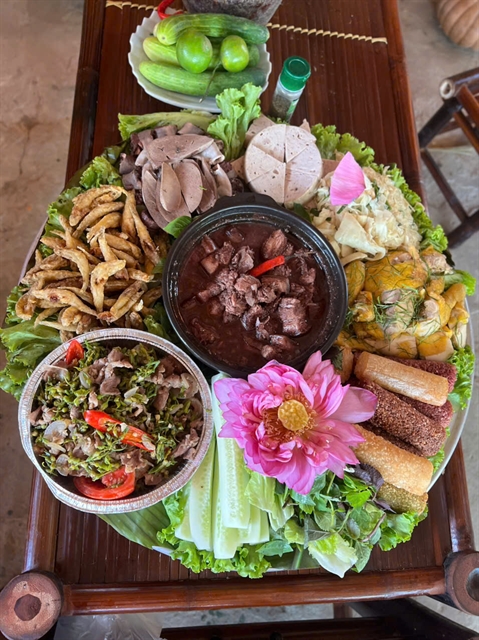 |
| A large tray of Mường cuisine featuring a variety of traditional dishes that can tempt any palate. VNS Photo Hải Yến |
Thanh Hà
HÀ NỘI — After trying the cuisine of the Mường ethnic people, I became convinced that anyone fortunate enough to taste it would eagerly return for a second, third or even a thousandth helping. Its memorable and distinctive flavours together with its use of diverse ingredients make it an experience that lingers long after the meal is over.
Previously, I had only tried Mường specialties in Phú Thọ and Hòa Bình provinces, where a large number of Mường communities live, or at restaurants in Hà Nội, where I believe the dishes were adapted to suit local diners' tastes.
But then I discovered that authentic Mường cuisine was available in Hà Nội's Mường Cốc Village in Mỹ Đức Commune, about an hour's drive from the city centre.
"The most distinctive aspect of our cuisine is that our dishes are made with natural ingredients, using different spices and cooking methods," Lê Hải Yến, a Mường Cốc villager who runs Gió Núi Farmstay, told me.
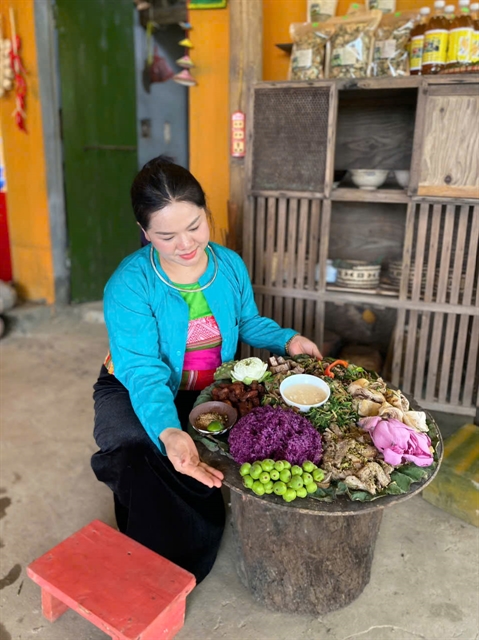 |
| Mường Cốc villager Lê Hải Yến presents a traditional Mường feast featuring steamed chicken, pork grilled with pomelo leaves, lime-marinated steamed pork, steamed wild greens and purple sticky rice. VNS Photo Hải Yến |
"The best dishes are normally found at our ceremonial feast, which is often served on important occasions such as weddings, housewarmings or during the Tết (Lunar New Year) holiday.
"But now, as tourism continues to grow, an increasing number of visitors come to experience our culture and cuisine. To meet this demand, traditional feasts are prepared upon request for guests wishing to sample our local dishes."
Yến said that, traditionally, there were no plates at all. Instead, a large serving tray lined with banana leaves was prepared to hold all of the food, which was chosen from a traditional menu of 69 dishes.
The most distinctive offering is the traditional feast featuring dishes made entirely from Mường pork. Mường pigs are raised using traditional free-range methods and fed a natural diet free of growth hormones, resulting in firm, lean meat with a sweet, aromatic flavour.
In the past, Mường pork was primarily boiled or steamed. Today the dishes have become far more diverse. A feast includes all parts of the pig, particularly the offal. The meat is prepared in a variety of ways, including boiling, grilling, steaming or turning it into salads or soup.
"We also prepare traditional feasts with a wide variety of ingredients, including pork, chicken, buffalo, beef, fish and shrimp, giving visitors plenty of options to suit their tastes," said Yến.
Feast traditions
Among the dishes I tasted, I preferred buffalo meat cooked with lá lồm (leaves from a local vine), meatballs wrapped in pomelo leaves and sour marinated fish.
The buffalo meat is lightly charred to enhance its aroma, then cleaned, cut into small pieces and simmered with seasonings until tender.
Lồm leaves are then washed and added to the stew to created a perfect balance of flavours.
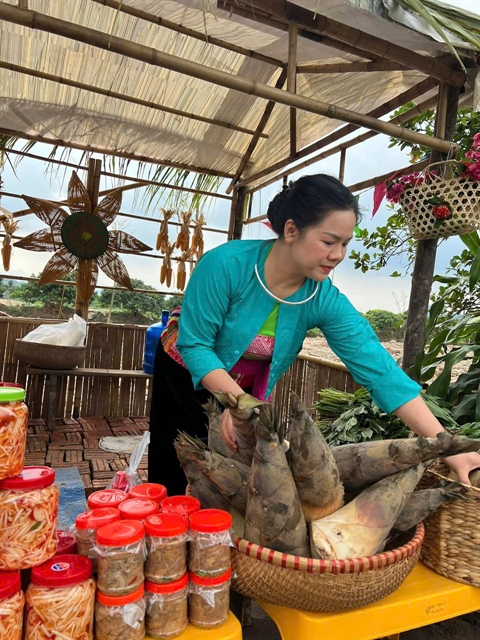 |
| Bamboo shoots are among the most distinctive ingredients in Mường cuisine. VNS Photo Hải Yến |
To make the meatballs, minced meat is seasoned, wrapped in fresh pomelo leaves and grilled over glowing coals. The pomelo leaves release a subtle fragrance that masks any gamey flavours in the meat, imparting a distinctive and enticing aroma to the patties.
Meanwhile, the fish used for the last dish is freshly caught from local springs before being cleaned and seasoned with salt, ginger, pepper, citronella, bamboo shoots and chilli, then wrapped in banana leaves and steamed. Hours of steaming create the unique taste of the finished fish.
Along with the meat dishes, pickled bamboo shoots and steamed wild vegetables are served with a special dipping sauce made from fermented rice vinegar. Diners can taste the bitterness, astringency, sweetness, richness and spiciness of the vegetables blending together.
"The Mường people love dishes with a sour flavour, as it makes the food more appetising. We make different pickles from scallions, wild eggplants, bamboo shoots, papaya and cassava leaves," Yến said.
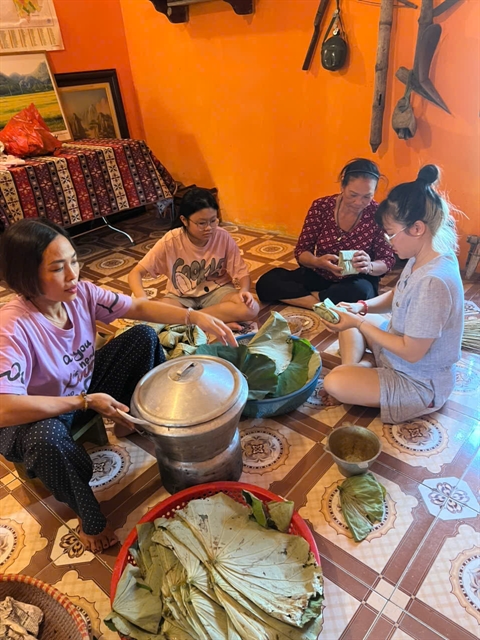 |
| Mường villagers steam sticky rice for a traditional feast. VNS Photo Hải Yến |
"We also enjoy bitter foods, such as papaya leaves and bitter melon, which are staples of our daily meals, as they are available in our gardens and easy to find in the forest. After steaming, they can be both bitter and sweet."
Mountain flavours
A special dish that is always present is purple sticky rice, made from a special type of glutinous rice that has a fragrance of mountain herbs. The rice is dyed a striking purple colour using lá cẩm (magenta leaves) and the grains are plump and shiny. Even when cooled, the rice remains soft and chewy, retaining its delicate texture.
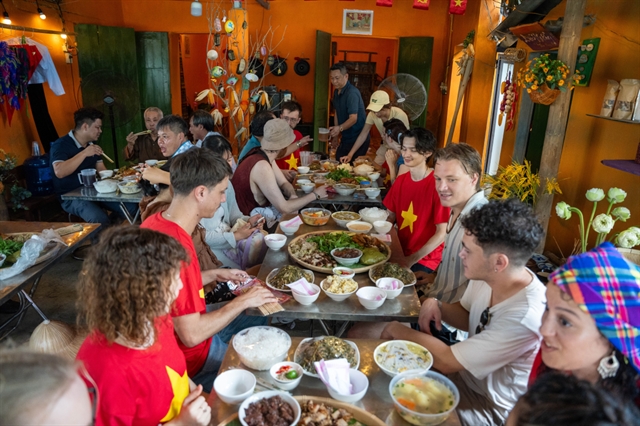 |
| Visitors at Gió Núi Farmstay enjoy authentic Mường cuisine. VNS Photo Hải Yến |
Many other typical Mường dishes also contribute to the appeal of the local cuisine. Rice packed in bamboo tubes is chewy and fragrant, and is often eaten with simple sesame and salt.
Alongside the large tray of shared dishes is served a steaming bowl of canh loóng, a soup made from pork bones, bitter bamboo shoots or banana stems. It makes the meal easier to enjoy, balancing the richness of the meat and creating a harmonious, complete dining experience.
Yến said a Mường ceremonial feast can take a long time to prepare, so visitors are advised to place their order before arriving. She added that if visitors wish to participate in the preparation, the chefs at her homestay will be happy to guide them. — VNS
Life & Style
 Life & Style
 Life & Style
 Life & Style
.jpg) Life & Style
Life & Style
 Life & Style
 Life & Style
 Life & Style
 Life & Style
 Life & Style
 Life & Style
 Life & Style
 Life & Style
 Life & Style
 Life & Style