 Life & Style

Lotte, Phát Đạt combine strengths in Thu Thiem project
1.
|
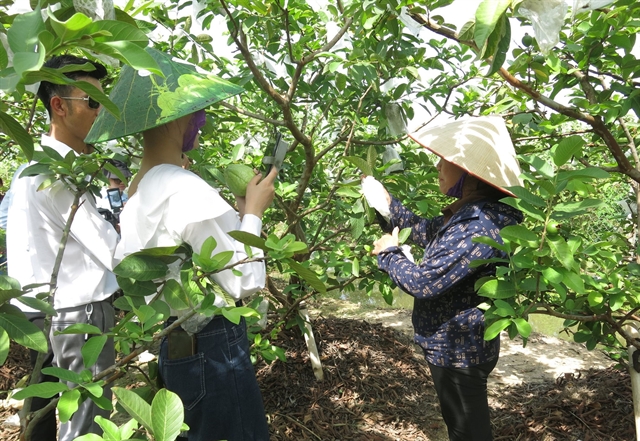
| The Forest Management and Agricultural Extension Board of Hải Phòng has invited TikTok creators to help farmers from the Nam Sơn Guava Cooperative promote their products on digital platforms. — Photos baohaiphong.vn |
HẢI PHÒNG — By mid-morning, guava orchards in Hải Phòng are already busy with visitors. Under the summer sun, rows of green trees stretch across the fields, heavy with fruit.
Some guests walk between the rows, picking guavas straight from the branches. Others stop to film short videos or livestream their visit.
Many first heard about these orchards online.
In recent years, digital platforms have started to change farm life in parts of Hải Phòng, helping farmers reach customers more directly and turn their gardens into destinations.
In Vĩnh Bảo, where pear guava is widely grown, farmers are learning to tell their own stories. Short clips showing daily work watering, bagging fruit, harvesting – are shared on TikTok, Facebook or Zalo. Most are filmed on mobile phones, and the videos are simple but capture the real, everyday lives of farmers.
For visitors, this is part of what attracts them. Instead of buying through intermediaries, they come to the orchards, see the process and pick fruit on site.
Growers also benefit from more stable demand. Nguyễn Thị Là, a farmer in Nam Sơn Village, Vĩnh Bảo Commune, said her family cultivates more than one hectare with around 1,000 guava trees.
“When the guavas ripen, customers who have placed orders come to collect them. There is no fruit left unsold,” she said.
She said local guavas stand out for their firm texture and sweeter taste. The area lies along the Luộc River, where alluvial soil mixed with sand creates favourable growing conditions. Locals still call parts of the land the 'King’s fields', reflecting its longstanding reputation as a fertile farming area.
Some farmers are combining production with tourism, welcoming small groups into orchards to pick fruit, taste it fresh and learn about cultivation.
A similar model is seen at Thắng Thủy Agricultural Cooperative. According to director Cao Thị Hằng, members produce their own promotional videos, showing real scenes from vegetable plots, flower fields and fruit gardens. The cooperative’s earlier success with chrysanthemum fields, widely shared online, has helped draw visitors and provided experience for developing other models.
Elsewhere, larger farms are also using digital tools. At Mây Sanh Farm in An Dương Ward, livestreaming has become routine. Daily work from early morning to harvest is shared online. This has helped attract more visitors, many of whom come after following these updates.
Local agricultural officials say similar approaches are appearing in several communes. Farmers are investing in greenhouses, water-saving irrigation and safer production, while gradually applying digital tools for traceability and sales.
|
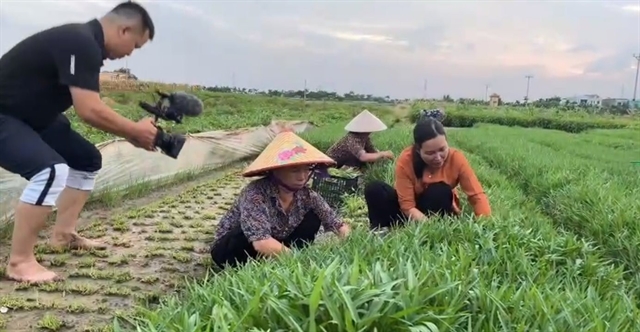
| Some agricultural service providers have started producing their own video clips to introduce their products on digital platforms, aiming to attract visitors and encourage on-site purchases. |
These efforts reflect Resolution 57-NQ/TW on digital transformation, which encourages wider use of technology across sectors, including agriculture. At the local level, this can already be seen in daily work, from filming farm activities to selling products online.
The trend is creating a new direction, linking agriculture with experiential tourism to add value from the same land.
Challenges in carrying out the digital transformation remain, however.
Digital adoption is uneven, mostly driven by younger farmers or those familiar with technology. Many others, despite having good products, lack the skills to promote them online or interact with customers.
Phạm Văn Thường, a member of Nam Sơn Guava Cooperative, said many local farmers share the same concern. While they want to attract visitors, they still need guidance.
“We know the fruit is good and the orchards are beautiful, but we don’t know how to present that online,” he said.
Infrastructure is another issue. While Hải Phòng has strong transport links, connections between farming areas are still limited, making it harder for visitors to plan trips.
In addition, many products are still sold in raw form with simple packaging that lacks the branding or styling to become more attractive as gifts.
Local officials say closer coordination is needed. Along with farmers, businesses, travel agencies and content creators should be involved to build more complete value chains and better promote rural destinations.
Back in the orchards, the change is visible, though gradual. Smartphones are now common tools used for selling, sharing and connecting.
For many farmers, going digital is no longer new. It is becoming part of daily work, helping their guava orchards reach beyond the village. — VNS
Life & Style
 Life & Style
 Life & Style
 Life & Style
 Life & Style
 Life & Style
 Life & Style
 Life & Style
 Life & Style
 Life & Style
 Life & Style
 Life & Style
 Life & Style
 Life & Style
 Life & Style