 Life & Style

Việt Nam, Denmark issue joint statement on establishment of Comprehensive Strategic Partnership
1.
Lương Thu Hương
Traditional Vietnamese folk arts have long been performed on village stages and in communal houses. Today, thanks to a group of university students, they are finding an unexpected new home inside a small interactive box, where 3D technology, AI, and digital storytelling bring centuries-old heritage vividly to life.
Created by students at FPT University, the Dáng Hình Di Sản (Shapes of Heritage) project uses 3D models, AI-generated performances and digital storytelling to transform traditional heritage into an immersive experience, inviting users to see, hear, touch and connect with the country's cultural treasures.
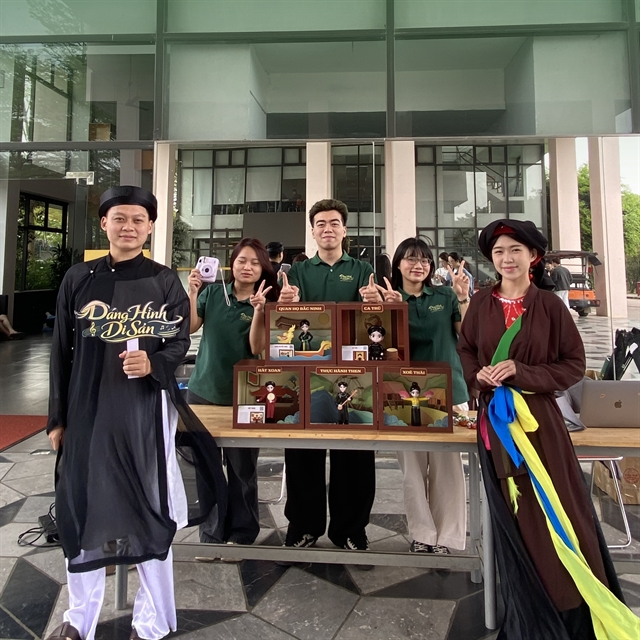 |
| The 'Dáng Hình Di Sản' (Shapes of Heritage) project was initiated by a group of five students from FPT University. — Photo courtesy of Dáng Hình Di Sản |
Phùng Phương Anh, leader of the project, said the idea originated as the team's graduation project.
“We noticed that many traditional cultural values are becoming increasingly unfamiliar to young people. As technology continues to evolve and become an integral part of everyday life, we wanted to use it as a bridge to bring cultural heritage closer to the public," Anh said.
That was how Shapes of Heritage was born, with the dual aim of completing a graduation project and reimagining traditional cultural values through a modern medium while preserving their original spirit.
“Traditional approaches remain fundamental to safeguarding cultural heritage. However, digital technology can create more vivid, immersive and interactive experiences, making heritage more accessible to the public, particularly younger generations, who are accustomed to consuming information through digital platforms," Anh added.
The project comprises five interactive boxes featuring five of Việt Nam's traditional performing arts – ca trù ceremonial singing, xòe dance of the Thái ethnic group, quan họ folk singing, then singing of the Tày, Nùng and Thái ethnic groups, and hát xoan folk singing.
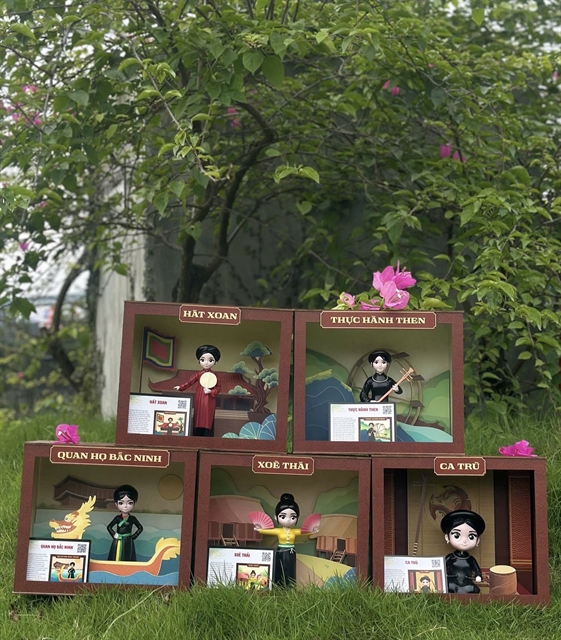 |
| The project comprises interactive boxes featuring five of Việt Nam's traditional performing arts. — Photo courtesy of Dáng Hình Di Sản |
“They are all UNESCO-inscribed elements of Việt Nam's intangible cultural heritage, recognised for their outstanding artistic and historical value. Yet despite their significance, they remain relatively inaccessible to the general public, particularly younger generations,” Anh said.
Shapes of Heritage began with extensive research, as the team developed the concept, studied reference materials and gathered visual and audio resources. They also worked with manufacturers to produce 3D-printed figurines and custom-made wooden boxes.
The next stage involved building digital models and using AI to transform real-life images into animated characters. Throughout the digitisation process, the team paid close attention to authenticity, striving to recreate every detail and movement as faithfully as possible to the original heritage forms.
Interactive learning
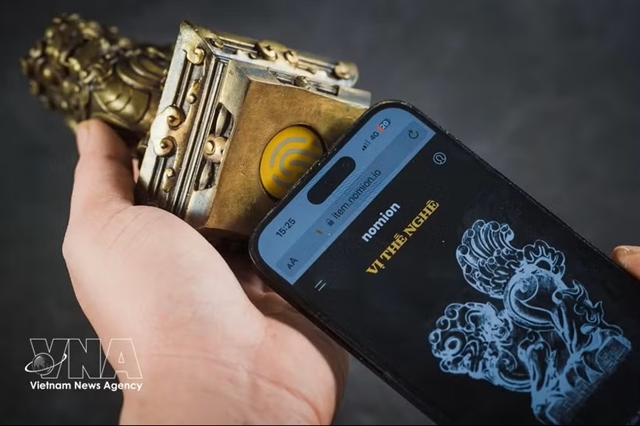
A key feature of the interactive boxes is that each one goes beyond a meticulously crafted 3D model that faithfully recreates traditional artisans and their cultural settings. Every box is also integrated with a QR code that gives users access to digital content, including AI-generated videos and stories exploring the heritage behind each art form, creating a unique interactive experience.
Inside, 3D-printed figurines bring iconic cultural scenes to life. One depicts a hát xoan artisan performing before an ancient communal house in Phú Thọ, while another recreates male and female singers exchanging graceful quan họ folk songs aboard a traditional dragon boat.
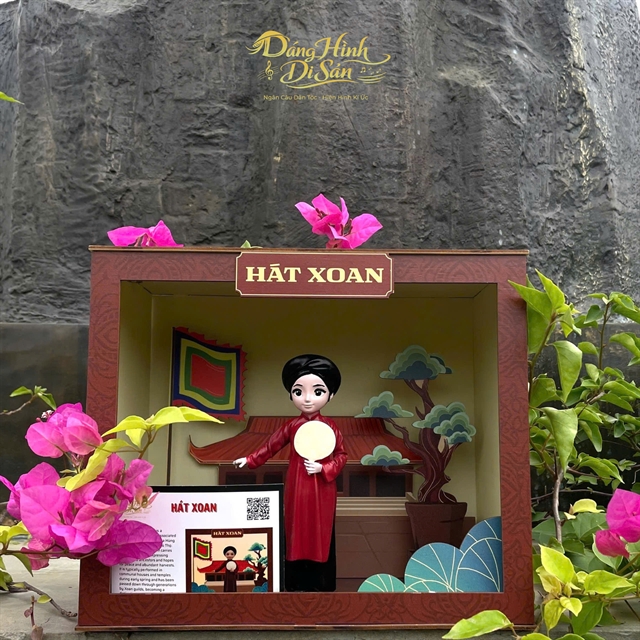 |
| An interactive box depicting a 'hát xoan' singer. The Vietnamese folk art has been recognised as a UNESCO Intangible Cultural Heritage element. — Photo courtesy of Dáng Hình Di Sản |
Elsewhere, a then singer plays the tính lute alongside xòe Thái dancers set against the mountainous landscape of the Northwest. Another scene captures the refined artistry of ca trù, evoked through the rhythmic sounds of sênh clappers and phách rhythm sticks.
According to Anh, the greatest challenge is maintaining the balance between authenticity and creativity.
"If too much emphasis is placed on technology, cultural heritage may become overly modernised. On the other hand, if traditional methods of presentation are preserved without adaptation, it can be difficult to engage younger audiences," she explained. "Therefore, our team always prioritises the accuracy and authenticity of the content, using technology only to improve accessibility."
 |
| Scanning the QR code on the box allows users to watch AI-generated performances of traditional folk arts and enjoy their melodies. — Screenshot courtesy of Dáng Hình Di Sản |
The boxes were made available for sale from March. Within just over one month, 54 boxes were sold, generating more than VNĐ35 million (US$1,300) in revenue. The project's customers include not only young people with a passion for Vietnamese culture, but also museums, souvenir shops and educational institutions.
Many young people shared that this was the first time they had learned about or truly understood traditional art forms such as ca trù, xoan singing, and xòe dance. After experiencing the project, some even took the initiative to learn more about these cultural heritage traditions and shared their discoveries with friends.
"Feedback like this demonstrates that technology can naturally spark curiosity and help connect people with cultural heritage in a meaningful and engaging way," Anh said.
The team is presently focusing on traditional art forms from the north of the country. Anh revealed that in the future, they plan to expand the project to include cultural heritage from central and southern Việt Nam, such as nhã nhạc (Huế royal court music), đờn ca tài tử (Southern amateur folk music) and the Space of Gong Culture in the Central Highlands.
"By using digital technology, we can recreate the atmosphere of these folk arts in a more vivid and immersive way, allowing audiences not only to experience the cultural setting but also to understand the stories behind this remarkable cultural heritage," Anh said. VNS
Life & Style
 Life & Style
 Life & Style
 Life & Style
 Life & Style
 Life & Style
 Life & Style
 Life & Style
 Life & Style
 Life & Style
 Life & Style
 Life & Style
 Life & Style
 Life & Style
 Life & Style