 Society
SBV to curb property price inflation, enforce lending rate rules
1.
|
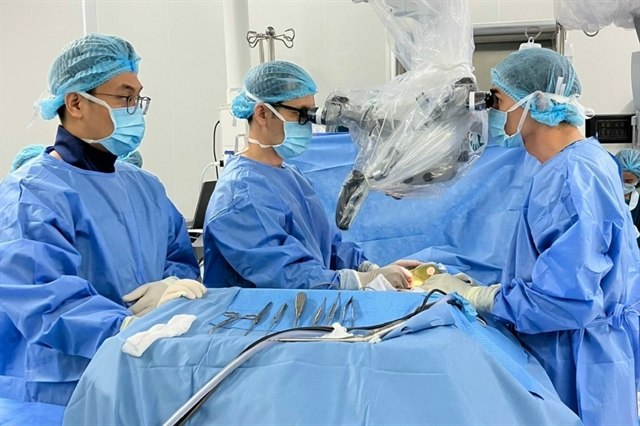
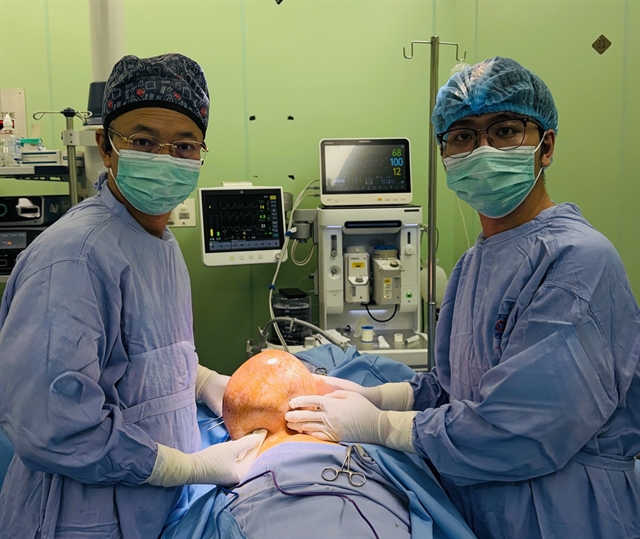
| Vinmec Central Park General Hospital's surgical team is working on the patient. — Photo courtesy of the hospital |
HCM CITY — Vinmec Central Park General Hospital has successfully performed complex brain tumour surgery on a Cambodian patient using a multidisciplinary treatment protocol.
The 64-year-old woman was previously admitted to the HCM City-based private hospital in a lethargic state with complete loss of speech and motor paralysis due to a large brain tumour causing compression.
The patient, identified as An Muy Kohn, began experiencing unusual changes, including slowed mobility and a significant decline in communication skills. Her condition progressed rapidly, leading to the loss of both language and motor skills, leaving her completely dependent on family members for all daily activities.
A cranial magnetic resonance imaging (MRI) scan revealed a large tumour, approximately 4.5 cm in diameter, located in the left temporal lobe, an area directly related to language function.
Upon admission, hospital doctors determined this was a challenging case not only because of the tumour’s large size but also due to its location close to a vital brain area and its involvement with numerous blood vessels.
Of particular concern was the patient's co-existing autoimmune thrombocytopenia, a condition that increases the risk of serious bleeding during and after surgery. Low platelet counts and impaired clotting ability meant any surgical intervention carried a heightened risk of dangerous bleeding.
An interdisciplinary treatment strategy was immediately activated, with the patient receiving care from a haematologist to bring her platelet count back to a safe level.
In addition, to eliminate the risk of bleeding from the tumour’s extensive blood supply, a neurosurgeon performed embolisation of the tumour’s blood vessels before surgery, helping to reduce blood loss during the procedure.
Once the risks were under control, the surgical team proceeded with the operation. The large tumour was compressing the language cortex and major blood vessels and had displaced the brainstem. It also tended to bleed profusely, making dissection particularly difficult.
After five tense hours, and thanks to advanced microsurgical techniques, the team completely removed the tumour without damaging the motor cortex or language areas of the brain.
|
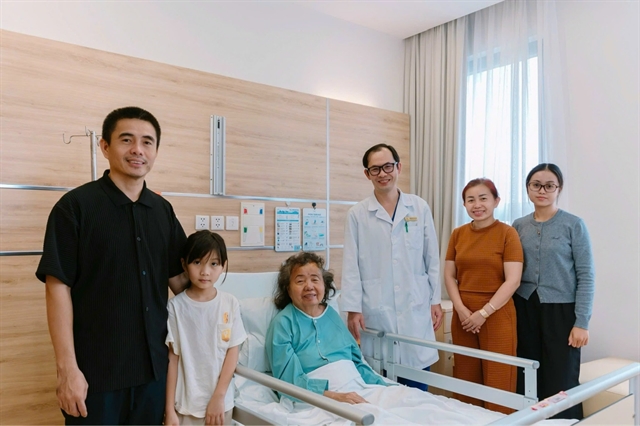
| The patient made an impressive recovery after the complex surgery. — Photo courtesy of the hospital |
Following the surgery, the patient received daily post-operative care and rehabilitation exercises. As a result, after only six days, the patient, who had been lethargic, unable to walk and had lost the ability to speak, became alert, communicated fluently and could move independently.
According to Dr Trương Văn Trí, Head of the hospital’s Neurosurgery Department, the success of this case is clear evidence of the trend towards multidisciplinary brain tumour treatment, a trend being applied at leading medical centres worldwide.
“Instead of addressing each problem individually, the entire treatment process is structured as a continuous roadmap in which each speciality plays a key role and is closely interconnected,” said Trí.
A noteworthy point is the role of assistive techniques in modern neurosurgery at the hospital. The use of high-magnification surgical microscopes allows surgeons to clearly distinguish the boundaries between tumour tissue, vascular structures and vital nerves, thereby maximising tumour removal while preserving nerve function.
Furthermore, anaesthesia and pain management are not limited to simply keeping things safe during surgery but also play an active role in haemodynamic control, maintaining cerebral blood flow and supporting early post-operative recovery.
Modern pain management methods help reduce complications and facilitate early functional recovery for patients. In the post-operative phase, effective pain management combined with early rehabilitation is considered an indispensable link in optimising treatment outcomes.
"Our goal is not only to remove tumours but also to help patients quickly return to normal life with the best possible quality of life. The hospital is ready to receive and effectively handle complex cases, contributing to improving the chances of survival and recovery for patients in the region," Dr Trí said. — VNS
Society
 Society
 Society
 Society
 Society
 Society
 Society
 Society
 Society
 Society
 Society
 Society
 Society
 Society
 Society