 Society

NA must embody spirit of action, innovation, development: top legislator
1.
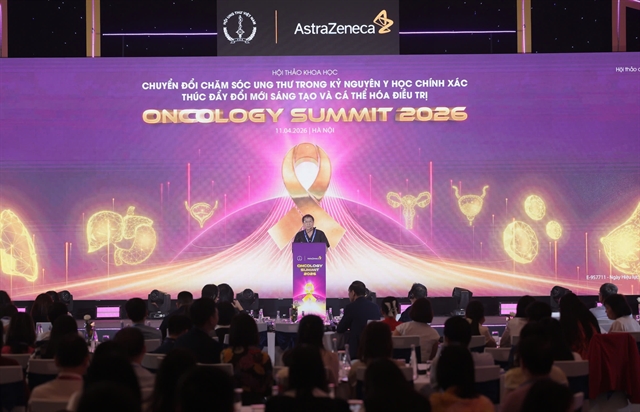 |
| Assoc. Professor Bùi Diệu, President of the Việt Nam Cancer Association, speaks at the summit. — Photo courtesy of the organiser |
HÀ NỘI — Cancer care with precision medicine towards personalised treatment and improved patient outcomes was the main topic of discussion at the recent Oncology Summit jointly held by the Việt Nam Cancer Association and AstraZeneca Việt Nam.
Domestic and international experts updated scientific progress as well as discussed impactful implementation models, such as digitalised Multidisciplinary Teams (MDT), liquid biopsy and the application of Artificial Intelligence (AI) in pathological diagnostics, thereby supporting the development of precision medicine and optimising patient care.
At the event, Assoc. Professor Bùi Diệu, President of the Việt Nam Cancer Association, said that the application of medical advancements is no longer an option but an urgent requirement to enhance cancer care efficiency.
“Promoting precision medicine based on molecular testing, liquid biopsy, and digital data – alongside the application of technology and AI in diagnosis and monitoring – will help personalise treatment protocols for each patient, improve efficacy and optimise healthcare system resources," said Diệu.
"The key to this transformation lies in the implementation of advanced diagnostic technologies, including liquid biopsy in molecular testing.
"In addition, the integration of digital health data infrastructure and the application of AI in diagnosis and disease monitoring serve as powerful drivers.
"These innovations enhance clinical outcomes at the individual level while optimising the utilisation of healthcare system resources.”
During the forum, participants updated solutions shaping the future of oncology. Presentations focused deeply on the role of Multidisciplinary Teams (MDT), biotechnological advancements, and AI applications.
According to experts, international studies showed that cancer patients can improve survival by more than 15 months when MDT is applied in diagnosis and treatment, compared with settings where MDT is not implemented.
However, several barriers continue to hinder the adoption of MDT, including a lack of digital infrastructure, causing data fragmentation. The solution shared by international experts lies in implementing digitalised MDT platforms directly connected to electronic medical records for real-time monitoring of treatment results.
Dr Jomtana Siripaibun, Director of the Oncology Centre at Chulabhorn Hospital, Thailand, said that MDT is a vital strategy in cancer treatment, and digital transformation is a mandatory condition for this model to operate sustainably.
“By implementing a digital MDT platform connected to clinical data, we have recorded more efficient case preparation and more consistent treatment records," she said.
"The key is to start with a priority disease group and a fully recorded, monitored, standardised consultation process, to step-by-step build systemic capacity for modern cancer care."
Concurrently, the convergence of liquid biopsy and AI is expected to reshape the fields of molecular diagnostics and anatomic pathology. Instead of relying solely on invasive tissue biopsies, liquid biopsy allows for the analysis of circulating tumour DNA to detect early signs of recurrence or drug resistance. In addition, when combined with AI, the diagnostic process gains consistency, reduces turnaround time, and assists in biomarker quantification.
Dr Chien-Feng Li, Head of Clinical Pathology and Laboratory Medicine at Chi Mei Medical Centre and Adjunct Professor at the National Sun Yat-sen University School of Medicine, Taiwan, said that advancements in liquid biopsy and AI are creating a landmark shift in cancer diagnosis and treatment, especially when implemented as a multimodal diagnostic model, combining histological, molecular, liquid biopsy,and AI data, to support precision medicine.
“This approach helps select more appropriate treatments for each patient and optimises care. To leverage this potential, investment in infrastructure and human resource training will be key factors for the healthcare system," said Dr Li.
According to GLOBOCAN 2022, Việt Nam records approximately 180,000 new cancer cases and over 120,000 deaths annually. The age-standardised incidence and mortality rates are 150.8 and 99.0 per 100,000 population, respectively, reflecting an increasing disease burden on the healthcare system and society.
Common cancers include breast, liver, lung, colorectal and stomach. Notably, a trend toward younger patients is seen in breast and colorectal cancers, posing new challenges for early screening, diagnosis, and treatment.
Factors such as an ageing population, rapid urbanisation and lifestyle changes, including smoking, obesity and physical inactivity, contribute to the rising case numbers.
Projections suggest that new cancer cases in Việt Nam could increase by 60-70 per cent by 2050, emphasising the urgent need for national strategies for prevention, early detection and treatment optimisation. — VNS
Society
 Society
 Society
 Society
 Society
 Society
 Society
 Society
 Society
 Society
 Society
 Society
 Society
 Society
 Society