 Society
European higher education week opens new opportunities
1.
|
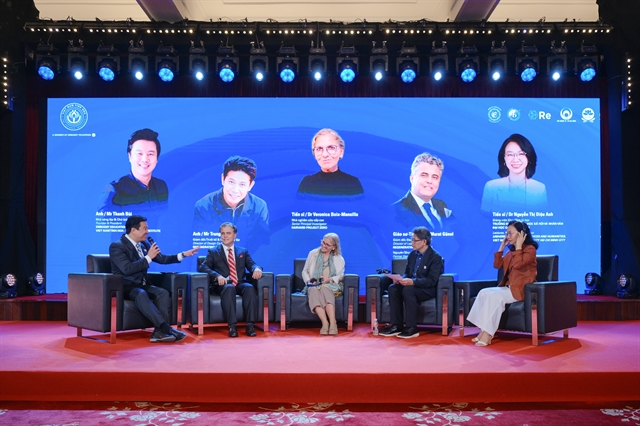
| Speakers discuss the future of education and global academic collaboration at the “Việt Nam – A Global Academic Touchpoint” conference in HCM City on April 7. —Photo courtesy of Việt Nam Tinh Hoa – The Futures Institute |
HCM CITY — An international education conference titled “Việt Nam – A Global Academic Touchpoint” was held on April 7, marking a milestone as three leading global academic institutions – Harvard Project Zero, Stanford d.school and MIT Media Lab – gathered in Việt Nam for the first time.
Held at the Independence Palace, the event aimed to foster an open academic dialogue on the future of education while positioning Việt Nam as an emerging global academic hub.
A key highlight was the signing of a long-term strategic partnership between Việt Nam Tinh Hoa – The Futures Institute, under the Embassy Education ecosystem, and the three international partners. The collaboration is expected to co-develop a new model of elite education that combines global academic excellence with Vietnamese cultural identity.
Organisers said the initiative would help nurture the potential of Vietnamese students while equipping them with competencies needed for global integration, addressing growing questions about how education systems can balance international readiness with cultural preservation.
In the context of rapid global change driven by technology, particularly artificial intelligence, speakers emphasised the need for education to evolve beyond traditional approaches. Elite education, they noted, is becoming a strategic direction to develop high-quality human resources capable of leadership and sustainable contributions to society.
Rather than focusing solely on academic achievement, this model prioritises the development of well-rounded individuals, including critical thinking, creativity, leadership and social responsibility. It also promotes personalised learning, placing students at the centre and recognising their unique potential.
Thanh Bùi, founder of Việt Nam Tinh Hoa – The Futures Institute, highlighted the importance of collaboration among stakeholders, including policymakers, educators, businesses and communities, to ensure the sustainable development of elite education.
He also stressed the need for equitable access to avoid limiting such opportunities to a small group, adding that future initiatives would focus on early talent development and building flexible, innovative learning ecosystems.
Meanwhile, Trung Lê, founder of Regenerating Education, pointed to the growing role of “co-creation” in modern academia, where knowledge is generated through networks of interaction rather than by a select few.
Veronica Boix-Mansilla added that global citizenship competencies should serve as a guiding framework across education systems, enabling individuals not only to succeed personally but also to contribute meaningfully to society.
The conference also saw the announcement of the Việt Nam Tinh Hoa Scholarship programme, aimed at nurturing talent and supporting future generations as a key national resource.
The event is expected to contribute to a broader transformation in Việt Nam’s education landscape towards a more open, collaborative and globally connected approach. — VNS
Society
 Society
 Society
 Society
 Society
 Society
 Society
 Society
 Society
 Society
 Society
 Society
 Society
 Society
 Society