 Society
European higher education week opens new opportunities
1.
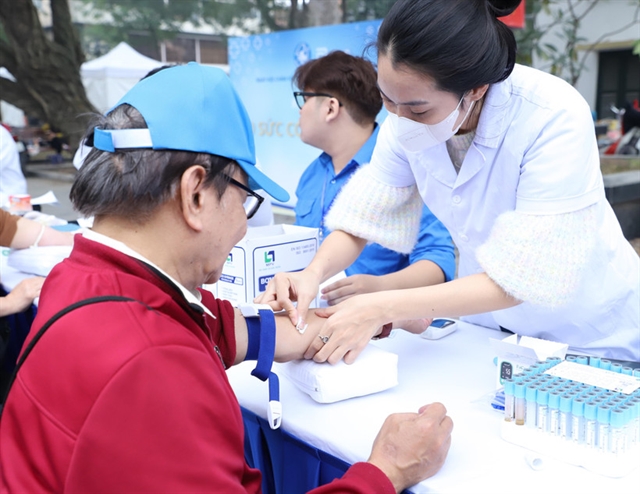 |
| Free health screenings were conducted for members of the public in Hà Nội on April 5. — VNA/VNS Photo |
HÀ NỘI — For many families, a lung cancer diagnosis arrives not as a gradual warning, but as a shock.
Hà Nội resident Nguyễn Thị Huyền, who asked that her name be changed to protect her identity, recalled how her family never imagined cancer could strike them.
Her relative, who had chronic obstructive pulmonary disease, went for regular check-ups and paid close attention to his health.
“We thought we were doing everything right. Screening for lung cancer never crossed our minds,” she said.
It was only when a persistent cough worsened that doctors recommended further screening, which led to the discovery of a tumour caused by lung cancer.
“The feeling was overwhelming — fear, anxiety and immediate worries about finances and how to arrange work to care for him,” Huyền said.
“We were lost at first, trying to understand treatment options.”
That uncertainty eased after the family sought care at K Hospital’s Tân Triều facility, where doctors provided a clear treatment roadmap.
The patient underwent minimally invasive endoscopic surgery and recovered quickly.
“Just one week after the surgery, he could walk 500–600 metres. That was a huge relief for us,” she said.
“We realised that lung cancer is not necessarily a death sentence if it is detected early.”
After that experience, she said cancer screening should be proactively requested and incorporated into routine medical check-ups.
“Detecting cancer at an early stage brings significant benefits for both patients and their families, including higher treatment effectiveness and better financial outcomes, as early-stage surgery is often covered by health insurance,” she told Sức Khoẻ & Đời Sống (Health and Life) newspaper.
"The care-giving journey can be long and emotionally taxing, especially when disease is detected at a late stage," she said.
Lung cancer is currently one of the leading causes of cancer-related deaths in Việt Nam, with around 25,000 new cases each year, according to the Ministry of Health.
According to Associate Professor Dr Đỗ Hùng Kiên, deputy director of K Hospital, only about 20 per cent of lung cancer patients in Việt Nam are diagnosed at an early stage when surgery is possible. Meanwhile, 40 to 50 per cent of cases are detected at stage four, the final stage, and 25 to 30 per cent at stage 3.
At later stages, patients often present with severe symptoms such as shortness of breath, chest pain, persistent cough or even metastasis to bones and brain. Treatment becomes longer, more complex and more costly.
“In early stages, the chance of a cure is significantly higher, treatment duration is shorter and the financial burden is lower,” he said.
“Patients can return to normal life and work. But in late stages, especially stage 4, treatment is no longer aimed at curing the disease but prolonging life. Patients may have to rely on the health care system for the rest of their lives.”
Survival rates reflect this stark contrast. For stage 1, the cure rate can reach 70 to 90 per cent. In stage 2, five-year survival drops to a rate of 50 to 60 per cent. By stage 3, it falls to 15 to 36 per cent, and in stage 4, only about 10 per cent of patients survive beyond five years.
Despite clear benefits, early screening for lung cancer remains limited in Việt Nam.
Dr Lê Thái Hà, deputy director general of the Việt Nam Administration of Disease Prevention, said Resolution 72 issued in September 2025 emphasised early detection and screening of risk factors as a key strategy.
“The goal is to help people understand their health status and detect diseases early, especially cancer,” she said. “Screening programmes also play an important role in raising public awareness.”
However, several challenges persist, including limited health care capacity, shortages of trained personnel and insufficient equipment.
“To implement lung cancer screening at the community level, imaging tools like chest X-rays are needed, along with the application of artificial intelligence to support diagnosis,” Hà said.
Some countries have already demonstrated the effectiveness of systematic screening.
In Japan and Malaysia, community-based lung cancer screening programmes using chest X-rays combined with AI have been deployed to detect early-stage disease and reduce the burden on health care systems.
“These models show that early detection is feasible if supported by the right infrastructure and policies,” Hà said, adding that Việt Nam could adopt similar approaches.
K Hospital has begun piloting such initiatives, though they have not yet been expanded nationwide.
Dr Kiên said a national lung cancer screening programme was essential, noting that current efforts were still fragmented, with smaller screening programmes at health care facilities or communities.
He also suggested integrating chest X-rays into general health check-ups, particularly in community-based or free health screening campaigns. — VNS
Society
 Society
 Society
 Society
 Society
 Society
 Society
 Society
 Society
 Society
 Society
 Society
 Society
 Society
 Society