 Society
84 individuals investigated for transnational online frauds
1.
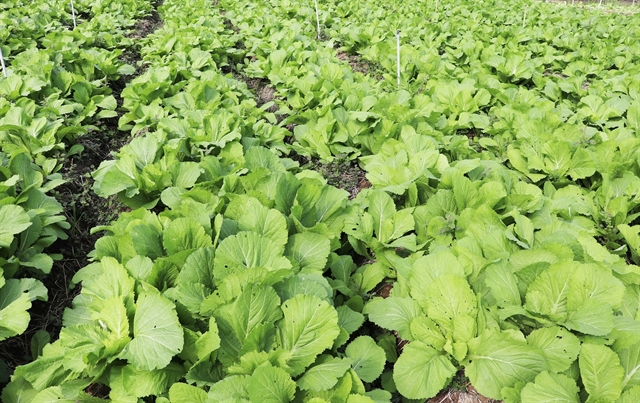 |
| Green mustard vegetables in Đồng Tháp Province are grown using water-saving sprinkler irrigation technology. — VNA/VNS Photo Hữu Chí |
Đồng Tháp — Đồng Tháp Province is developing specialised vegetable growing areas that are safe, sustainable, and adapted to new natural conditions.
The Mekong Delta province has focused on developing vegetable cultivation through planned, concentrated growing areas that create large market volumes, according to its Department of Agriculture and Environment.
It has also built value chains for production, bringing farmers together in co-operative groups and co-operatives to raise productivity and product quality, while addressing market access problems and reducing risks.
The vegetable sector not only helps diversify crops but has also become a stable livelihood, providing good incomes for many farmers.
Farmers in the province have actively applied scientific and technical advances such as growing vegetables in net houses and greenhouses, using agricultural plastic mulch, and installing water-saving sprinkler and drip irrigation systems.
About 90 per cent of vegetable growing areas now use F1 hybrid seeds, which have short growing periods and strong resistance to pests and diseases, helping improve both economic returns and product quality.
In Châu Thành Commune, vegetables are one of the key products.
The commune’s 768 hectares of vegetables produce about 17,000 tonnes of vegetables to the market each year, mainly leafy vegetables and herbs.
Vegetable farming has helped many farming households in the commune achieve stable lives and gradually become better off.
Nguyễn Văn Thương, a farmer in the commune, said his family uses a mist-sprinkler irrigation system to save water and arranges crop rotation efficiently in adherence to the principle of using short-term crops to support long-term ones.
He grows different vegetables such as sawtooth coriander, spring onions, mustard greens, and perilla in rotation on his 4,000 square metre field to have year-round harvests.
His family earns more than VNĐ150 million (US$5,800) each year, he said.
Nguyễn Văn Nam, deputy head of the commune’s Economic Bureau, said: “The commune is promoting the application of science and technology in intensive farming and guiding farmers towards clean and safe vegetable production to meet growing market demand.”
Measures such as using F1 seeds, integrated pest management, biological products, net houses, and greenhouses have been applied in specialised growing areas.
Long Bình Commune has also emerged as a key vegetable growing area of the province.
Located in the freshwater-controlled Gò Công area, it has formed safe vegetable co-operatives that apply science and technology to adapt to climate change.
Huỳnh Thị Kim Huệ, Chairwoman of the Long Bình Commune People’s Committee, said the commune will continue to implement sustainable agriculture projects linked to diversifying co-operation models and investing in irrigation infrastructure for agricultural production.
The Hòa Thạnh General Agricultural Co-operative in Long Bình Commune has more than 100 members producing vegetables under Vietnamese good agricultural practices (VietGAP) and safe standards.
Nguyễn Thanh Quang, director of the co-operative, said: “The application of science and technology in safe specialised vegetable cultivation has brought very high efficiency for both producers and consumers.”
The co-operative’s members produce an average of about 10 vegetable crops a year. Each crop yields at least 2 tonnes per 1,000 square metres in the rainy season, while in the dry season it can reach 4 tonnes.
After costs, farmers earn profits of VNĐ5–8 million ($193–310) per crop.
The co-operative is committed to purchasing all products from its members so they feel secure in investing in vegetable cultivation.
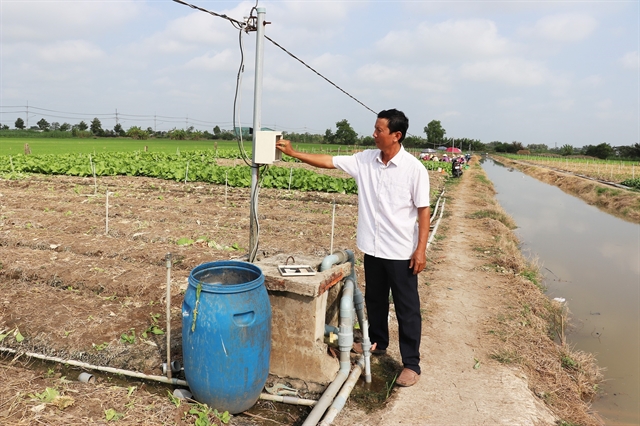 |
| Nguyễn Thanh Quang, Director of the Hòa Thạnh General Agricultural Co-operative in Đồng Tháp Province’s Long Bình Commune, operates an automated sprinkler irrigation system on a vegetable field. — VNA/VNS Photo Hữu Chí |
Farmers in the province have applied high-quality standards such as VietGAP.
Mỹ An Hưng Commune has 1,000 hectares of taro planted under safe production methods and 108 hectares are certified VietGAP.
To support large-scale taro farming, the province invested VNĐ37 billion ($1.4 million) to build infrastructure for a 126-hectare taro growing area in the commune. This project helps bring farmers together and link them in a value chain.
The infrastructure includes roads, electricity, and irrigation systems, such as pumping stations and automatic sluice gates.
Lê Hà Luân, Director of the Department of Agriculture and Environment, said the province will continue restructuring agriculture towards an ecological approach, applying science and technology and digital transformation in managing growing areas.
The agriculture sector will focus on developing key products, including safe vegetables, linked with processing and consumption, he said.
The province aims to expand vegetable growing areas to 76,245 hectares with output of 1.6 million tonnes this year.
It will establish and replicate concentrated growing models that apply smart technology, trace product origins, and develop value chains, gradually increasing the value of the vegetable sector for both the domestic market and exports. — VNS
Society
 Society
 Society
 Society
 Society
 Society
 Society
 Society
 Society
 Society
 Society
 Society
 Society
 Society
 Society