 Society

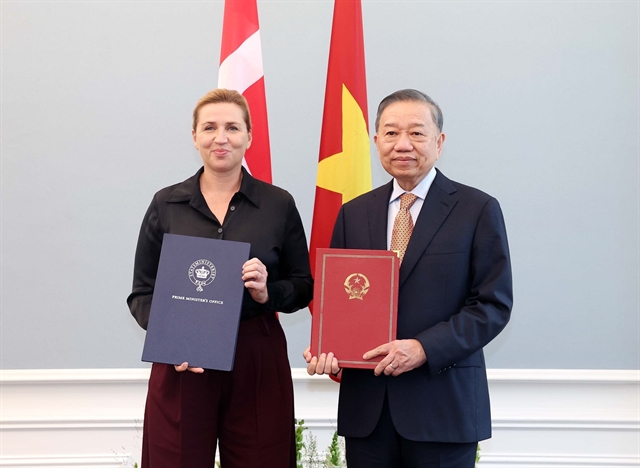
Việt Nam, Denmark issue joint statement on establishment of Comprehensive Strategic Partnership
1.
 |
| A part of centre Hà Nội. Hà Nội is granted additional authority to issue special mechanisms and policies for housing development in key areas. — VNA/VNS Photo Vũ Quang |
HÀ NỘI — A new legal framework is set to reshape the capital’s growth, with the Law on Capital 2024 allowing Hà Nội to deploy special mechanisms to spur housing in satellite areas such as Hoà Lạc, Sơn Tây, Xuân Mai and Sóc Sơn, a move officials and experts say could finally link homes to the transport, jobs and services needed to draw people out of the overcrowded historic core.
The approach is expected to deliver a breakthrough in organising urban space by tying housing development to backbone transport infrastructure. It is also seen as the linchpin for the long-term target of decongesting more than 860,000 residents from the inner city by 2045.
Under the law, Hà Nội is granted additional authority to issue special mechanisms and policies for housing in satellite towns and key areas to the west, south and north of the capital, aligned with plans for economic corridors and strategic transport axes.
That marks a shift in urban thinking. Rather than mechanically pushing people out of the centre, the city is moving towards a proactive, controlled deconcentration model, with housing at the core but developed in step with transport infrastructure, employment and essential public services.
According to the Hà Nội Capital Planning for the 2021–2030 period, with a vision to 2050, the population of the historic inner city is projected to fall by about 860,000 by 2045. Most of those residents are to be redistributed to satellite towns and new development areas. To meet the goal, a sufficiently large and diverse housing supply across segments at affordable prices is a prerequisite.
A key feature of the law’s orientation is the requirement to link housing with backbone transport infrastructure, industrial zones, high-tech zones and education and health care centres. These are the vital factors that determine whether residents will move away from the inner city.
In practice, Hà Nội’s satellite towns have developed slowly for years, in part because of weak and unsynchronised connectivity. Many housing projects have been built, but they lack schools, hospitals, jobs and convenient links to the centre, making residents reluctant to relocate for the long term.
“Decongestion will only succeed if residents perceive the quality of life in the new areas as equal to or better than their previous homes. Housing is a necessary condition, but the sufficient condition is convenient transport infrastructure, stable employment, and full social services,” said urban planning expert, architect Nguyễn Hồng Thái.
“In that context, areas like Hoà Lạc with its High-Tech Zone, Sơn Tây linked to education, training and tourism, Phú Xuyên with industry and logistics, and Sóc Sơn with aviation industry – services… are identified as new growth poles capable of generating jobs and attracting residents.”
Many experts argue that allowing Hà Nội to introduce special housing mechanisms in satellite areas will not only serve the decongestion goal but also create positive spillover effects for urban structure, the real estate market and the capital’s long-term economic growth.
Moving more than 860,000 residents out of the inner city is expected to bring clear environmental and quality-of-life benefits. In particular, the special mechanisms under the Law on Capital could help redirect real estate investment flows, reduce excessive concentration in the centre and unlock significant development potential in satellite areas.
“Hà Nội’s inner city is under enormous pressure from traffic, technical infrastructure and public services. When the population is rationally redistributed, the city will have the conditions to renovate public spaces, increase green areas, and improve quality of life for both those who remain and those moving to new areas,” said Trần Ngọc Chính, chairman of the Việt Nam Urban Planning and Development Association.
“Linking housing development with backbone transport infrastructure and new growth poles will help form a multi-centred urban structure, reducing overload on the historic inner city. If implemented synchronously, satellite areas will no longer be peripheral regions but complete towns capable of self-balancing population and employment.”
Significant challenges and difficulties
Architect Trần Tuấn Anh, an urban planning expert, said that despite a more favourable legal framework, rolling out special mechanisms for housing tied to decongestion still faces major hurdles.
First, large-scale housing in new areas demands huge investment in infrastructure. State budgets are limited, and mobilising socialised capital continues to face obstacles in risk and benefit sharing.
Second is the risk of a mismatch between housing and infrastructure. If homes rise faster than infrastructure, new urban areas could become ghost towns lacking vitality. If infrastructure comes first but housing lags, social resources may be wasted.
Third, prices and access matter. If homes in decongestion areas are too expensive, the main targets, middle and low-income groups, will struggle to afford them.
Fourth, without reasonable compensation, support and resettlement policies, the risk of complaints and project delays remains high.
“To implement the law’s special mechanisms effectively, Hà Nội needs a synchronous, long-term system of solutions,” said Anh.
He said the city should establish flexible financial mechanisms for infrastructure and housing in decongestion areas, with priority given to public transport as the decisive factor in shortening distances in space and time and making daily work and study more convenient.
At the same time, housing products should be diversified with priority for low-income groups, because without tight oversight it is easy to drift away from the original objectives.
Experience from major projects also shows that land clearance remains a challenge, meaning this work needs to move one step ahead.
Moreover, improving urban governance and regional coordination is urgent. Decongestion is not an issue for individual projects or single localities. It requires close coordination among departments, sectors and authorities at all levels within a unified framework. — VNS
Society
 Society
 Society
 Society
 Society
 Society
 Society
 Society
 Society
 Society
 Society
 Society
 Society
 Society
 Society