TPBank secures $50 million in long-term funding from DEG
1.
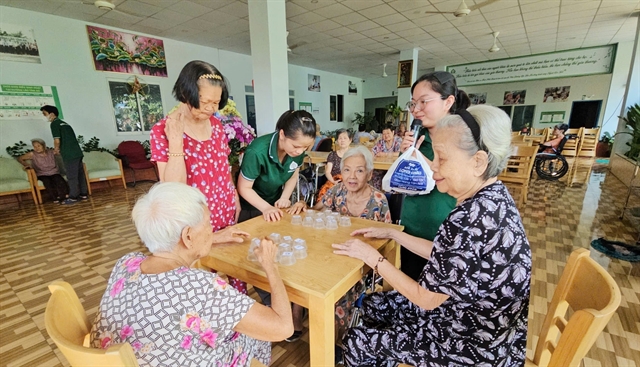 |
| Senior citizens at a nursing home in HCM City. — VNA/VNS Photo Đinh Hằng |
HÀ NỘI — Việt Nam’s rapidly ageing population is leading to a growing demand for elderly care services, but experts note that the workforce for this field remains inadequate in both quantity and quality.
Statistics show that in 2025, people aged 60 and above accounted for more than 14 per cent of the population. By 2036, Việt Nam is projected to officially become an aged society.
This unavoidable and irreversible trend is raising new issues for development strategies, governance, management and the selection of socio-economic growth models.
On September 9, 2025, the Politburo issued Resolution 72-NQ/TW on the protection, care and improvement of public health, which stresses the need for “attention to training and developing a high-quality, balanced health care workforce with adequate ethical standards and professional capacity to meet task requirements and public satisfaction.”
The document also highlighted the need for the “development of elderly care facilities; continued improvement of rehabilitation service systems; and effective integration between medical facilities and elderly care institutions.”
The Prime Minister has also approved the National Strategy for the Elderly to 2035, reaffirming the goal of improving the quality of life and comprehensive health care for senior citizens.
Elderly care is increasingly recognised as a social task of profound humanitarian value that requires systematic investment, rather than merely a family responsibility or a community activity.
State management agencies have paid greater attention to policy formulation, planning and the development of a professional workforce in this field, but significant challenges persist.
Minister of Education and Training Nguyễn Kim Sơn pointed out that demand for elderly care services is rising rapidly, while the number of formally trained personnel remains limited.
Currently, there are only two institutions nationwide offering master’s and doctoral programmes in geriatrics. Other specialisations, such as nursing, nutrition, public health, social work and mental health, have only included elderly care as a part of the general curriculum.
In addition, short-term training programmes in geriatrics, geriatric nursing, palliative care or therapy for senior citizens remain unpopular and insufficient to meet actual needs.
Elderly care work requires patience and dedication and often involves considerable physical and mental pressure, making the sector less attractive.
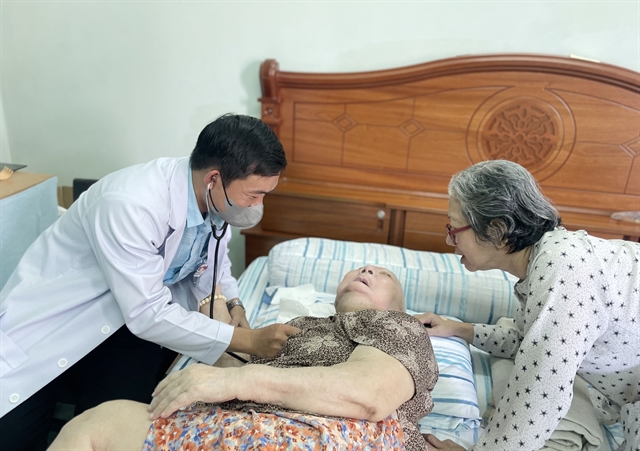 |
| An elderly woman in HCM City receives an at-home medical examination. — VNA/VNS Photo |
The profession has yet to be properly valued by society, according to Sơn. Care workers are often seen merely as domestic helpers or auxiliary labour, which undermines motivation and long-term commitment to the profession.
Professional capacity among care workers is also uneven. Due to high demand, many caregivers, especially those providing home-based care, have not received systematic training in medical knowledge, psychology, communication skills or handling age-specific situations.
The social perception of care work as a female occupation, while the number of elderly men is increasing, has led to a shortage of male workers in the sector.
Building a professional workforce
Associate Professor Dr Phạm Quốc Thành, president of Thái Bình University, said that training and developing the elderly care workforce requires a comprehensive set of solutions that are both strategic in the long term and feasible in the short term.
The first priority is to raise social awareness of the role, significance and importance of the workforce, he said.
Thành explained that elderly care is still widely regarded as low-skilled labour, leading to reluctance to enter the field. Communication, education and social outreach play a particularly important role in changing perceptions and fostering positive attitudes and respect for care workers.
Measures could include stepping up communication through mass media and social networks about society’s growing demand for elderly care services; integrating modules on caring for older persons into general education and career guidance programmes; and honouring and rewarding those who make contributions to elderly care.
These activities would help shift social perceptions, enhance professional status and create motivation for workforce development in the sector, said Thành.
Policy-wise, he noted that legal frameworks should be further refined to include an official occupational code for 'elderly care workers' and related skill standards, which will serve as the basis for training, assessment and professional certification.
In addition to opening geriatric care programmes in educational institutions, mechanisms should be put in place to inspect, evaluate and supervise training quality, Thành said. Specific certification standards should be set for each training level to ensure consistency and international recognition.
The Government could also introduce supporting policies in regard to tuition fees, scholarships and training costs, or establish remuneration, career advancement and welfare mechanisms for elderly care workers.
At the same time, efforts should be made to strengthen workforce statistics, forecasting and data management, and to build a national database on the elderly care workforce to support policymaking, training planning and labour supply-demand matching, said Thành.
He added that Việt Nam could expand cooperation with countries like Japan, Sweden and the Republic of Korea, which have advanced training and workforce management systems in elderly care, to learn from their models, particularly for training standardisation, practical skills, professional ethics and quality assessment processes.
Only through coordinated implementation can Việt Nam build an elderly care workforce that is sufficient in quantity and strong in quality, capable of meeting the demands of population ageing and sustainable development, he said. — VNS
 Society
 Society
 Society
 Society
 Society
 Society
 Society
 Society
 Society
 Society
 Society
 Society
 Society
 Society