PETRONAS reaffirms partnership with Việt Nam on energy security
1.
|
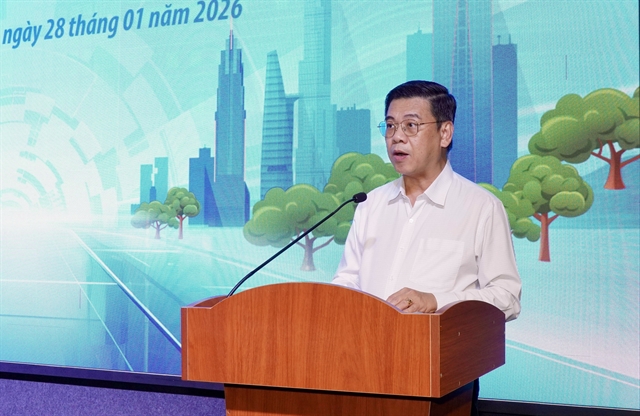
| Nguyễn Văn Dũng, vice chairman of the HCM City People’s Committee, speaks at the consultation workshop on the development strategy for the Việt Nam International Financial Centre in the city. — VNA/VNS Photo |
HCM CITY — HCM City on January 28 held a high-level consultation workshop to gather expert input for its draft strategy to develop the Việt Nam International Financial Centre in the city, as part of its long-term ambition to position itself as a regional and eventually global financial hub.
The workshop was jointly organised by the city Institute for Development Studies (HIDS) and the city Việt Nam International Financial Centre (VIFC-HCMC), with the participation of representatives from central ministries, city leaders, international consulting firms, and domestic and foreign economic and financial experts.
According to the draft strategy, it aims to enter the top 75 global financial centres under the Global Financial Centres Index (GFCI) by 2035, with a longer-term target of reaching the top 50 by 2045.
In the 38th edition of the GFCI released in September 2025, the city ranked 95th out of 120 financial centres worldwide, climbing three places compared to the previous assessment.
While this improvement is seen as a positive signal, it also highlights the considerable gap the city must bridge to catch up with leading regional financial hubs.
The target of joining the world’s top 75 financial centres is widely regarded as challenging, but it reflects both the city’s ambition and its perceived potential at a time when global capital flows are undergoing significant restructuring.
Against this backdrop, the city is accelerating efforts to finalise a comprehensive development strategy for VIFC-HCMC, laying the groundwork for the next phase of implementation.
Speaking at the workshop, Nguyễn Văn Dũng, vice chairman of the city People’s Committee, said the city is currently prioritising two key tasks.
The first is to complete the operational regulations for the international financial centre, to be applied consistently in both HCM City and Đà Nẵng, in accordance with National Assembly Resolution No. 222/2025/QH15 on international financial centres in Việt Nam and eight related government decrees issued in late 2025.
At the same time, the city is continuing to refine the draft development strategy for VIFC-HCMC by collecting additional feedback from consulting firms and experts.
“The goal for the initial phase from 2026 to 2030 is to build and firmly establish the foundations of the international financial centre, creating strong momentum for subsequent development stages,” Dũng said.
From a strategic advisory perspective, Arnaud Ginolin, managing director and senior partner at The Boston Consulting Group (BCG), stressed that building an international financial centre of global stature is a long-term journey that requires a clear roadmap and sustained commitment in execution.
According to Ginolin, VIFC-HCMC is currently at an early stage of development, with a critical objective over the next three to five years being to emerge as a regional financial centre.
Achieving this will require the city to gradually expand its range of financial products serving international investors in Việt Nam, while also providing cross-border financial services to markets across Asia and Southeast Asia.
However, he cautioned that the path towards becoming an international financial centre is highly competitive.
Over the past five to ten years, many countries have launched international financial centres, yet not all have achieved global relevance. Some have remained mere intermediaries, lacking sustainable competitive advantages.
Drawing on international experience, BCG noted that financial centres typically pursue one of two development paths: either rapid diversification across a wide range of products from the outset, or deep specialisation in a limited number of niche areas before expanding gradually.
For HCM City, a diversified product strategy in the early stage is considered more appropriate, before targeting global financial centre status over the next 10 to 15 years.
On this basis, BCG recommended that VIFC-HCMC initially focus on developing four core product groups to build early competitive advantages.
The first priority is the international capital market, including international bond products and initial public offerings (IPOs) targeting global investors.
International trade finance was also identified as a key pillar, encompassing cross-border payment services, trade finance and supply chain finance, leveraging the strong growth in trade and foreign direct investment flows into Việt Nam and the wider region.
|
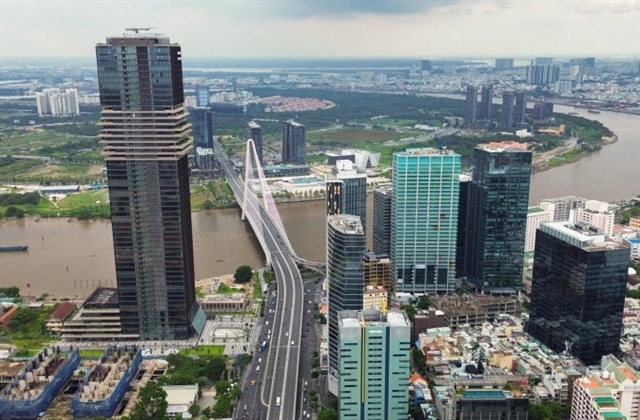
| An aerial view of HCM City, where the city is advancing plans to develop the Việt Nam International Financial Centre as part of its long-term strategy to strengthen its role as a regional and global financial hub.— VNA/VNS Photo |
In addition, digital banking and fintech were highlighted as potential breakthrough areas, through the establishment of digital hubs and “digital factories” where global financial institutions can locate development and operational centres, supported by regulatory sandbox mechanisms.
BCG also underscored the importance of niche segments such as commodity finance, green finance and maritime finance, all of which hold significant potential in the city but require the early completion of a robust legal and regulatory framework to be effectively developed.
Providing further insight into the strategy refinement process, Trương Minh Huy Vũ, director of HIDS and Chairman of the VIFC-HCMC Operating Authority, said the drafting committee has so far received six formal written submissions from the State Bank of Viet Nam, the Ministry of Finance, consulting organisations and direct expert contributions.
The committee will continue working closely with partners, particularly BCG, to finalise the draft and provide detailed responses and explanations to the feedback received.
Vũ noted that five major issues are currently being prioritised for clarification, including the overall structure and logic of the strategy; development orientations for key product groups such as trade finance, supply chain finance, green finance and innovation; domestic and international partnership networks; foundational legal issues; and the need to balance medium-term strategic planning with effective day-to-day operations.
Alongside strategy development, VIFC-HCMC is also studying longer-term challenges related to institutional frameworks, capital flow infrastructure and, notably, digital infrastructure and services.
Cooperation with major domestic technology companies to build secure and sovereign digital infrastructure, capable of supporting artificial intelligence and advanced digital platforms, has been identified as a critical pillar for the sustainable development of the international financial centre in the years ahead. — VNS
 Society
 Society
 Society
 Society
 Society
 Society
 Society
 Society
 Society
 Society
 Society
 Society
 Society
 Society