 Society

Top leader hails friendship association's role in nurturing Việt Nam–Denmark ties
1.
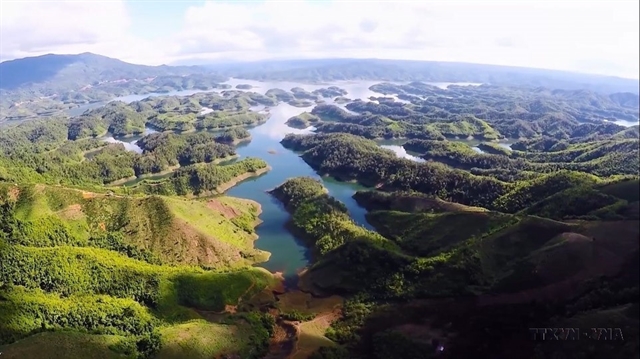 |
| Tà Đùng National Park is dubbed the 'Hạ Long Bay of the Central Highlands' and holds premium biodiversity value in Lâm Đồng Province as well as in the wider Central Highlands region. — VNA/VNS Photo Hưng Thịnh |
LÂM ĐỒNG — Tà Đùng National Park is renowned as an attractive tourist destination, dubbed the 'Hạ Long Bay of the Central Highlands', and serves as a shining example in forest protection and development linked to biodiversity conservation.
In addition to effectively managing and protecting existing forest areas, the Tà Đùng National Park Management Board in Lâm Đồng Province has collaborated with various organisations to implement coordinated and effective measures.
These aim to restore and expand forest coverage, contributing to greening every inch of land within the assigned forest compartments under their management and protection.
Nestled amid the majestic great forests of the Central Highlands, Tà Đùng National Park is not only famous as a captivating tourist spot, but also stands out in its efforts to protect and develop forests while preserving biodiversity.
Here, facing escalating challenges such as drought, climate change and illegal logging or forest land encroachment, the Tà Đùng National Park Management Board has proactively deployed numerous effective solutions.
These preserve natural forests while greening every patch of land and hillside, enhancing forest cover in the assigned management and protection areas.
Tà Đùng National Park is located in the east of the Đắk Nông Plateau, west of the Di Linh Plateau and southwest of the Chư Yang Sin highlands. It is a watershed protection forest for two major rivers: the Krông Nô-Sêrêpôk River to the north and the Đồng Nai River to the south.
It also serves as the primary source of water for domestic use, agricultural and industrial production and hydropower in a key economic region of southern Việt Nam.
Spanning a natural area of approximately 21,000ha, Tà Đùng National Park boasts over 85 per cent forest cover in its core zone, with primary forest accounting for more than 48 per cent and secondary forest over 36 per cent.
Positioned between the southern Central Highlands and southeast region, Tà Đùng is recognised as a key conservation site within the Đồng Nai River basin landscape conservation area and the southern Trường Sơn landscape conservation area. It is one of 222 endemic bird areas worldwide.
According to Director of the Tà Đùng National Park Management Board Khương Thanh Long, afforestation has been identified as a core task.
Over the past few years, alongside stringent forest protection efforts, the board has maintained annual planting activities on bare land within the park's forest compartments. Since last year, nearly 620ha of new and regenerated forest have been established in these areas.
In just the last two years, in response to the Prime Minister's 'One Billion Trees' initiative, the management board has partnered with buffer zone residents and relevant organisations and individuals to plant nearly 32,500 trees. These were planted in degraded forest areas, around the unit's headquarters, along National Highway 28 and at public facilities, public lands, roads, schools and villages in the park's buffer zone.
Achieving these results stems not only from the unit's relentless efforts, but also from active support by the local community and authorities. Socialised afforestation activities mobilising community participation at Tà Đùng National Park have made positive strides, becoming a highlight in environmental protection and climate change adaptation.
Community forests
For several years, the Tà Đùng National Park Management Board has proactively connected with numerous organisations and individuals to source seedlings and carry out afforestation and forest development on bare lands.
According to the board, tree planting will become an annual event at the unit, with volunteer participation not only fostering forest growth but also raising community awareness of the value provided by forest ecosystems.
As a result, afforestation and forest regeneration at Tà Đùng go beyond mere numbers of trees or areas planted.
More importantly, there has been a shift in approach. Forests are no longer solely the State's responsibility, but a shared concern for the community and businesses. High survival rates, well-nurtured demarcated forests and active involvement from local forest protection forces are all highly positive indicators.
Moreover, through communication activities and field trips, many young people have gained opportunities to learn about and better understand the importance of forest protection.
In recent years, the Centre for Environmental Education and Forest Environmental Services under Tà Đùng National Park has organised numerous extracurricular sessions and forest canopy explorations for pupils from lower secondary schools in the park's buffer zone communities.
Here, the children immerse themselves in nature, enjoy the fresh air, observe many endemic flora and fauna and visit famous scenic spots within Tà Đùng forest.
Park staff also integrate knowledge about forest trekking skills and forest fire prevention and control principles in an engaging manner, making it easy and effective for pupils to absorb.
This ignites environmental and natural resource protection awareness, nurturing a sense of responsibility among these tiny forest guardians living in the buffer zone communities of Tà Đùng National Park. — VNS
Society
 Society
 Society
 Society
 Society
 Society
 Society
 Society
 Society
 Society
 Society
 Society
 Society
 Society
 Society