 Society

AIMCONNECT 2026 Held in Singapore, Bringing Global Automotive Leaders Together to Explore the Future of AI, Trust and Connected Mobility
1.
 |
| Doctors during a patient examination. The healthcare sector is developing a project on implementing a free hospital policy for all. VNA/VNS Photo |
HÀ NỘI — Việt Nam’s health sector is pushing towards zero-fee hospital treatment and regular health checks for all citizens in line with Politburo Resolution No. 72-NQ/TW.
The Ministry of Health has recently been collecting public and expert opinions to help implement the policy.
Deputy Minister Vũ Mạnh Hà noted that in 2024, health insurance coverage in Việt Nam reached 94.29 per cent of the population.
The network of medical facilities now reaches down to the commune level, while professional capacity at advanced, basic and primary levels has improved significantly.
“The list of medicines and medical equipment covered by health insurance – and therefore accessible to patients with health insurance cards – has been progressively expanded,” Hà said.
Despite these achievements, major challenges remain.
Out-of-pocket spending by citizens accounts for over 40 per cent of total medical costs, remaining high compared with World Health Organization recommendations.
The risk of impoverishment due to illness persists, particularly for the poor, vulnerable groups and those living with chronic or long-term conditions. Household financial strain continues to grow unless decisive public-policy interventions are introduced.
“That is why the policy goal of gradually moving towards zero hospital fees is both an objective and urgent requirement. It reflects the humane character of Việt Nam’s social-policy system while ensuring people’s right to health care,” Hà said.
He added that zero-fee hospitals are not just a financial measure, but carry profound social significance. They reduce the cost burden on citizens – especially the poor and vulnerable – promote fairness in access to health services so that no one is left behind and improve quality of care by removing financial barriers that delay treatment.
The policy also supports the development of a sustainable health care system and lowers the risk that people postpone or abandon necessary medical care due to cost.
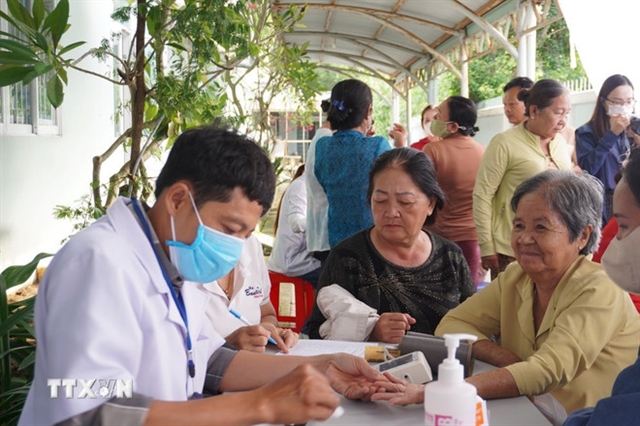 |
| Medical examination for people at the Community Health Care Programme. VNA/VNS Photo |
Meanwhile, Trần Thị Trang, director of the ministry’s Department of Health Insurance, said health care costs remain very high, with citizens paying an estimated 40 per cent out of pocket.
The total value of medical expenses not covered by the health insurance fund is estimated at around VNĐ24.8 trillion (US$942 million) per year.
Health insurance contributions remain low, at 4.5 per cent of the salary or reference base used for calculation.
The policy goal of zero hospital fees aims to achieve universal health insurance coverage while gradually reducing and ultimately eliminating co-payment rates.
“For the basic service package eligible for zero fees, we will define the list of services, diseases, medicines and medical equipment included,” Trang said.
“It will initially cover common conditions, prioritise essential diseases first and expand gradually in line with professional requirements and the financial capacity of the State budget and the health insurance fund, combined with social mobilisation. At the same time, we will set a maximum cost per medical visit.”
Specifically, the average cost of inpatient and outpatient care nationwide will be set and adjusted annually or periodically, excluding a number of high-cost diseases and technical procedures.
Initially, the policy will apply at primary-level and basic-level facilities, as well as both public and private healthcare providers.
“Its implementation will follow a roadmap, with priority groups and contribution levels aligned with the health insurance fund’s balancing capacity and the socio-economic conditions of each period,” Trang said.
In terms of funding, the policy will rely on the pillars of the health insurance budget, the disease-prevention fund and social mobilisation.
This includes an expected increase in State-Budget spending and gradual rises in health insurance contribution rates between 2027 and 2030.
The State Budget will subsidise contributions for priority groups.
The Disease Prevention Fund will also be used, alongside diversified financial sources such as supplementary health insurance, commercial health insurance, patient assistance programmes and new revenue from taxes on products harmful to health.
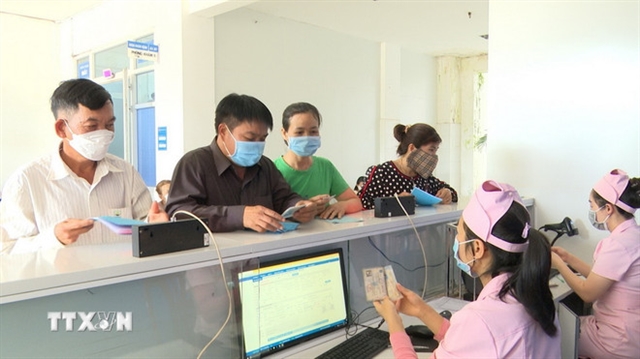 |
| People registering for health checks. VNA/VNS Photo |
Under the proposal, from 2026, citizens will receive at least one free annual health check or screening session, with implementation phased according to target groups.
Activities such as periodic health checks, free screenings, student health assessments, occupational health checks for workers and insured medical examinations will be integrated to provide free healthcare consultations and comprehensive electronic health records for all citizens.
Priority groups from 2026 – including near-poor households and individuals aged 75 and above receiving social pensions – will be entitled to full coverage of examination and treatment costs within the health insurance benefit package.
Reimbursement rates for medicines, medical equipment and technical services will be increased.
Additionally, health insurance contributions will rise from 2027 to around 5.1 per cent, with the State subsidising contributions for social-policy groups.
Between 2028 and 2030, the goals include reducing out-of-pocket spending to below 30 per cent, further raising reimbursement rates for medicines, equipment and services, piloting screening for two to three cost-effective diseases, covering preventive services under the health insurance fund, increasing health insurance coverage to above 95 per cent of the population, raising contribution rates to 5.4 per cent and piloting supplementary health insurance and diversified insurance packages.
After 2030, universal health insurance coverage is expected, along with expanded screening for three to five cost-effective diseases.
Zero hospital fees nationwide will apply within the basic service package, expanding gradually as resources allow. Health insurance contribution rates are projected to rise to six per cent from 2032.
The primary health care network and a smart, multi-tiered health insurance payment system are expected to be fully implemented. VNS
Society
 Society
 Society
 Society
 Society
 Society
 Society
 Society
 Society
 Society
 Society
 Society
 Society
 Society
 Society