 Society

Việt Nam steps up fight against counterfeits, IP violations
1.
|
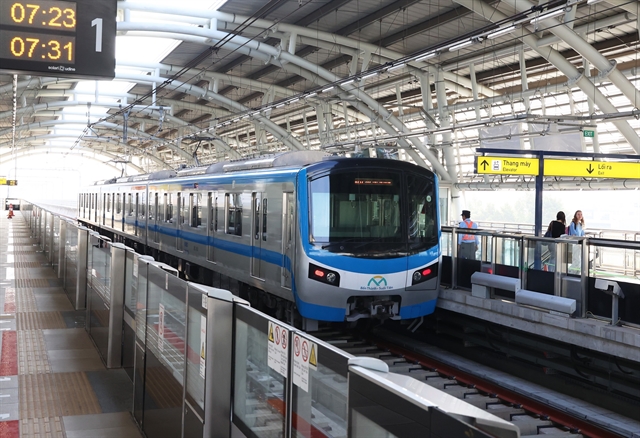
| HCM City plans a metro network of 27 lines spanning more than 1,000 kilometres. — VNA/VNS Photo Hồng Đạt |
HÀ NỘI — The gradual operation of metro lines in Hà Nội and HCM City is a major milestone in the development of urban transport infrastructure.
Beyond easing traffic congestion, urban railway systems lay the groundwork for transit-oriented development (TOD), opening new growth potential for the real estate market in the medium and long terms.
Urbanisation pressure and infrastructure challenges
Under Hà Nội’s master plan to 2030, the capital city’s permanent population is projected to reach around 11 million, with an urbanisation rate of approximately 70 per cent. Rapid population growth, coupled with increasingly limited land in the inner city, is placing significant pressure on infrastructure, particularly transport.
Urban planning experts note that metro systems are not merely transport projects but the “backbone” for reshaping long-term urban development. As public transport becomes the main axis of mobility, residential, commercial and service activities are likely to shift and cluster around stations, forming higher-density urban areas that make more efficient use of land.
In recent years, the concept of TOD has gained prominence in discussions on planning and real estate development in Việt Nam. Unlike traditional approaches, TOD focuses on building multifunctional urban areas within walking distance of public transport hubs, especially metro stations.
Matthew Powell, Head of the Hà Nội Office at Savills Việt Nam, said TOD is an important factor for development in Việt Nam over the next 5–10 years, particularly in urban areas, investing heavily in urban rail systems. The Government’s and the National Assembly’s adoption of special mechanisms for urban railway development indicates that TOD is no longer a theoretical concept but a clear policy direction.
In Hà Nội, steps towards optimising TOD are already emerging through future metro projects and those under construction. Metro Line 3 (Nhổn–Hà Đông) is nearing completion, while Line 2 (Nam Thăng Long–Trần Hưng Đạo) and Line 5 (Văn Cao–Hoà Lạc) began construction in 2025. Once operational, these lines are expected to significantly reduce travel time while improving reliability and predictability in urban transport.
TOD as a growth driver for real estate
Đào Ngọc Nghiêm, Vice President of the Vietnam Urban Planning and Development Association, said TOD is a key approach to sustainably reshaping urban spaces.
“If implemented synchronously, metro lines will create a chain of satellite centres along transport corridors, where residents can live, work, and access services without relying heavily on private vehicles,” he said.
The expert underlined that TOD is not solely a real estate issue but a comprehensive combination of planning, transport, social infrastructure, and land policy. High-density residential development around stations must be accompanied by schools, healthcare facilities, public spaces, and urban amenities to ensure quality of life.
David Jackson, Principal and CEO of Avison Young in Việt Nam and Cambodia, pointed out that financial mechanisms and land policies play a big role. In many places, rising land values near stations are used to reinvest in transport systems and public amenities, creating a positive cycle that encourages sustainable TOD growth instead of just short-term price jumps.
Nguyễn Văn Đính, Chairman of the Vietnam Association of Real Estate Brokers, said the stage when infrastructure is “taking shape” often presents the greatest opportunities for long-term investors. Projects located near metro lines under construction, with clearly defined stations or depots and mixed-use planning, tend to offer more sustainable value growth than areas benefiting only from planning announcements.
Powell added that the next 5–10 years will be a pivotal period for TOD to move from policy to practical implementation.
In this context, projects linked to metro infrastructure, supported by sound planning and integrated amenities, are key considerations for both homebuyers and investors. Once just a “keyword” in planning documents, TOD now has actual value, shaping Việt Nam’s urban landscape for the coming decade. — VNA/VNS
Society
 Society
 Society
 Society
 Society
 Society
 Society
 Society
 Society
 Society
 Society
 Society
 Society
 Society
 Society