 Society

VPS leads brokerage market share on HNX in Q3
1.
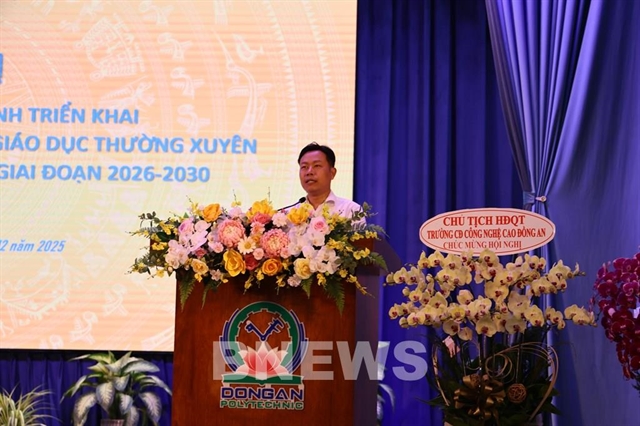 |
| Deputy Minister of Education and Training Lê Quân speaks at the conference in HCM City on December 1 on strengthening vocational training standards. — VNA/VNS Photo Huyền Trang |
HCM CITY — A national conference has called for bold, future-oriented reforms in vocational education as Việt Nam faces rapid shifts driven by digital technologies, artificial intelligence, automation and the green economy.
Speaking at the conference on December 1, officials stressed that upgrading training quality, standardising programmes and developing a highly-skilled workforce are now urgent priorities to keep pace with an evolving labour market.
According to reports presented at the conference, despite challenges posed by the pandemic and the transition to a two-tier local administration model, the 2021–2025 strategy on vocational and continuing education has been implemented on schedule.
Eight strategic task groups have been carried out, with a strong emphasis on linking training with enterprises and labour market needs.
Several components have also been integrated into the three National Target Programmes on sustainable poverty reduction, ethnic community and mountainous region development, and new-style rural development.
To strengthen digital capabilities among workers, the Ministry of Education and Training has introduced a national digital skills programme aligned with the basic digital competency framework.
It targets government officials, enterprise employees and the general public, prioritising practical, everyday skills such as online information search, e-payment, using online public services and digital safety.
Local education leaders and training institutions highlighted progress in supporting disadvantaged groups but acknowledged ongoing challenges, including uneven autonomy mechanisms, difficulties attracting high-quality trainers and gaps in training quality across regions.
Trương Hải Thanh, deputy director of the city’s Department of Education and Training, said the city has 481 vocational education institutions, which enrolled and trained more than 1.5 million learners during 2021-25.
Its trained labour rate reached about 88.1 per cent in early 2025, surpassing the target set by the municipal Party Congress.
The city currently has 100 accredited training programmes, including four recognised under the US-based ABET quality assurance system.
It is also accelerating digital transformation in vocational training, applying big data, IoT and cloud computing to build online learning platforms while expanding international cooperation with institutions in Germany, Japan, Australia, South Korea and Taiwan (China).
For the 2026-30 period, the city aims to strengthen digital competencies in vocational education, develop shared digital platforms, expand online training systems, apply AI for personalised learning, enhance simulation-based practice and build open learning resources.
 |
| Trương Hải Thanh, deputy director of HCM City’s Department of Education and Training, highlights the city’s efforts to enhance training quality. — VNA/VNS Photo Huyền Trang |
Phạm Vũ Quốc Bình, deputy director of the Department of Vocational and Continuing Education under the Ministry of Education and Training, said the sector will restructure the vocational education system toward more streamlined, internationally-aligned high-quality colleges.
“It will renew training programmes to focus on ‘skills of the future,’ and expand online learning, virtual simulation and AI-powered personalised training.”
The ministry will also standardise teacher qualifications and introduce mechanisms to attract experts, artisans and skilled professionals into teaching.
Concluding the conference, Deputy Minister of Education and Training Lê Quân said Việt Nam’s vocational education system is at a ‘golden opportunity’ for breakthrough development, in line with the Politburo’s Resolution No. 71-NQ/TW, which calls for rapid improvements in training high-skill human resources to support digital transformation, green growth and productivity gains.
“The next phase requires completing the legal framework under the amended Law on Vocational Education, with school-enterprise partnerships remaining the key to success, alongside stronger career guidance and post-secondary streaming,” he said.
The ministry has requested the Department of Vocational and Continuing Education to urgently review and propose updates to the national development strategy to meet emerging demands.
Ministries, localities and training institutions were urged to provide practical data, improve governance, embrace technology, and strengthen communication to raise public awareness of the critical role of vocational education in developing a digital-ready workforce. — VNS
Society
 Society
 Society
 Society
 Society
 Society
 Society
 Society
 Society
 Society
 Society
 Society
.jpg) Society
Society
 Society
 Society