 Society

Sovico and Hamburg Forge Partnership to Expand Vietnam-Germany Economic Ties
1.
|
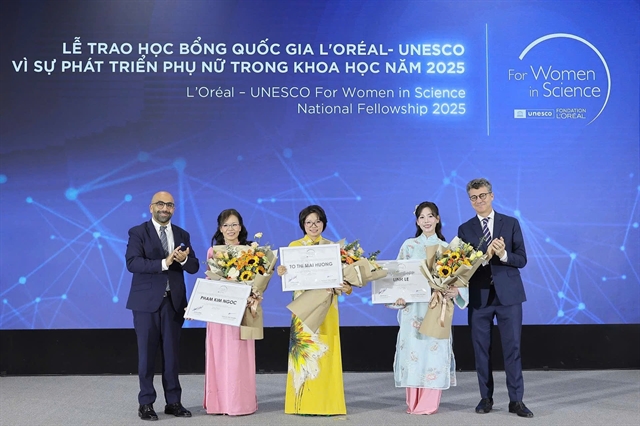
| Phạm Kim Ngọc, Tô Thị Mai Hương, and Lê Linh (in traditional ao dai) receive the L’Oréal–UNESCO For Women in Science Award. — VNS Photo Thu Trang |
HÀ NỘI — Three excellent female scientists on Monday received the L’Oréal – UNESCO For Women in Science Award for their oustanding researches.
The National Fellowship 2025 Ceremony was held in Hà Nội, recognising the exceptional scientific minds — women directly tackling humanity’s most pressing challenges, including climate change, artificial intelligence, and energy security.
Amidst the global race driven by technological revolutions and green transition, the role of women scientists has never been more essential.
The three recipients of the National Fellowship 2025, selected from over 100 scientific proposals, epitomise the programme’s rigorous criteria and strategic vision — prioritising fundamental and applied research with real-world impact, and direct contributions to sustainable development.
The first one is Assoc. Prof. Dr. Tô Thị Mai Hương, who is Deputy Head of the Research, Innovation and International Cooperation Department, and also Head of the Executive Board of the Innovation and Startup Centre under the University of Science and Technology of Hà Nội.
She has a breakthrough pathway to low-emission agriculture. Climate change demands a transformation in agriculture and Hương is pioneering a cutting-edge approach: using precise gene-editing technology (prime editing) to enhance the expression of specific genes by inserting short transcriptional enhancer sequences.
Her goal is to optimise carbon allocation in rice plants and reduce root exudates, positively influencing root-zone microbial communities and significantly reducing methane emissions — a potent greenhouse gas produced under anaerobic conditions in rice paddies.
The second one is Assoc. Prof. Dr. Phạm Kim Ngọc — Head of the Department of Nano Materials and Thin Films, Faculty of Materials Science and Technology, University of Science, Vietnam National University HCM City. She draws a pathway towards energy-efficient artificial intelligence (AI).
As AI booms, its massive electricity consumption has become a critical challenge and Ngọc focuses on In-Memory Computing architectures to overcome the traditional von Neumann bottleneck.
By developing memristors — devices capable of storing analog states that mimic synaptic behavior — particularly self-rectifying memristors, her research spans materials, devices, and integrated circuits.
The last one is Dr. Lê Linh, who is Postdoctoral Researcher at the Stanford University, the US. She owns a breakthrough solution for next-generation energy storage.
A successful energy transition requires better batteries. Linh advances promising research on Lithium–Sulfur (Li–S) batteries, targeting an energy density of around 350Wh/kg and extended cycle life.
Her project designs multifunctional liquid electrolytes that combine co-solvents and additives to minimise polysulfide shuttling and stabilise lithium metal, thereby improving capacity and durability.
Inclusive scientific development
The prestigious award L’Oréal – UNESCO For Women in Science (FWIS) was established in 1998.
It has recognised more than 4,700 women scientists worldwide, including seven laureates who later received the Nobel Prize in scientific fields after being honored by the FWIS programme.
Since its launch in Việt Nam in 2009, the L’Oréal – UNESCO FWIS programme has remained steadfast in its mission: to identify and nurture the brightest “gems” of Vietnamese science and enable them to realise bold research ideas.
Over 16 years of strong and continuous commitment to empowering women in science, 41 Vietnamese female scientists have been honoured, accompanied by numerous research projects that have made their science marks internationally.
At the event, Wagih Ahmed, Chief Executive Officer of L’Oréal Việt Nam, said, “The world needs science, and science needs women. The award programme vividly demonstrates that when women are given opportunities and support, they can achieve extraordinary feats and create positive changes for society. They are an endless source of inspiration for younger generations pursuing the challenging yet profoundly rewarding path of science.”
Jonathan Baker, UNESCO Representative to Việt Nam, affirmed, “Science is a universal language, a critical engine for human progress, and that its full potential can only be realised when women are equally represented and empowered to lead. Supporting women in science is not a symbolic act – it is an investment in our shared future.”
The National Fellowship 2025 Ceremony marks the beginning of a new chapter in these scientists’ research journeys. From rice fields to semiconductor labs and battery innovation, their intellect and dedication are shaping a more sustainable future for Việt Nam and the world. — VNS
Society
 Society
 Society
 Society
 Society
 Society
.jpg) Society
Society
 Society
 Society
 Society
 Society
 Society
 Society
 Society
 Society




