 Society

Top Vietnamese leader highlights new horizon for Việt Nam–Denmark cooperation
1.
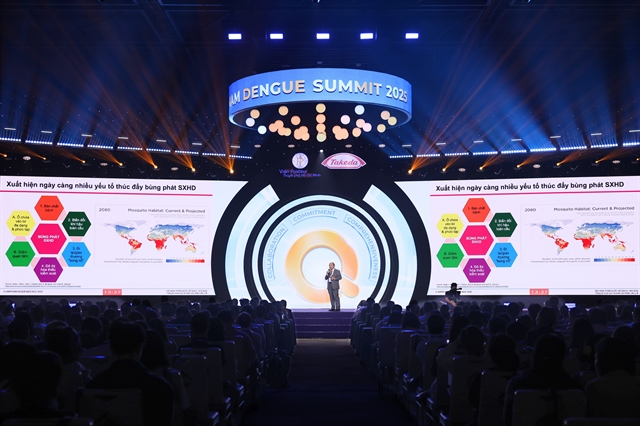 |
| Delegates attend a plenary session discussing global dengue trends and prevention strategies at the Vietnam Dengue Summit 2025 in HCM City from November 28 to 29. — Photo courtesy of the organisers |
HCM CITY — More than 700 delegates gathered in HCM City for a national scientific conference calling for stronger multisectoral actions to curb rising dengue cases amid increasingly complex transmission patterns.
The Vietnam Dengue Summit 2025 (VDS 2025), held on November 28–29 and co-organised by the Pasteur Institute HCM City and Takeda Vietnam, brought together representatives from the Ministry of Health, the World Health Organization (WHO), research institutes, hospitals, universities and international organisations.
Under the theme “Advancing comprehensive actions for effective dengue control,” the summit focused on improving preparedness, reducing severe cases and strengthening the health system’s readiness as dengue spreads across more regions and age groups.
The two-day conference centred on four strategic pillars: communication, clinical management, proactive prevention and predictive modelling.
Pre-conference sessions on November 28 included scientific capacity-building activities and parallel workshops on national dengue trends, data-presentation skills and scientific writing. Nearly 30 research groups presented studies on epidemiology, treatment, diagnostics and community education.
At the plenary session on November 29, experts discussed global and regional lessons, including a proactive prevention model from Argentina, offering insights applicable to Việt Nam.
Assoc. Prof. Nguyễn Vũ Trung, director of the Pasteur Institute HCM City, said Việt Nam remains one of the world’s major dengue hotspots. The disease is no longer seasonal and now circulates year-round, he said.
“This reality demands an integrated strategy across surveillance, prevention, clinical management and risk communication, backed by strong multisectoral collaboration,” he noted.
WHO has identified dengue as one of the top 10 global health threats. Việt Nam reports more than 100,000 cases annually, with infections peaking at nearly 370,000 in 2022 — the country’s highest on record.
From January to October 2025, Việt Nam recorded 110,503 dengue cases and 23 deaths, up 16.8 per cent in cases and two additional deaths compared with the same period last year.
Recent data show shifting age patterns and wider geographic spread. The southern region remains hardest hit, and the proportion of patients over 15 has risen significantly, underscoring that dengue affects all age groups, not just children.
Prof. Vũ Sinh Nam, senior dengue advisor at the National Institute of Hygiene and Epidemiology, stressed the need to shift from passive response to proactive prevention, integrating vector control, surveillance, behaviour-change communication, standardised clinical care and vaccination in line with WHO recommendations.
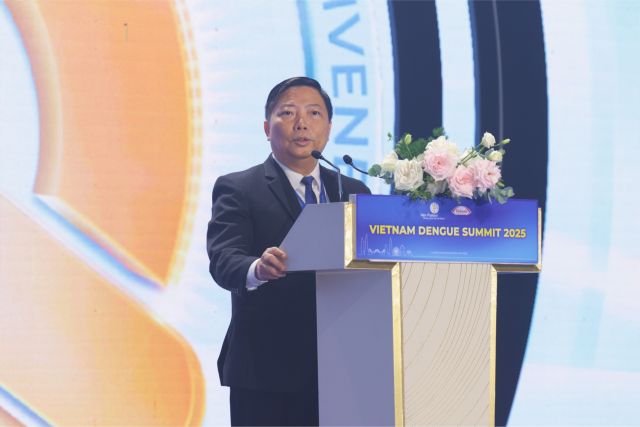 |
| Assoc. Prof. Nguyễn Vũ Trung, director of the Pasteur Institute in HCM City, delivers opening remarks highlighting the need for integrated and proactive dengue-control measures at the Vietnam Dengue Summit 2025. — Photo courtesy of the organisers |
Prevention remains key amid rising burden
Benjamin Ping, general manager of Takeda Vietnam, said that while public awareness of dengue is high, understanding of its risks and economic burden remains limited. Hospitalisations, school absenteeism and financial strain on families remain common, he said.
“With no specific antiviral treatment, prevention is essential — including vector control, risk communication and access to dengue vaccination, now available in Việt Nam,” he added.
Takeda’s dengue vaccine, recommended by WHO for countries with a high disease burden, has been approved in 41 countries, with more than 21 million doses distributed globally.
The summit also launched the monograph “Dengue – Supporting capacity building for Việt Nam’s medical workforce” to enhance professional capabilities at the grassroots level.
Presentations on the use of artificial intelligence in dengue surveillance and forecasting showcased new technological tools to support early warning systems and future prevention efforts.
Parallel discussions explored digital-era dengue communication, improved clinical management and forecasting technologies, creating platforms for knowledge exchange among researchers and frontline health workers.
Participants agreed that comprehensive, multisectoral coordination — from preventive healthcare and clinical management to communication and community engagement — is crucial to reducing cases, lowering mortality and preventing large outbreaks.
Proactive prevention, including vaccination, is expected to play an increasingly important role in easing the disease burden and improving the health system’s capacity to respond to future surges.
VDS 2025 concluded with a unified call for action, reaffirming strong cooperation among stakeholders and a shared commitment to advancing scientific progress and integrated solutions for effective dengue control in Việt Nam. — VNS
Society
 Society
 Society
 Society
 Society
 Society
 Society
 Society
 Society
 Society
 Society
 Society
 Society
 Society
 Society