 Life & Style
Việt Nam, Switzerland to turn education, sci-tech, innovation into cooperation focus
1.
HÀ NỘI — After finishing her work at 5.30pm at a kindergarten, Emma Wylie travels more than five kilometres from her office in Tây Hồ Ward to a Vietnamese class on Hoàng Quốc Việt Street in Cầu Giấy Ward.
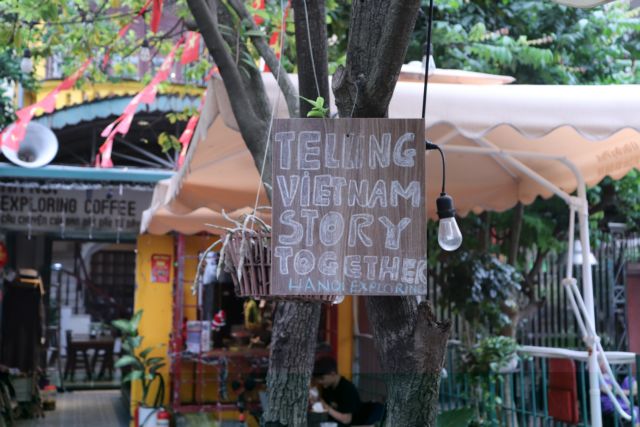 |
| Hanoi Exploring classes are held at a café in a small alley in Hà Nội. — Photo vtv.vn |
In a small room at a café, the 25-year-old Scottish teacher joins five other students from Russia, Germany and the UK as they begin learning basic Vietnamese, covering greetings, self-introductions and even bargaining skills for shopping at local markets.
To them, learning the language is about far more than mastering vocabulary – it is a way to better understand the country's people, culture and way of life.
Wylie's class is part of Hanoi Exploring, a project founded in early 2024 by Lê Huy Khánh, a final-year student at the University of Languages and International Studies under Việt Nam National University, Hà Nội.
Having moved from the central highlands to the capital to attend university, Khánh understood the loneliness of starting over in an unfamiliar city.
Noticing that many foreigners were living in relative isolation because of language barriers, he came up with the idea of creating an open learning environment where foreigners can learn Vietnamese through real-life conversations and everyday experiences, rather than through traditional classroom instruction.
Each course consists of six in-person sessions, teaching short conversational phrases centred on real-life situations such as shopping at a market, bargaining, asking for directions and ordering food.
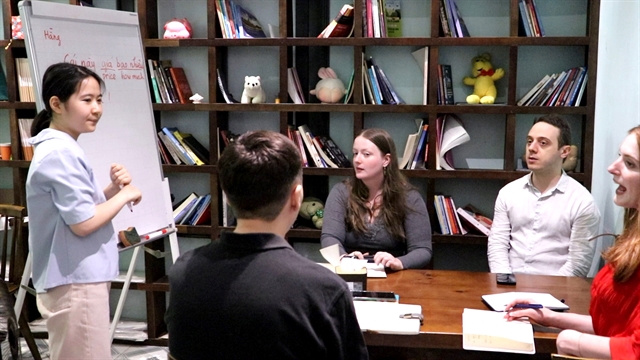 |
| The lessons focus on real-life situations such as shopping at a market, bargaining, asking for directions and ordering food. — Photo vtv.vn |
According to Khánh, the biggest challenge has been keeping volunteers motivated, as the project demands a considerable amount of time and effort without offering any financial compensation.
When it was first launched, the initiative had just six members, who often had to rent or borrow venues to keep the classes running. Foreign learners were also few and far between.
"But seeing how enthusiastic the students are every time they come to class, and how eager they are to learn about Vietnamese culture, gives us the motivation to keep going," he told VnExpress
In the early days, developing suitable teaching materials proved to be another major challenge, so the team had to spend months refining its approach.
Instead of focusing on spelling drills or academic grammar, which often discouraged learners, they adopted a simple principle: keep lessons practical and easy to follow.
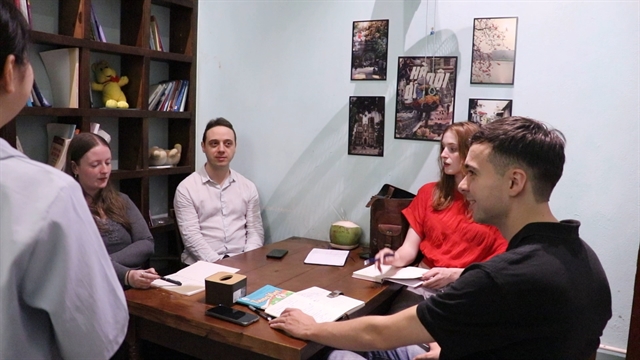 |
| Hanoi Exploring supports foreigners in adapting to their new lives in Hà Nội. — Photo vtv.vn |
Learning together
Teaching a tonal language is always a challenge. Nguyễn Minh Hằng, a 21-year-old volunteer, said many learners struggle to distinguish between vowel pairs such as ô and ơ, or u and ư. Others take weeks to tell the difference between the Vietnamese tones.
Collin Richardson, one of the students, admitted that learning Vietnamese had been much more challenging than he had expected.
"At first, I honestly thought learning Vietnamese would be easier," Richardson said.
"I assumed it would be fairly straightforward because Vietnamese words are quite short. But the more I learned, the more I realised I was wrong. The hardest part for me is the tones."
To help overcome these difficulties, Hằng designs lessons around real-life scenarios and incorporates explanations of common cultural differences and 'culture shock' moments into her classes.
Hanoi Exploring receives support from the owner of the café in Cầu Giấy, who provides the venue free of charge during the evening on each weekend. From an initial six members, the group has now grown into a network of 20 volunteers, most of them university students with advanced foreign language qualifications.
The classes benefit not only the learners but also the Vietnamese volunteers. Teaching in a multicultural environment enables them to strengthen their communication skills, improve their foreign language proficiency and broaden their perspectives on the world.
The interaction creates a two-way exchange, in which both teachers and students learn from one another and grow together.
"Volunteering here has taught me more than just about other cultures. It has also shown me how much foreigners appreciate and respect our language,” Hằng said.
To date, the project has helped more than 200 foreigners integrate into the local community. Many of them have made significant progress after several weeks of study.
"I can now understand many numbers and Vietnamese words. I've even managed to have phone conversations with my friends in Vietnamese," Richardson said.
Wylie added: “I try to communicate with my neighbours in Vietnamese. Even though I can't speak it very well yet, it has helped bring us closer together.”
As learners become more confident in using Vietnamese, they not only find everyday life easier but also begin to engage with their surroundings in a different way – from addressing people appropriately and observing social etiquette to understanding and responding more naturally in everyday conversations.
In this sense, language is more than simply a means of communication. It serves as a bridge between cultures, narrowing the gap between foreigners and local communities while fostering mutual understanding. — VNS
Life & Style
 Life & Style
 Life & Style
 Life & Style
 Life & Style
 Life & Style
 Life & Style
 Life & Style
 Life & Style
 Life & Style
 Life & Style
 Life & Style
.jfif) Life & Style
Life & Style
.jfif) Life & Style
Life & Style
 Life & Style