 Economy



Spouses of Vietnamese, Swiss leaders visit Hà Nội University of Pharmacy
1.
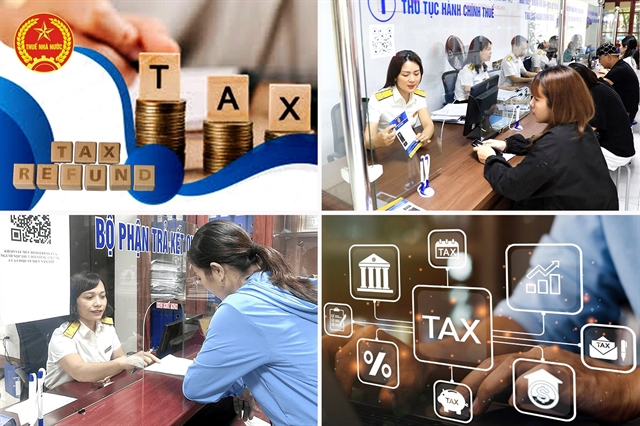 |
| The ministry is seeking comments on a draft National Assembly resolution to lower income taxes for business households, individuals and enterprises. — Photo cafebiz.vn |
HÀ NỘI — The Ministry of Finance is deploying a broad package to lower tax obligations, extend payment deadlines, streamline administrative procedures and speed up the digitalisation of tax administration.
Tax policy is among the solutions with the most direct impact on companies. Rather than prioritising near-term revenue collection, fiscal policy is being run to help them preserve cash flow, expand production and build more sustainable revenue sources.
A survey by the Vietnam Chamber of Commerce and Industry shows that beyond legal difficulties, business households and individuals face high and volatile input costs at 59.3 per cent, weakening market demand at 43.8 per cent, and a lack of capital and labour at 32.6 per cent. Micro-enterprises face similar pressures.
The ministry is seeking comments on a draft National Assembly resolution to lower income taxes for business households, individuals and enterprises. The plan would cut corporate income tax payable by 30 per cent in 2026 and 2027 for enterprises with annual revenue of no more than VNĐ10 billion (US$384,000), reducing state budget revenue by an estimated VNĐ6.7 trillion ($255.72 million) over two years, including around VNĐ3.19 trillion in 2026 and VNĐ3.51 trillion in 2027.
It said the tax cuts would initially reduce budget revenue but would directly support business households, individual companies and micro-enterprises, allowing them to retain profits for reinvestment and production expansion, while lifting disposable income and supporting living standards, consumption and savings, contributing to economic growth.
The corporate income tax reduction comes alongside a cut in value-added tax to 8 per cent from 10 per cent that runs through end-2026. Payment deadline extensions for VAT, corporate income tax and land rental fees are also continuing.
Tax Department data show that total tax reductions stood at nearly VNĐ55.13 trillion in the first half. The VAT cut saved businesses and individuals about VNĐ21.89 trillion. Zeroing the environmental protection tax on fuel was equivalent to about VNĐ26.64 trillion, the 0 per cent special consumption tax on gasoline cut costs by about VNĐ3.7 trillion, and abolishing the business license fee from early 2026 reduced obligations by nearly VNĐ2.9 trillion.
Including payment deferrals, the total support package was larger. About VNĐ173.6 trillion in taxes, fees and charges was exempted, reduced or deferred in the first seven months of this year.
Economists said the support policies have not weakened state revenue collection. State budget revenue in the first seven months was estimated at VNĐ1.83 quadrillion, equal to 72.5 per cent of the annual estimate and up 16 per cent from a year earlier.
In the first half, the ministry cut administrative procedures by 76.3 per cent, processing time by 51.7 per cent and compliance costs by 52.23 per cent, while reducing business conditions by 27.82 per cent.
In the tax sector alone, 127 administrative procedures directly related to production and trade have been proposed for reduction or simplification. The reform aims to substantially cut compliance time and costs, rather than simply reducing the number of procedures.
Mai Xuân Thanh, Director of the Tax Department, said the goal of the 2026-30 tax administration strategy and digital tax management model, with a vision to 2045, is a comprehensive breakthrough in system architecture and business processes that minimises manual filing obligations.
The ultimate goal is a “zero-touch” model in which information technology systems automatically process tax obligations based on interconnected data, giving taxpayers a smart, user-friendly and modern platform similar to those in developed countries instead of cumbersome administrative procedures.
The tax sector is also accelerating digitalisation and data integration, making greater use of existing information to reduce requests for companies to declare or resubmit data. Effective data connectivity will cut time spent on tax compliance and reduce staffing and administrative costs for businesses. — VNS
Economy
 Economy
 Economy
 Economy
 Economy
 Economy
 Economy
 Economy
 Economy
 Economy
 Economy
 Economy
 Economy
 Economy
 Economy