 Life & Style

Việt Nam, Switzerland to turn education, sci-tech, innovation into cooperation focus
1.
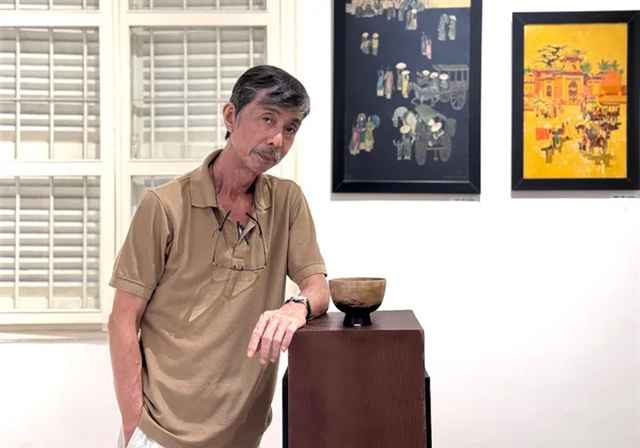 |
| Researcher Phạm Hoàng Quân. Photo sggp.org |
The Southern Women's Museum in HCM City is showcasing a collection of traditional lacquerware dating from the 1950s to the 1990s, offering the public a rare glimpse into the craft's artistic legacy.
Researcher Phạm Hoàng Quân, who co-curated the collection, spoke to the media about the effort to preserve the legacy of a traditional craft village and the place of southern lacquerware in the evolution of Việt Nam's traditional lacquer art.
What inspired you to document and curate a collection on the traditional lacquer craft of Thủ Dầu Một – Bình Dương and Sài Gòn – HCM City from the 1950s to the 1990s?
It is part of the project driven by a growing sense of loss, as the legacy of Việt Nam's traditional crafts continues to fade. Far from being merely old handicrafts, the objects in this collection preserve the memory of vibrant craft communities that once flourished in Thủ Dầu Một – Bình Dương and Sài Gòn – HCM City, recording the names of more than 140 artisans, workshops and lacquerware manufacturers from the era.
Today, many of these pieces are considered almost to be antiques, as the traditional craftsmanship and materials once used to produce them have largely disappeared.
To me, a craft village is defined by more than its output. Its true value lies in the lives of its artisans, the craftsmanship handed down from one generation to the next, and the shared cultural memories embedded within the community.
The collection represents a systematic effort to preserve the heritage of traditional lacquerware for scholarly research. It is also an important visual archive that will contribute to future efforts to identify, restore and promote the distinctive identity of Việt Nam's traditional lacquer craft.
Where do you think Vietnamese lacquer art stands among countries with long lacquer traditions?
The lacquer craft has a history spanning thousands of years in many Asian countries, including China, Japan and South Korea. Việt Nam also has a long tradition of using natural lacquer, dating back to ancient times.
What gives Vietnamese lacquer art its distinctive identity, however, is the emergence of lacquer painting in the 1930s, when the process of polishing became a decisive artistic technique rather than merely a finishing step.
Whereas traditional lacquerware was largely appreciated for its craftsmanship, Vietnamese lacquer painting evolved into a unique artistic medium with its own visual vocabulary.
Even Chinese researchers use a term for Vietnamese lacquer painting that highlights the polishing technique. That distinction is significant not simply as a technical term, but because it underscores the defining feature that sets Vietnamese lacquer painting apart as a unique artistic genre on the world stage.
The defining feature of traditional Vietnamese lacquerware is its use of natural lacquer, prized for its durability and the rich depth and distinctive beauty it brings to each piece.
As an organic material from the cây sơn tree (scientifically named Toxicodendron succedaneum), it is also free from toxic fumes, making it safer for users. These qualities are difficult to compare with modern handicrafts, which increasingly use industrial materials.
Why do you consider the period from 1950 to 1990 as the golden age of lacquerware in this area?
The establishment of the Thủ Dầu Một Vocational School in 1901 laid the foundation for the local lacquer industry, but it was not until more than 40 years later that the craft began to thrive.
The turning point came after 1943, with the founding of Thành Lễ and the rise of other renowned workshops such as Trần Hà and Văn Thoát, ushering in a golden age for the region's lacquer craft.
At its peak, about 90 per cent of households in Tương Bình Hiệp Ward, HCM City, depended on lacquerware production for their livelihoods. Renowned brands such as Thành Lễ, Trần Hà and Văn Thoát established shops in Sài Gòn – HCM City, forging a strong connection between the production hub and the marketplace.
Perhaps most remarkably, lacquerware was not reserved for exhibition halls or the fine arts community. It became part of everyday life. Furniture, folding screens, tea sets, photo albums, jewellery boxes and countless decorative items all embodied the aesthetic values and remarkable craftsmanship of southern Vietnamese artisans during that period.
Why did you choose these humble, everyday objects to tell the story of southern Vietnamese lacquerware?
I want visitors to understand that lacquerware was woven into everyday life. These everyday objects reflected the craftsmanship, aesthetic sensibilities and way of life of their time.
These seemingly humble objects tell the richest story of the craft village. They reveal how lacquerware found its way into every home, becoming an integral part of daily life, gift-giving customs and the collective memories of generations of southern Vietnamese.
I hope visitors leave not only with an appreciation of the beauty of the objects on display, but also with a sense of the vitality of the craft village that once flourished.
Once we recognise the value of these seemingly ordinary objects, we will be better equipped to preserve, revive and pass on the tradition of lacquer craftsmanship to future generations. — VNS
Life & Style
 Life & Style
 Life & Style
 Life & Style
 Life & Style
 Life & Style
 Life & Style
 Life & Style
 Life & Style
 Life & Style
 Life & Style
.jfif) Life & Style
Life & Style
.jfif) Life & Style
Life & Style
 Life & Style
 Life & Style